Rear drum brake · passenger cars & SUVs
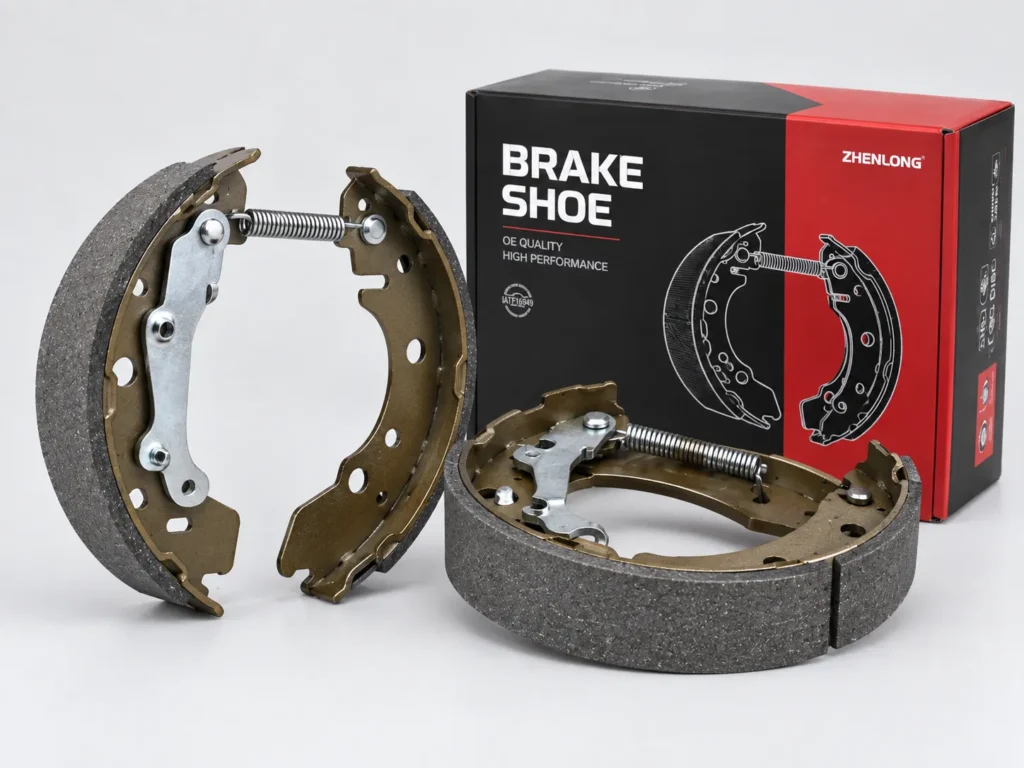
Wholesale Drum Brake Shoes for Passenger Car Rear Brake Repair
Source replacement brake shoes for passenger cars and SUVs from a brake shoe manufacturer and supplier that makes its own friction linings and drum brake shoes.
We supply rear drum brake shoes for auto parts stores, repair shops, distributors and importers that need more than a product number. We help buyers identify the correct brake shoe, check the surrounding drum brake components and reduce fitment or installation problems before bulk ordering.
You can send us
- OE numbers
- VIN
- Existing supplier numbers
- Vehicle applications
- Brake shoe photos
- Dimensions
- Excel purchasing list
Instead of asking you to search through a large catalog by yourself, we help narrow down the correct brake shoe set based on the information you already have.
GS8671Rear drumHardware kitK11123Rear drumWheel cylinderPhoto · old shoeParkingConfirm typeVIN · JTD…To confirmDrum sizeRear Drum Brake Shoes
Parking Brake Shoes
OE / VIN / Application Matching
Shoe + Wheel Cylinder Matching
Mixed SKU Wholesale Orders
Private Label Packaging
Scope the job first
What Does Your Drum Brake Job Actually Need?
Replacing the Shoe Is Often Only One Part of the Repair
A worn brake shoe may be the visible problem, but the actual service job can also involve the wheel cylinder, springs, adjuster, parking brake mechanism or brake drum.
For repair shops, replacing the shoe without checking these parts can create repeat labor. For parts stores, selling only the shoe can mean the customer comes back after the vehicle is already disassembled.
Brake Shoes Only
Brake shoes alone may be sufficient when the drum is still serviceable, the wheel cylinder is dry and operating correctly, and the hardware remains in usable condition.
This is normally the simplest replacement situation.
Typical situation
The friction lining has reached its service limit, but the rest of the drum brake system shows no obvious leakage, deformation or hardware problem.
Brake Shoes + Hardware
A brake shoe replacement can also be a good time to inspect the return springs, hold-down components and adjuster hardware.
Old drum brake hardware can suffer from corrosion, heat cycling and loss of spring tension.
If the vehicle already has high mileage, replacing only the friction shoes while reusing severely aged hardware may increase the chance of noise, drag or poor shoe return.
Brake Shoes + Wheel Cylinder
If the wheel cylinder is leaking or sticking, installing new brake shoes alone will not solve the root problem.
Brake fluid can contaminate the friction lining, while a sticking piston can cause uneven shoe movement or braking imbalance.
In these cases, the brake shoe and brake wheel cylinder should be evaluated together.
Complete Rear Drum Brake Service
For a more complete drum brake repair, the service may involve:
- Brake shoes
- Wheel cylinder
- Return springs
- Hold-down hardware
- Adjuster components
- Parking brake mechanism
- Brake drum
For distributors and repair-shop suppliers, organizing related drum brake parts by vehicle application can make purchasing and servicing easier than treating every component as an isolated SKU.
Not Sure Yet
You do not need to scope the job before contacting us.
Send the vehicle information, the old product number or photos of the removed shoes and we will start from there — including telling you which surrounding parts are commonly needed on that application.
Two different problems
Brake Shoes for Auto Parts Stores and Repair Shops
One Wants Fewer Returns. The Other Wants No Repeat Labor.
A parts store wants the correct reference, manageable inventory and fewer returns. A repair shop wants the vehicle back on the road without repeating the same repair.
For Auto Parts Stores & Distributors
An auto parts store rarely wants the largest possible brake shoe catalog. What matters more is carrying the references that local repair shops actually request.
A practical program should answer
Is this the correct shoe for the vehicle?
Vehicle application, OE number, dimensions and hardware layout checked before supplying.
Service shoe or parking brake shoe?
Both get called “rear brake shoes” — the function and application can be completely different.
Does the customer also need hardware?
Supplying the related components reduces a second trip after the drum is already off.
Can I reorder the same reference later?
Stable part numbers, packaging and identification matter for repeat inventory.
For Repair Shops & Installers
Repair shops are less interested in catalog size and more interested in avoiding repeat labor.
Common questions
- Why is one shoe worn more than the other?
- Why is the lining wet?
- Why does the parking brake still not hold?
- Why is the pedal travel too long?
- Why does the vehicle pull during braking?
- Why is the new brake shoe noisy?
- Why does the drum not fit easily after installation?
The system around the shoe
Brake Shoes Work Inside a Complete Drum Brake System
A Brake Shoe Does Not Operate Independently
Its movement, contact and release depend on several components inside the drum brake assembly.
Understanding this relationship helps both parts stores and repair shops identify what the customer actually needs. Select a component to highlight it.
Click a component
Brake shoes carry the friction lining that contacts the inside surface of the brake drum. They are the main friction components in the system.
The brake drum provides the rotating friction surface.
Its internal diameter, surface condition and roundness affect how the shoes contact and wear.
The wheel cylinder converts hydraulic pressure into outward movement of the brake shoes.
A leaking or sticking wheel cylinder can directly affect brake shoe performance.
Return springs pull the brake shoes back after the brake pedal is released.
Weak or damaged springs may contribute to drag, uneven wear or poor shoe return.
Hold-down components keep the brake shoes correctly positioned against the backing plate.
Incorrect or damaged hardware can create movement and noise.
The adjuster maintains the correct relationship between the brake shoes and the drum as the lining wears.
A seized or incorrectly installed adjuster can cause excessive clearance or uneven braking.
Depending on the vehicle, the parking brake may operate through the same rear brake shoes, or through a separate parking brake shoe inside a disc rotor hat.
This difference is important when identifying the correct product.
Seven components, one job. Tell us the vehicle and we will tell you which of them that application usually needs.
Identification mistake #1
Rear Drum Brake Shoes or Parking Brake Shoes?
Not All Rear Brake Shoes Are the Same Product
A vehicle may use full rear drum brakes, or it may use rear disc brakes with a smaller internal parking brake shoe.
Treating both as “rear brake shoes” is one of the most common ways to ship the wrong part.
| Feature | Rear Drum Brake Shoe | Parking Brake Shoe |
|---|---|---|
| Main function | Normal service braking | Holds the vehicle when parked |
| Typical operation | Hydraulic wheel cylinder | Parking brake cable or actuator |
| Main friction surface | Brake drum | Inner drum surface inside rotor hat, or a dedicated drum |
| Typical buyer | Repair shop / parts store | Repair shop / parts store |
| Common error | Wrong width or shape | Confused with a normal rear brake shoe |
Service Brake Shoes
Service brake shoes are part of a hydraulic drum brake system.
When the brake pedal is applied, the wheel cylinder pushes the shoes outward against the drum.
Parking Brake Shoes
Parking brake shoes may be smaller and operate mechanically through a cable or actuator.
They should not be selected simply because they are located at the rear axle.
When sending an inquiry, tell us whether the product is for the main rear drum brake or the parking brake system. One line saves a whole quotation cycle.
Five routes
How to Identify the Correct Brake Shoe Set
Use More Than One Reference Whenever Possible
Brake shoes can be more difficult to identify visually than many buyers expect.
Two shoes may have a similar overall curve while differing in width, spring holes, parking brake lever location or lining length.
Method 1 — OE Number
An OE or OEM number is one of the most direct identification methods.
Send the number from the old product, vehicle record or supplier catalog.
Method 2 — Vehicle Application
This information helps narrow the possible drum brake configuration.
Provide
Method 3 — Brake Shoe Dimensions
If part numbers are unavailable, dimensions can help identify the product.
Measure the old shoe, not the drum alone — the two do not always tell the same story.
Shoe Width
Must correspond with the drum and brake system.
Shoe Radius / Drum Diameter
Curvature should correspond with the intended drum size.
Lining Length
References can use different lining coverage on a similar steel shoe.
Lining Thickness
Should match the specification and available drum clearance.
Spring-Hole Positions
Determines compatibility with return springs and hold-down hardware.
Method 4 — Old Brake Shoe Photos
Clear product photos can be very useful.
Photograph
Method 5 — Existing Box or Supplier Number
If the customer still has the old box, barcode or supplier reference, send it together with the vehicle information.
Multiple reference points reduce the risk of incorrect identification.
Visual matching fails here
Same Shape Does Not Mean the Same Brake Shoe
Seven Ways Two Near-Identical Shoes Differ
Visual matching alone is one of the easiest ways to order the wrong brake shoe.
Two shoes may appear almost identical when photographed separately but still differ in critical details.
Different Shoe Width
A few millimeters of width difference can make the product unsuitable for the intended drum.
Different Shoe Radius
The shoe may follow a different drum diameter even if the steel structure looks similar.
Different Spring Holes
Return springs and hold-down components depend on the correct hole positions.
Different Anchor Points
The shoe must interact correctly with the backing plate and anchor points.
Different Parking Brake Lever
A visually similar shoe may use a different parking brake lever or attachment layout.
Different Adjuster Contact Area
The lower or upper shoe contact points may differ depending on the adjuster design.
Different Friction Lining Length
The location and length of the lining may vary even when the metal shoe body appears similar.
Find the source first
Oil or Brake Fluid on the Brake Shoe? The Wheel Cylinder Decides Whether New Shoes Survive
Otherwise the Replacement Shoes Become Contaminated Again
A wet brake shoe should not simply be treated as a friction-material problem. If oil or brake fluid reaches the lining, the source of contamination needs to be identified before new shoes are installed.
The wheel cylinder is the component that pushes the shoes outward — its condition directly affects how the shoes operate.
Wheel Cylinder Leakage
Brake fluid around the wheel cylinder, backing plate or shoe lining can indicate a leaking wheel cylinder.
Possible effects
- Reduced friction
- Uneven braking
- Brake pull
- Lining contamination
- Abnormal wear
Axle Seal Leakage
On some rear axle designs, gear oil can reach the drum brake area if an axle seal leaks.
This contamination may look different from brake fluid, but it can still reduce friction and damage the braking surface.
Contaminated Friction Lining
Once the lining absorbs oil or brake fluid, simply cleaning the visible surface may not restore predictable friction behavior.
Signs the Wheel Cylinder Needs Attention
Check the wheel cylinder when you see:
Why Replacing Only the Shoes May Not Solve It
If a wheel cylinder piston is sticking, new shoes may still wear unevenly.
If the cylinder is leaking, new shoes can become contaminated soon after installation.
The correct repair is therefore based on the condition of the complete drum brake assembly rather than replacing the friction component alone.
Build Related SKUs for Parts Store Inventory
Parts stores can make drum brake purchasing easier by linking:
…instead of treating each component as an unrelated product. This makes it easier for counter staff to identify what else the repair shop may require.
Have a contaminated set in front of you right now? Send a photo of the shoe and the backing plate — the pattern of the wetness usually identifies the source.
Before the second set
Diagnose the Problem Before Replacing Another Brake Shoe Set
The Symptom Usually Points at Another Component
If a newly installed brake shoe system is not working as expected, replacing the shoes again should not be the first automatic response.
Every row below ends in an action — what to check, then what to do about it.
| Symptom | What to check | What to do |
|---|---|---|
| Poor Braking | Wheel cylinder movementShoe adjustmentContaminated liningDrum conditionHydraulic operation | Adjust the shoes out to correct clearance first — most "weak rear brakes" are simply under-adjusted. If the lining is contaminated, replace the shoes and the leaking part. Bleed the circuit if the pedal is also soft. |
| Brake Noise | HardwareShoe contactDrum surfaceSpring installationContamination | Refit with new hold-down and return hardware, apply a thin film of high-temperature grease to the backing-plate contact pads, and confirm the springs are on the correct anchor. Replace the drum if the surface is scored. |
| Uneven Wear | Wheel cylinderAdjusterShoe positionDrum conditionHardware | Free off or replace the seized adjuster, replace a dragging wheel cylinder, and confirm primary/secondary shoes are in the correct positions. Then replace shoes as an axle set — never one side only. |
| Wet Brake Shoes | Wheel cylinder leakageAxle seal leakage | Identify the source, repair it, then replace the contaminated shoes. Cleaning a soaked lining does not return it to service. |
| Long Brake Pedal Travel | Shoe adjustmentAdjuster mechanismHydraulic conditionDrum clearance | Adjust the shoes and confirm the self-adjuster actually operates (apply the brakes while reversing). If travel is still long, the problem is hydraulic — bleed the system and check the master cylinder, not the shoes. |
| Weak Parking Brake | Parking brake cableShoe adjustmentLever positionParking brake shoe condition | Adjust the shoes to the drum before adjusting the cable — tightening the cable to mask under-adjusted shoes is the most common mistake, and it drags the linings. Replace a stretched or seized cable. |
Why Are the Brake Shoes Wearing Unevenly?
Uneven brake shoe wear is often a system problem. The pattern of wear provides useful clues about what is happening inside the drum.
One Shoe Wears Faster Than the Other
Possible factors
The primary and secondary shoes — or the leading and trailing brake shoes on leading-trailing designs — should also be checked for correct installation where the brake design uses different positions.
One Side of the Vehicle Wears Faster
Inspect
Only Part of the Lining Contacts the Drum
Partial contact can indicate a drum surface problem, shoe geometry issue, incorrect adjustment or fitment mismatch.
New shoes may require an appropriate bedding period, but severe contact irregularity should not simply be ignored.
The parts around the shoe
Should Drum Brake Hardware Be Replaced With the Shoes?
Not Always — But It Should Always Be Inspected
Brake shoe hardware is exposed to heat, vibration, corrosion and repeated movement throughout the life of the vehicle.
Not every brake job requires every piece of hardware to be replaced, but the components should at least be inspected.
Return Springs
Return springs pull the brake shoes away from the drum when braking pressure is released.
A weakened spring can contribute to drag or slow shoe return.
Hold-Down Springs & Pins
These components keep the shoes positioned correctly on the backing plate.
Damaged or badly corroded hold-down hardware can allow excessive movement.
Adjuster Components
The adjuster maintains the correct shoe-to-drum clearance.
A seized adjuster can lead to
- Excessive brake pedal travel
- Poor rear braking
- Uneven wear
- Inconsistent parking brake performance
Parking Brake Lever & Cable
If the parking brake still performs poorly after new shoes are installed, the problem may be in the cable, lever or adjustment rather than the friction lining.
The other half of the friction pair
New Brake Shoes Need a Serviceable Brake Drum
Inspect the Drum Before the New Shoes Go In
Installing new brake shoes against a badly worn brake drum reduces the quality of the repair.
Five checks, each with the decision that follows it.
Drum Internal Diameter
A brake drum wears larger internally over time. The actual diameter should be compared with the service limit specified for the vehicle.
A drum beyond its allowable service diameter should not be treated as a normal reusable drum simply because it has no visible crack.
Deep Grooves
Heavy scoring or grooves can reduce consistent shoe contact and affect bedding.
Heat Spots
Localized heat marks can indicate abnormal thermal loading or braking conditions.
Out-of-Round Condition
A drum that is no longer sufficiently round can create inconsistent shoe contact, pulsation or uneven wear.
Rust and Contamination
Rust, grease, brake fluid or other contamination should be addressed before the new brake shoes are returned to service.
Factory inspection
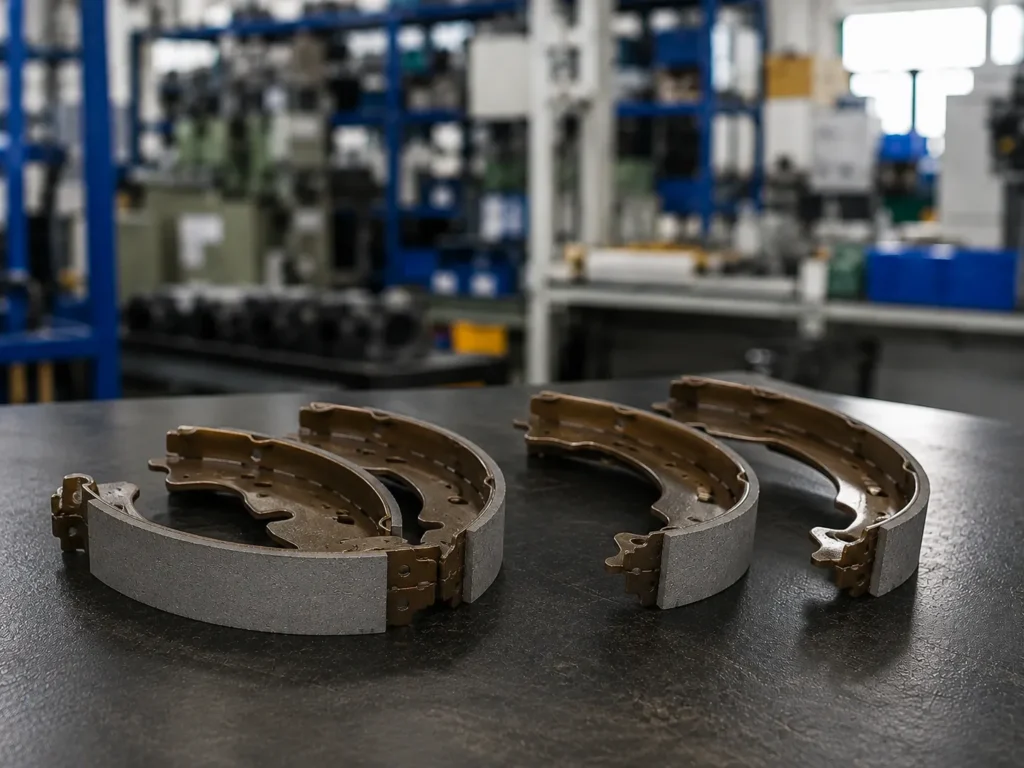
What We Inspect on Brake Shoes
Not the Colour of the Lining or the Look of the Box
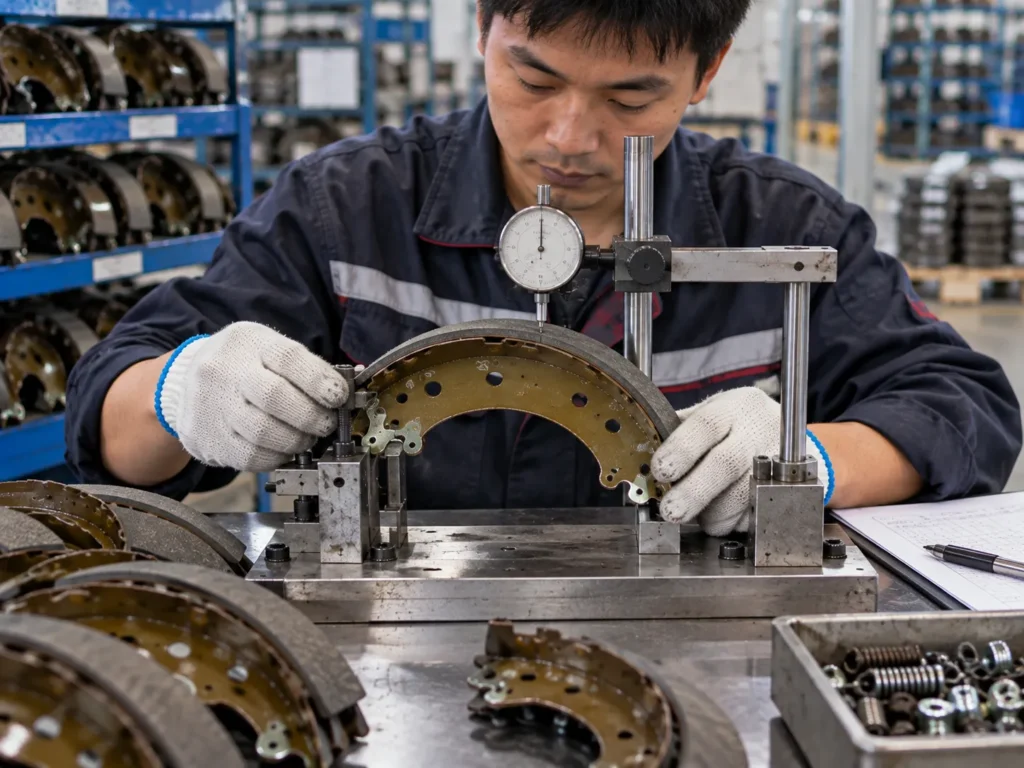
The dimensions, steel structure, lining placement and hardware-related geometry all matter. Our quality page shows the full brake shoe inspection process batch by batch.
Each check states what happens when it fails — an inspection point with no corrective action attached is just a list.
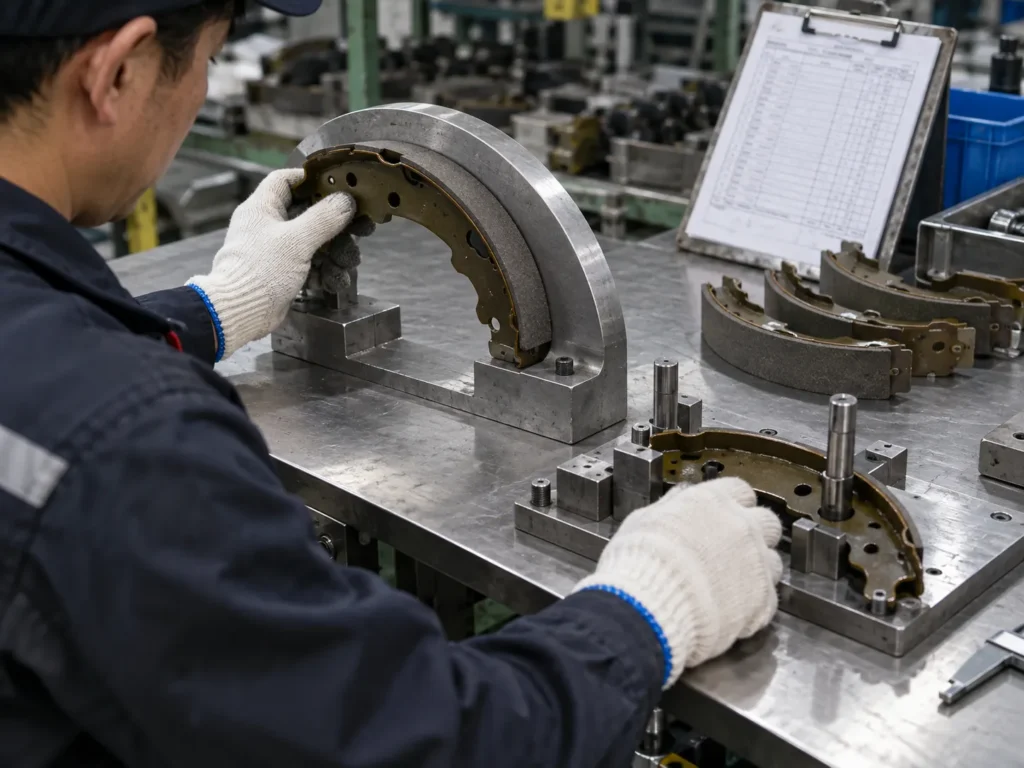
Shoe Geometry
The overall profile and curvature are checked against the intended product specification.
Poor geometry can affect installation and drum contact.
- Overall profile
- Curvature / radius
- Web-to-rim alignment
- Flatness of the web
Shoe Width
Width is checked because an incorrect shoe width can create immediate fitment problems.
Lining Dimensions
Inspection can include:
- Lining thickness
- Lining width
- Lining length
- Lining position
- Edge condition
Lining Attachment
The friction lining should be securely and consistently attached to the steel shoe body. We supply both bonded brake shoes and riveted brake shoes; on bonded sets the bond line is checked on every batch.
- Bond line continuity
- No lifted edges
- No adhesive voids
- Consistent across the set
Spring & Hardware Hole Position
Spring-hole and mounting-point positions need to correspond with the intended brake system.
Even a small visible difference can make the product difficult or impossible to install.
Steel Shoe Body
The steel component is checked for:
- Deformation
- Burrs
- Surface defects
- Coating condition
- Obvious dimensional problems
Part Number & Set Verification
Before packaging, the brake shoe set should be checked against the correct SKU and application.
This is especially important for wholesalers carrying many similar-looking references.
Batch-to-Batch Friction Consistency
The brake shoe lining should provide predictable braking behavior across normal service conditions.
Large variations between production batches create inconsistent braking feel and customer complaints — which is why we compare across batches, not across two shoes from the same box.
- Friction level against the agreed specification
- Variation between production lots
- Behaviour when hot, not only cold
- Consistency across the pair in one set
Friction Material Balance
Long wear life is useful, but harder is not automatically better.
An excessively aggressive or poorly balanced brake shoe material can influence drum wear, braking feel or noise.
Compliance
Quality Certifications — and What Each One Actually Covers
A Certificate Belongs to a Production Site and a Part Number, Not to a Logo
Brake shoes are a safety component, so the compliance question deserves a precise answer rather than a row of logos.
Our friction products and drum brake shoes are made in our own plant. Certificates are issued to a named production site — and approvals such as ECE R90 to specific part numbers — so we tell you which, and we provide the approval reference for the part numbers you are actually buying.
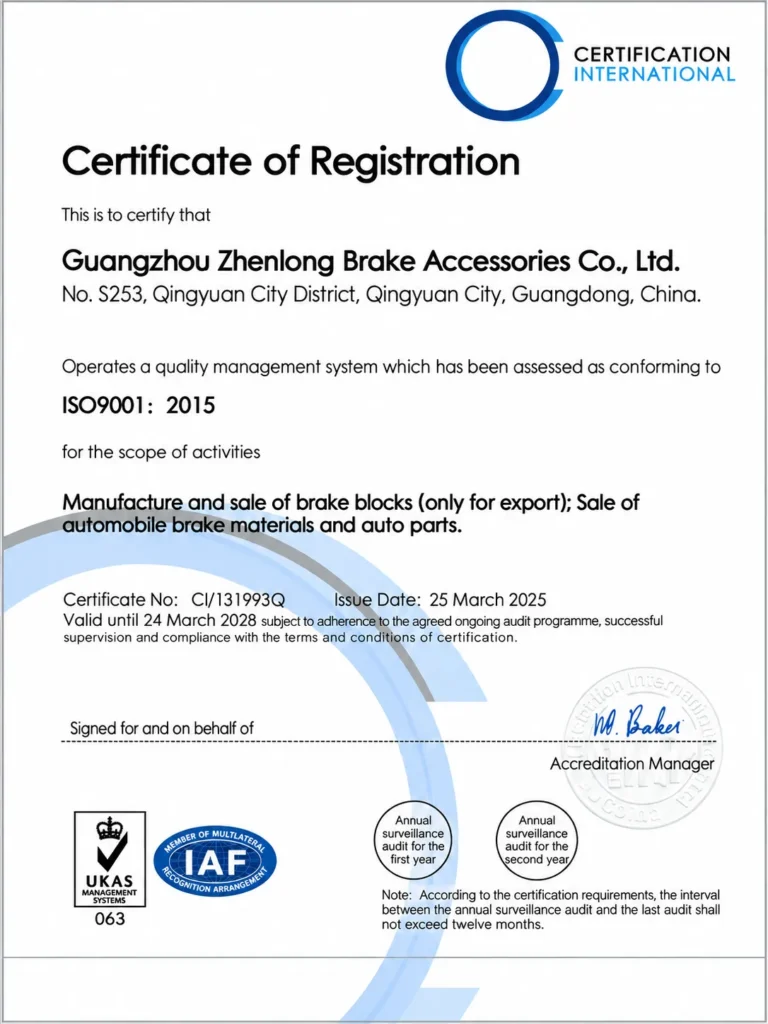
ECE R90
Issued per part number to the producing site
European approval for replacement brake linings. It is granted per part number to a specific producer — not to a company as a whole.
Ask us forThe approval number covering the exact references on your order.
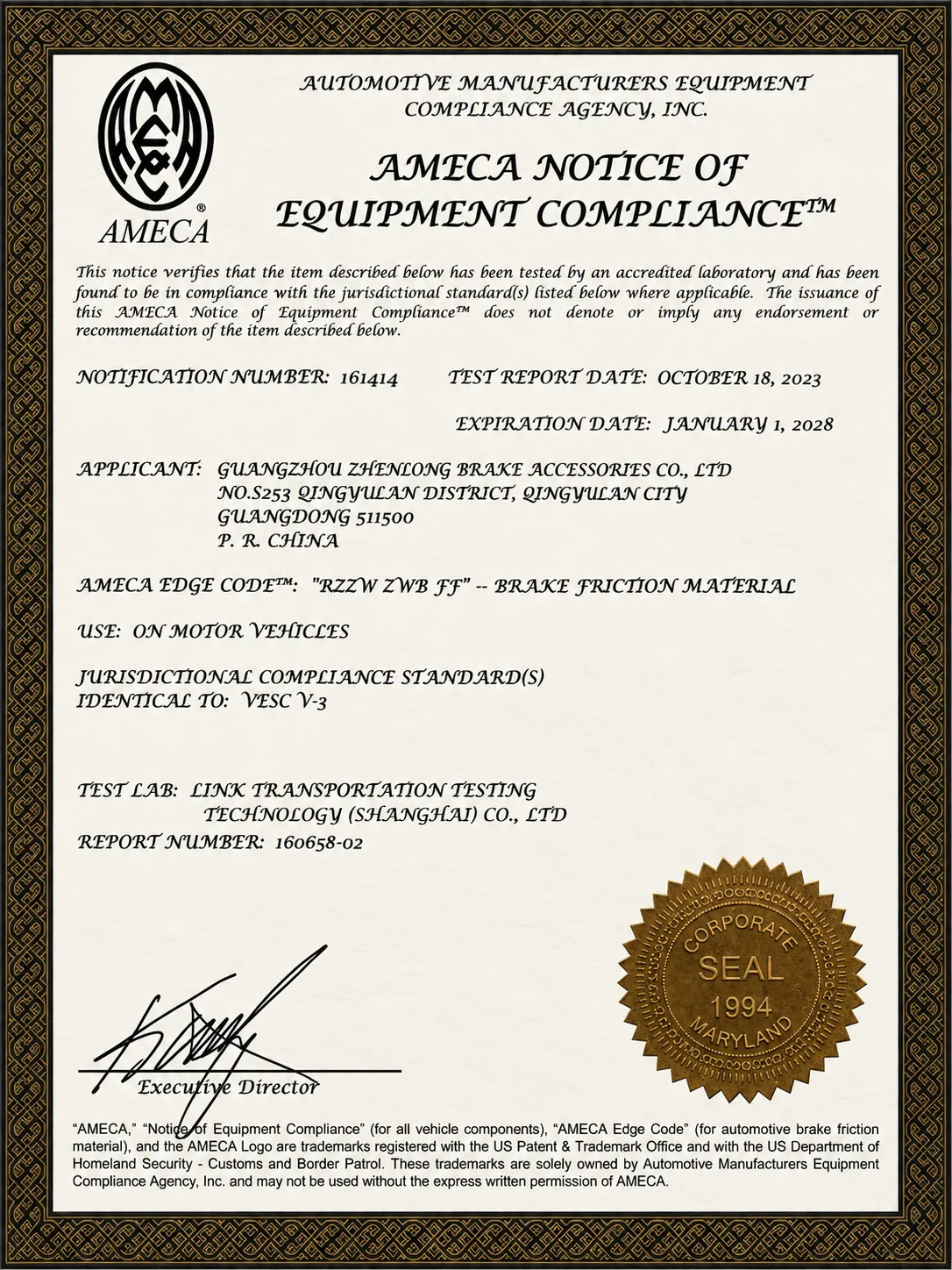
AMECA
Issued to the producing site
Registration of the friction material’s tested performance. Relevant to brake shoes because a shoe is a friction component.
Ask us forThe registered edge code for the lining on your references.
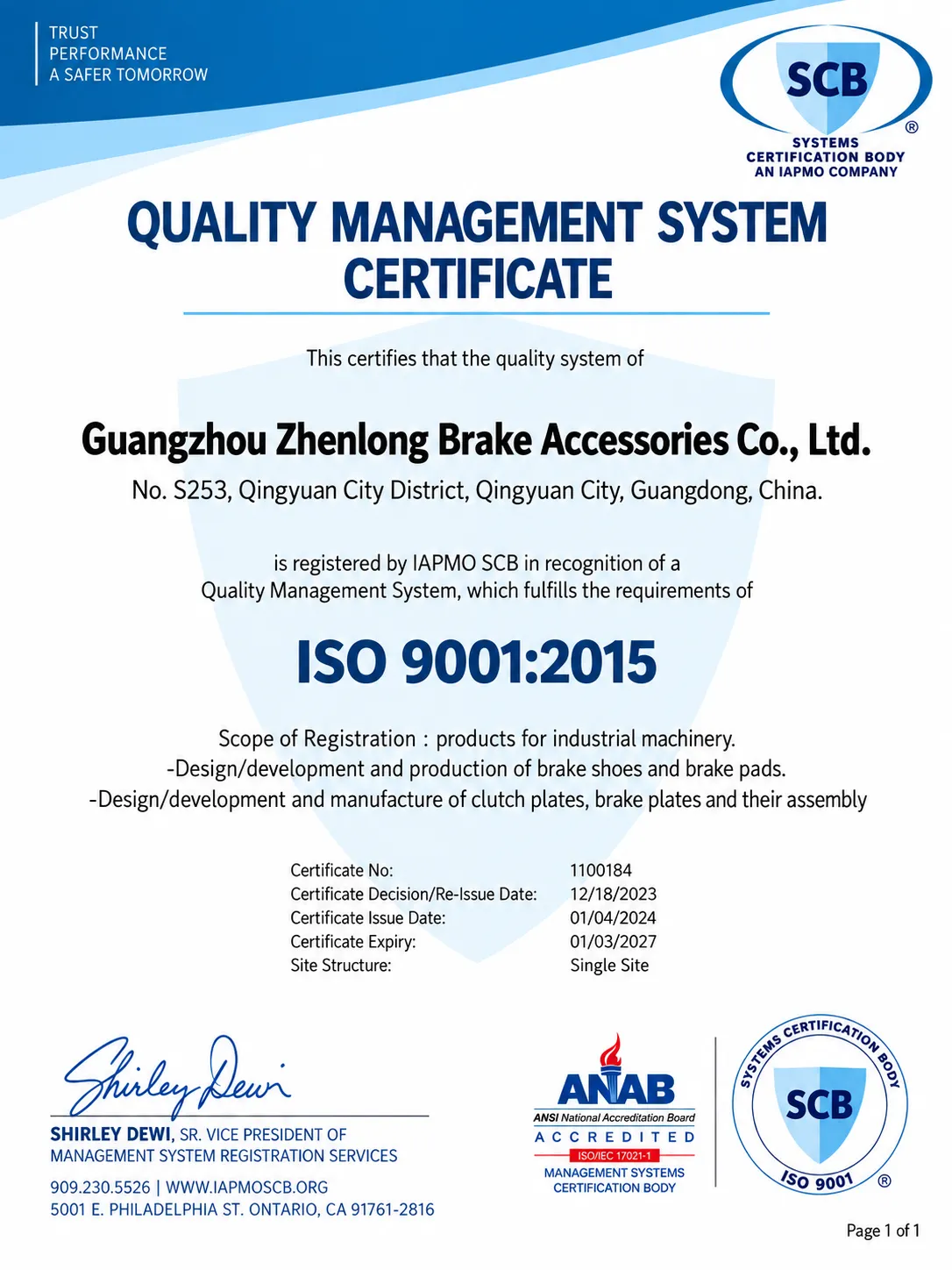
ISO 9001 Certification
Issued to the partner production site
Environmental compliance for friction material sold into the relevant US states, covering restricted substances in the formulation.
Ask us forThe compliance level marking for the destination you sell into.
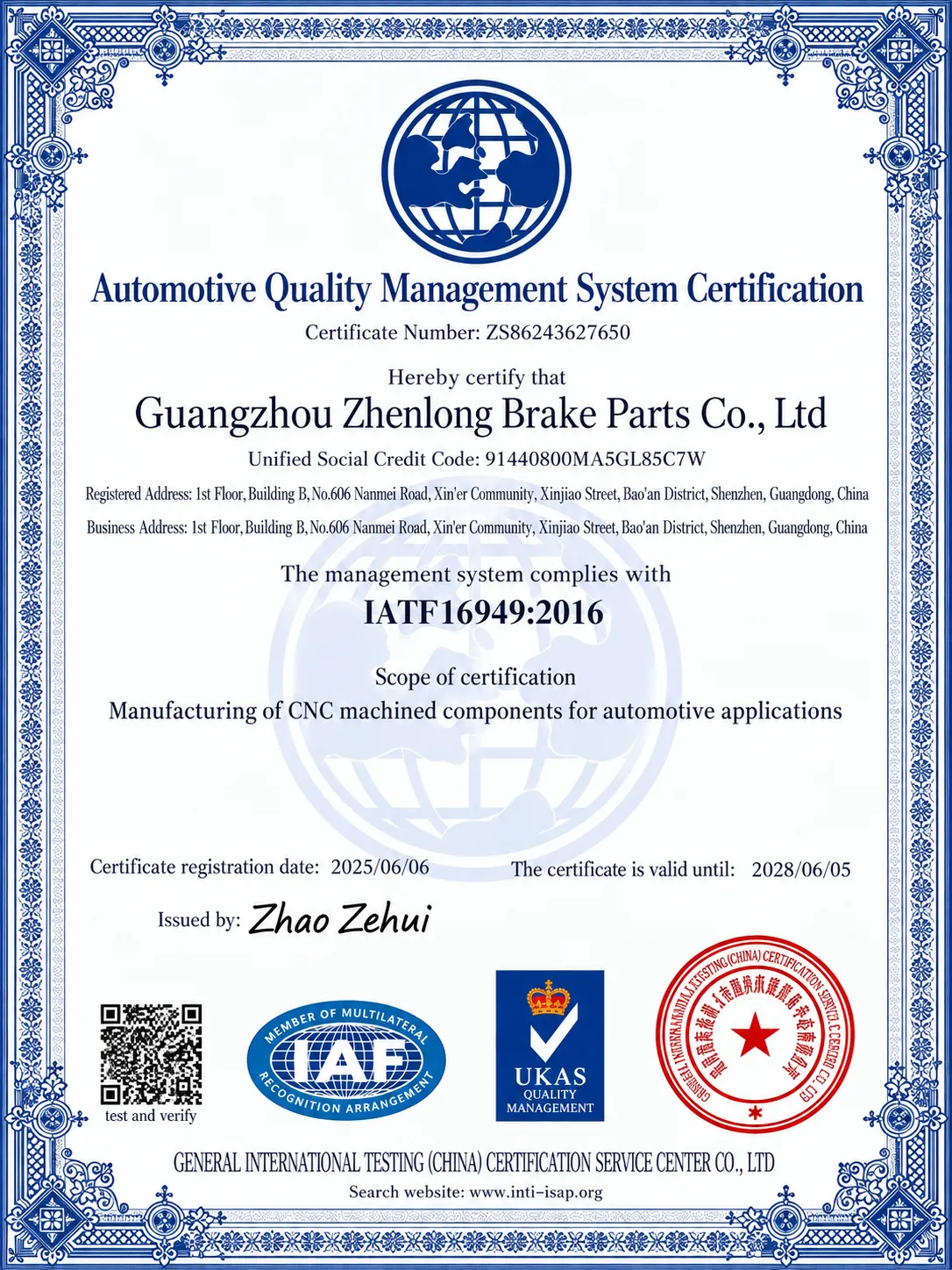
IATF 16949 / ISO 9001
Quality management system
A system certificate, not a product certificate. It says how a plant is run — it does not approve any individual brake shoe.
Ask us forThe certificate and its scope statement for the producing site.
What We Will Not Write
Three sentences you will find on a lot of brake pages that cannot be true as written:
- “We are R90 certified” — a company is not certified; a part number produced at a named site is.
- “All our brake shoes are R90 approved” — unless every single reference is covered, which is rarely the case.
- A partner factory’s approval number printed as if it were our own.
How We Phrase It Instead
On quotations and on the box:
If a reference on your list is not covered by an approval, we tell you before you order rather than after your customer asks for the paperwork.
Who you are dealing with
About Us
We Make Our Own Friction Products and Drum Brake Shoes.
We would rather tell you this on the product page than have you discover it during a factory visit.
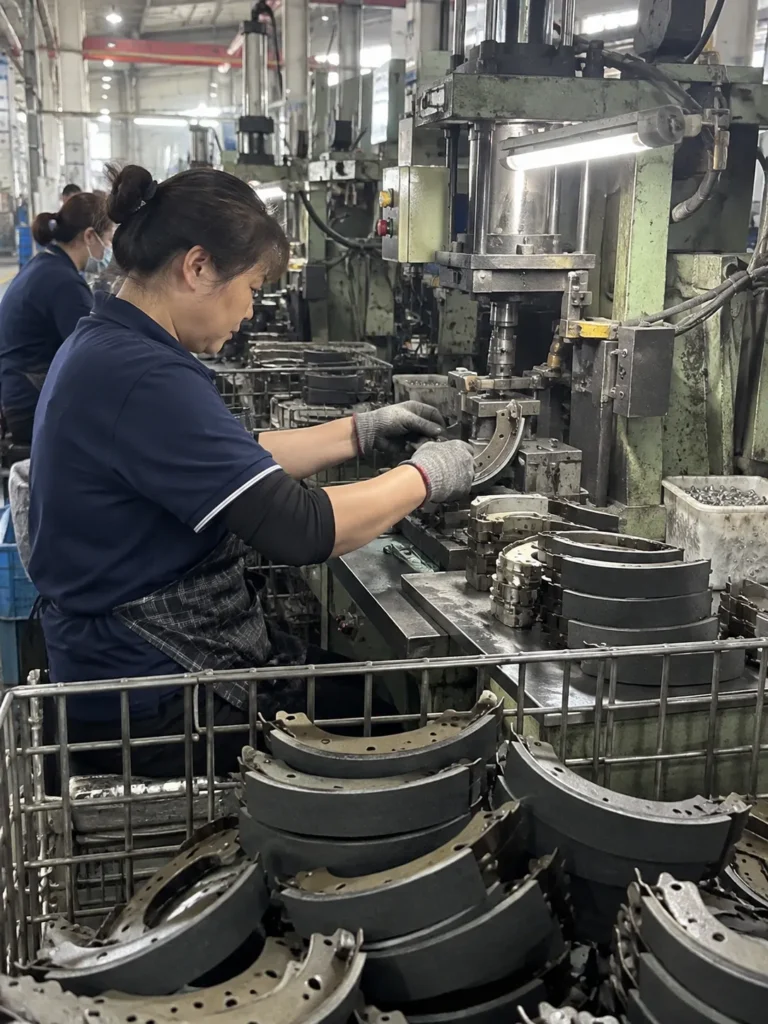
We are a small brake parts manufacturer in Guangdong, China. Brake pads, brake rotors and drum brake shoes are all produced in our own factory. What we make is stated plainly, product by product.
What We Manufacture
Friction products — brake pads and brake shoe linings — are made on our own lines.
Mixing, pressing and finishing happen in our plant, which is why the friction-material questions on this page are not theory to us. See how our brake shoes are made on our factory page.
What that gives you on a shoe order
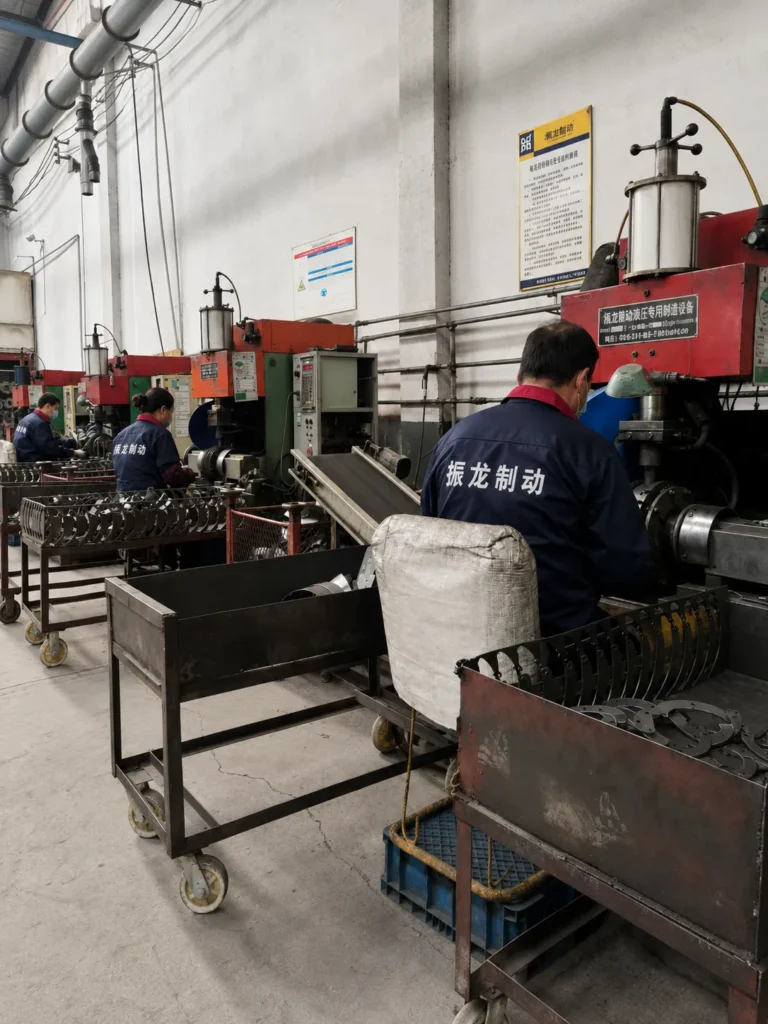
What We Produce and Inspect
Drum brake shoes and brake rotors are produced in our own factory as well. As a brake shoe manufacturer, we control the steel shoe, the lining and the final inspection.
What matters most for your returns rate is what happens on the line:
- We control shoe forming, lining attachment and finishing in-house
- We inspect against the checks listed on this page
- We verify the reference and the box label match
- We name the certificate holder and scope when you ask
Small Enough That Batches Do Not Get Mixed
We are not a large plant, and for a brake shoe programme that is the point. A small operation means one identifiable person is responsible for your batch, and references that look alike do not end up in each other’s cartons.
The Same Contact Every Order
You will not be handed to a different account each quarter. The person who reviewed your first list is the person who reviews the repeat order — which is why the second order rarely needs the same questions asked twice.
We Say No in Writing
Commercial truck and air-brake shoes, racing linings and drum brake references we cannot properly cover are marked out of your list before quotation. We would rather lose a line item than ship something we cannot stand behind.
Checkable, not claimable
Why Choose Us
Every Row Below Ends in Something You Can Test Before You Commit
We are not going to ask you to choose a brake shoe supplier on the strength of four adjectives.
Here is the same page’s content turned into a comparison — with the verification step in the last column.
What we are deliberately not saying
| Criterion | Common practice | What we do | How you verify it |
|---|---|---|---|
| Identification | You send a number, they send a price. | Application, shoe type and critical dimensions reviewed before quotation. | Put one deliberately ambiguous reference in your list. See whether the reply contains a question or only a price. |
| Service vs parking shoe | Both listed as "rear brake shoe". | Separated as different products, and we ask which system before quoting. | Send a VIN for a car with rear discs and ask which shoe it takes. |
| Certificates | "R90 certified" on the homepage, no number anywhere. | Approval reference per part number, with the producing site named. | Ask for the approval number of one exact reference — then check it against the register yourself. |
| What is in the box | Hardware "may be included". | Set contents stated on the order confirmation before production. | Ask for a photograph of one packed set before the shipment leaves. |
| Batch traceability | No batch marking on the carton. | Batch identification on the box, tied to the production lot. | Send us a photo of a box label from a previous order and ask us to trace it. |
| Related parts | Shoe only — the wheel cylinder is your problem. | Matching wheel cylinder and hardware references returned for the same applications. | Send five shoe references and see whether the matching cylinders come back with the quotation. |
| Saying no | Quotes everything, sorts it out later. | Out-of-scope references marked out before quotation, in writing. | Put a commercial truck shoe in your list on purpose and see whether it comes back priced. |
Every one of those tests costs you a single email and no commitment. Run two or three of them before the first order.
B2B purchasing
Wholesale Brake Shoe Supply for Parts Stores & Distributors
Many References, Small Quantities Each
A wholesale brake shoe order may include many references with relatively small quantities per SKU. That is different from purchasing one high-volume industrial product.
The purchasing model should therefore support practical assortment building.
Mixed SKU Orders
Different brake shoe references can be combined according to product availability and order arrangement. The same order can also include ceramic brake pads and vented brake rotors for the same vehicles.
This allows buyers to build a broader range without purchasing a very large quantity of every reference.
Send the complete list and we will review the references together rather than treating each one as a separate inquiry.
Standard Replacement Applications
We focus on standard aftermarket replacement brake shoes.
If you already have OE numbers or existing supplier references, send them directly so we can work from your current product structure.
Samples
Samples can be used to check:
- Dimensions
- Shoe shape
- Lining
- Hardware points
- Packaging
- Application match
…before a larger wholesale purchase.
Repeat Orders
For a parts store, a product that sells today needs to be reorderable tomorrow.
- Stable SKU references
- Consistent specifications
- Clear product identification
Packaging Options
Depending on the program, packaging can be discussed as:
- Neutral packaging
- Customer label
- Private label box
- Barcode / SKU label
The final packaging plan should correspond with order quantity and customer requirements.
Inventory strategy
Build a Brake Shoe Range Without Overstocking Slow-Moving SKUs
Buying Every Available Reference Is Rarely Efficient
Brake shoes usually move differently from brake pads in the aftermarket. Some references may sell regularly, while others are needed only for older or less common vehicle applications.
Step 01Start With Existing Sales History
If you already sell brake shoes, your past sales data is one of the best starting points. Identify the references that repair shops repeatedly request.
Step 02Use Current Supplier Numbers
You do not need to rebuild the product range from zero when changing suppliers. Send the numbers you already stock and we can work from that list.
Step 03Prioritize Real Repair-Shop Demand
Your local vehicle population and repair-shop customer base matter more than a generic global catalog. A smaller but useful product range is often better than a very large range full of slow-moving inventory.
Step 04Expand After the First Order
Start with the fast movers, place one mixed order, review what actually sold, then add the gaps. This reduces the risk of stocking brake shoes that rarely move.
Before you commit
Common Problems When Sourcing Brake Shoes From China
The Cheapest Brake Shoe Is Not Always the Lowest-Cost Product
A small dimensional or packaging error can create returns, repair-shop complaints and wasted labor.
These ten issues are specific to brake shoes — they are not the same list you would use for pads or rotors.
Correct Shape, Wrong Width
The shoe looks correct in a photo, but the width does not match the drum.
Wrong Spring-Hole Position
The overall shape is similar, but the return springs cannot be installed correctly.
Wrong Parking Brake Lever
The shoe fits the drum, but the parking brake connection is different.
Incorrect Shoe Radius
The shoe curvature does not correspond correctly with the intended drum size.
Lining Position Variation
Friction lining location or dimensions vary between batches.
Weak Lining Attachment
The connection between lining and steel shoe body is inconsistent.
Mixed Components
Primary/secondary shoes, left/right-related components or different references incorrectly packed together.
Missing Hardware
If the order specification includes hardware, the contents of each set should be checked before shipment.
Wrong Box Label
The physical shoe is correct, but the label or part number on the box is wrong.
For a distributor, this creates exactly the same operational problem as receiving the wrong part — the counter cannot trust the shelf, and every pick has to be verified by hand.
Poor Traceability
Without clear SKU and batch identification, claim investigation and repeat purchasing become much harder.
Questions
Frequently Asked Questions About Wholesale Brake Shoes
The ten questions parts stores, repair shops, distributors and importers ask most often.
The best starting points are the OE number, vehicle information, VIN, current supplier number or old brake shoe dimensions.
Photos can also help confirm shape and hardware layout. Use more than one reference where possible — visual similarity alone is not enough.
Not necessarily.
A rear drum brake shoe may be used for normal service braking, while a parking brake shoe may only operate the parking brake inside a separate drum or drum-in-hat system.
Tell us which system the product is for when you send the inquiry.
The hardware should at least be inspected.
Return springs, hold-down components and adjusters can wear or corrode over time and may affect brake operation if they are in poor condition. On a high-mileage vehicle, replace them while the drum is already off — which is why many buyers order a complete brake shoe kit with springs and hardware.
Not in every repair.
However, a leaking, seized or poorly operating wheel cylinder should be repaired or replaced before new brake shoes are returned to service — otherwise the new lining becomes contaminated or wears unevenly.
Possible causes include wheel cylinder problems, adjuster operation, shoe position, drum condition, parking brake issues and hardware problems.
The wear pattern should be diagnosed before replacing another set — the pattern usually identifies the cause.
Yes. Brake fluid can contaminate the friction lining and change its braking behavior.
The source of the leak should be corrected before replacement shoes are installed. A soaked lining cannot be cleaned back into service.
Useful dimensions include shoe width, drum diameter or shoe radius, lining dimensions and relevant mounting or spring-hole positions.
Yes. Send clear front and rear photos, the vehicle information and any visible numbers.
Dimensions are also helpful when the reference cannot be confirmed from the image alone. Photograph the complete shape on a flat surface, not only the lining.
Brake shoes and wheel cylinders are related components in drum brake systems and can be reviewed together based on vehicle application and order requirements.
Mixed SKU orders can be discussed according to the selected references, quantity and product availability.
Get a quote
Send Us the Drum Brake Job — Not Just the Part Number
You Do Not Need to Know Every Product Code Before Contacting Us
Tell us what vehicle you are working with and what parts you need.
If you already have a purchasing list, upload the complete list and let us review the references together.
Send the OE Number
Use the OE reference from your current purchasing system or existing product.
Send the Vehicle and VIN
Provide make, model, year and VIN where needed.
Send Photos of the Old Shoes
Front, back and hardware-position photos are useful for initial identification.
Send Shoe Dimensions
Shoe width, approximate drum diameter, lining dimensions and key hardware locations.
Upload Your Purchasing List
20, 50 or 100 references — upload the Excel sheet instead of sending them one by one.
Send us any of
Upload Your Brake Shoe List & Get a Quote
We will review the product requirement before quotation.
If you need 20, 50 or 100 references, do not send them one by one. Upload the sheet and let us review the complete requirement — including which surrounding drum brake parts those applications usually need.
Not sure which shoe fits? Send the OE number, VIN, current supplier reference or shoe dimensions and we can start from there.
Upload Your Brake Shoe List & Get a Quote
Send us the numbers. We help with the matching.