Brake Shoe Manufacturer & Supplier in China
Aftermarket drum brake shoes for distributors, auto parts stores and repair businesses. Send your OEM or aftermarket part-number list—we verify the references, quantities and packaging before quotation.
OEM & aftermarket references
Multiple SKUs in one order
Packaging & program support
Brake parts manufacturing
What Is a Brake Shoe—and How Does It Work?
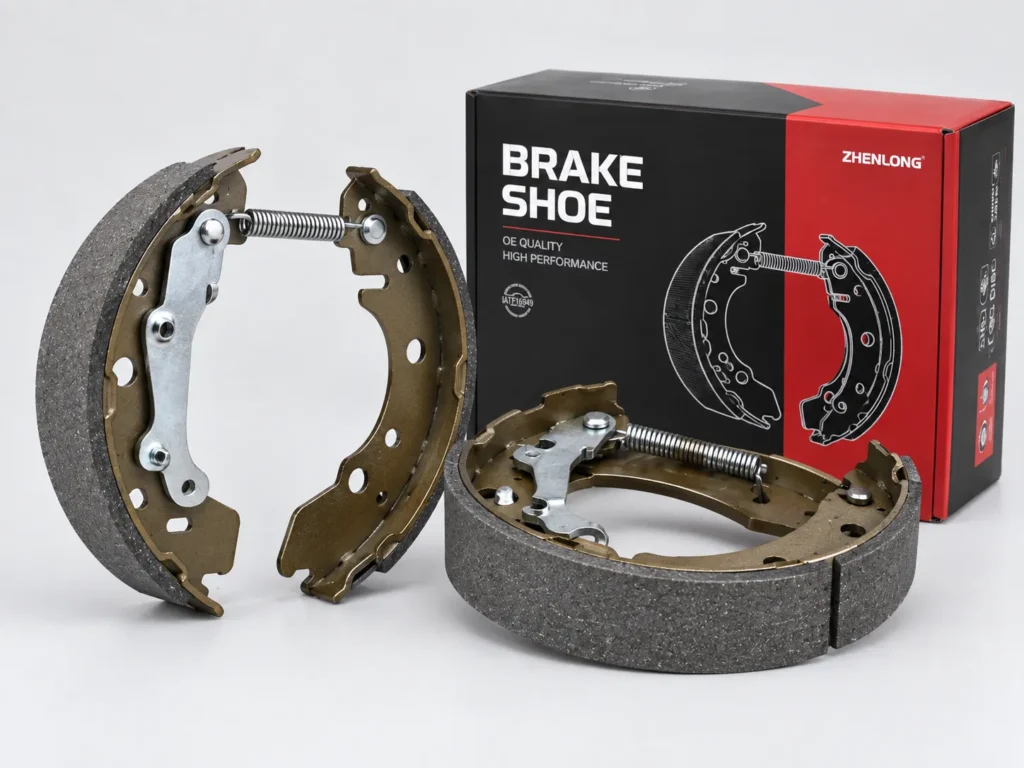
A brake shoe is a curved friction component used inside a drum brake. During braking, the wheel cylinder pushes the shoes outward so the friction linings contact the inner surface of the brake drum and generate braking force.
For buyers, correct fitment depends on more than the lining material. Shoe profile, width, mounting points, arc, hardware interfaces and part-number application all need to match the required reference.
Hydraulic force is applied
The wheel cylinder moves the brake shoes outward.
Friction lining contacts the drum
The lining creates friction against the drum’s inner surface.
Vehicle speed is reduced
Friction converts motion into heat and produces braking force.
Brake Shoe Supply Formats
We match brake shoe supply by reference and application. Availability of bonded, riveted or hardware-included configurations depends on the specific part number and product program.
Standard Replacement Brake Shoe Sets
Aftermarket replacement sets matched to vehicle applications and part numbers for regular wholesale supply.
Part-number matchedAftermarket
Bonded Brake Shoes
Friction lining bonded to the formed steel shoe where the reference design requires a bonded construction.
Reference dependentLining bond control
Riveted Brake Shoes
Mechanical lining attachment for references that specify riveted construction. Supply should be confirmed against the part number.
Reference dependentMechanical fastening
Brake Shoes With Hardware
Applicable springs, clips or installation hardware can be discussed where a complete service kit is required.
Kit optionOEM / private label
How We Select the Correct Brake Shoe
A quotation should not be based on a generic “brake shoe” request. We match each line item using reference data and the dimensions or configuration that matter for fitment.
REFERENCE VERIFICATION
Buyer Input
What We Verify
Key Dimension
Construction
Quote Output
OE / aftermarket number
Application match
Width / arc
Bonded / riveted
Matched reference + price
Vehicle / market info
Cross-reference
Lining thickness
Hardware need
Packaging option
Annual / order quantity
Supply feasibility
Mounting features
Program type
Lead-time confirmation
Best input: your current purchasing list with part numbers, quantities, target packaging and destination market.
What Matters in a Replacement Brake Shoe
The product should be evaluated as a complete friction assembly—not just by the color or thickness of the lining.
Fitment Accuracy
Profile, width, arc and mounting points need to match the intended reference.
Stable Friction
Friction behavior should remain predictable across normal operating conditions.
Lining Attachment
Bonded or riveted constructions require consistent attachment quality.
Wear Balance
Material selection should balance braking response, wear and service life.
Batch Consistency
Repeat orders require stable reference matching and production control.
Where Drum Brake Shoes Are Used
Application coverage varies by market and vehicle platform. The correct shoe should always be selected by reference rather than by vehicle type alone.
Use your current OE / aftermarket references for reliable matching.
Passenger Vehicles
Rear drum-brake applications across applicable passenger-car references.
SUVs & Pickups
Replacement brake shoe applications for applicable light-duty vehicle platforms.
Light Commercial Vehicles
Reference-based supply for applicable vans and light commercial applications.
Mixed Aftermarket Programs
Combine brake shoes with brake pads and rotors for broader brake-parts purchasing programs.
Different Buyers Have Different Brake Shoe Problems
A distributor does not buy the same way as a repair shop. The supply process should match the buyer’s inventory model, SKU depth and order frequency.
Distributors
Broad SKU programs and repeat replenishment.
Typical pain points
- Too many references to verify
- Packaging consistency
- Repeat-order continuity
Our solution
- Batch part-number matching
- Mixed-reference quotation
- Private-label program support
Auto Parts Stores
Need fast-moving references without building an oversized inventory.
Typical pain points
- Small quantities per reference
- Need broad coverage
- Slow quotation from suppliers
Our solution
- Mixed SKU purchasing
- Parts-list quotation
- Regular replenishment support
Repair Businesses
Prioritize correct fitment and responsive sourcing.
Typical pain points
- Wrong cross-reference risk
- Smaller purchasing lists
- Need pads / rotors / shoes together
Our solution
- Reference verification
- Flexible mixed lists
- Brake-parts consolidation
Build a Brake Shoe Program Around Your Market
For established buyers, the supply program can extend beyond the product itself to packaging, labeling and order structure. All options depend on the actual reference and order requirements.
OEM / Private-Label Workflow
Start with the references you sell, then confirm the commercial details around those references.
Part numbers, applications and quantities.
Neutral box, private label or market-specific requirements.
Confirm product and packaging where required.
Approved references move into the purchasing program.
Neutral packaging or private-label cartons.
Part-number labels, barcodes and buyer-specific information.
Discuss applicable spring / clip kits where required.
Build orders around the SKUs that matter in your market.
Commercial and product documents according to the order program.
Carton marks and shipment identification requirements.
Compare the Product—and the Supply Model
For a B2B buyer, the right decision is not only bonded versus riveted. It is also whether the supplier can manage reference matching, repeat supply and commercial requirements.
Brake Shoe Construction
Factor
Bonded
Riveted
Attachment method
Adhesive bonding
Mechanical rivets
Reference selection
Match original design
Match original design
Best buying rule
Buy by verified reference
Buy by verified reference
Direct Factory vs. Generic Trading Supply
Buyer Need
Top Brake Parts
Generic Sourcing
Part-list matching
Structured verification
Varies by supplier
Manufacturing evidence
Factory / QC pages
May be indirect
OEM / packaging program
Buyer-specific
Often limited
Brake Shoe Purchasing Checklist
Most purchasing errors happen before production—when the reference, application or commercial requirement is incomplete. Send these details first.
OEM or aftermarket references you currently buy or need quoted.
Estimated order quantity or annual demand helps evaluate the supply program.
Market information helps confirm packaging, documentation and application context.
Neutral box, private label, barcode, carton mark or other requirements.
Confirm whether the reference needs brake shoes only or applicable hardware.
Indicate target shipping time and destination so the quotation is commercially useful.
From Steel Shoe to Finished Assembly
The product page only shows the key manufacturing stages. Detailed equipment and factory evidence should live on the dedicated factory page.
Steel Forming
Steel components are stamped and formed to the required profile.
Surface Preparation
Steel surfaces are prepared for coating and lining assembly.
Lining Preparation
Friction material is prepared according to product requirements.
Bond / Rivet
The lining is secured according to the reference design.
Curing
Bonded assemblies undergo controlled curing where required.
Grinding
Lining and assembly surfaces are finished to specification.
Final Inspection
Finished references are checked before packaging and shipment.
Inspection Before the Product Reaches Your Shelf
Quality claims are more useful when buyers can see what is actually checked. This page summarizes the control points and links to the dedicated quality and certification evidence.
Width, profile, arc, mounting points and reference-critical dimensions.
Bonded or riveted attachment condition according to the product design.
Batch and production requirements for the applicable formulation.
Visual condition, finish, edges and steel component protection.
Finished product, packaging and order consistency before shipment.
Certifications & Compliance
Show only certificates and approvals that are current, applicable and verifiable for your actual products or quality system.
Where applicable by approved reference
Material / chemical compliance documentation
Add your current verified certificate
Replace this block with your actual certificate names, numbers, scope, issue dates and expiry dates.
Top Brake Parts factory
A Brake Parts Factory Built Around B2B Purchasing
Top Brake Parts is operated by Guangzhou Zhenlong Brake Parts Co., Ltd., a China-based brake parts factory founded in 2014. We supply brake pads, brake rotors and brake shoes to aftermarket buyers with an emphasis on reference matching, stable quality and practical order handling.
Send references instead of searching a retail-style catalog.
Combine pads, rotors and shoes in purchasing programs.
Manufacturing, QC and certification pages support buyer verification.
Commercial options for established aftermarket programs.
See How Buyers Evaluate and Source Brake Shoes
Use real project data in case studies and use the knowledge center for deeper technical content. This keeps the product page commercial without making it thin.
Replace with real data
Mixed-Reference Distributor Order
Show the buyer type, number of brake shoe references, packaging requirement, matching challenge and final supply outcome using verified order information.
Replace with real data
Private-Label Brake Shoe Program
Show how the project moved from part list and packaging brief to approval, production, inspection and shipment.
Related Brake Shoe Guides
Manufacturing stages, lining attachment and finishing.
Where each friction component is used and how they differ.
A practical purchasing workflow for aftermarket buyers.
What buyers should verify before bulk purchasing.
Brake Shoe Purchasing Questions
Keep this FAQ product-specific. General payment, company and shipping questions can live on the site’s main FAQ page.
How do you match brake shoe part numbers?
Send your OEM or aftermarket reference list. We verify the reference, application and key product configuration before preparing the quotation.
Can I order multiple brake shoe references together?
Yes. Mixed-reference purchasing is supported subject to the quantities, availability and commercial requirements of the order.
Do you supply bonded and riveted brake shoes?
Availability depends on the specific product reference. Send the part number so the required construction can be confirmed.
Can brake shoes be supplied with hardware?
Applicable spring, clip or hardware kits can be discussed where the reference and purchasing program require them.
What should I send for a quotation?
Part numbers, estimated quantities, target market, packaging requirements and delivery expectations are the most useful starting information.
Can I use my own brand and packaging?
Private-label packaging can be discussed for suitable orders. Artwork, labels, barcodes, carton marks and order quantities should be confirmed before production.
Can I combine brake shoes with pads and rotors?
Yes. Buyers can submit mixed brake-parts purchasing lists so compatible product categories can be quoted in the same sourcing process.
How do you control brake shoe quality?
Inspection focuses on reference-critical dimensions, lining attachment, friction material requirements, surface condition and final batch consistency. Detailed evidence belongs on the dedicated Quality Control page.