Solid & vented replacement rotors
Wholesale Brake Rotors & Brake Discs for Auto Parts Distributors & Repair Shops
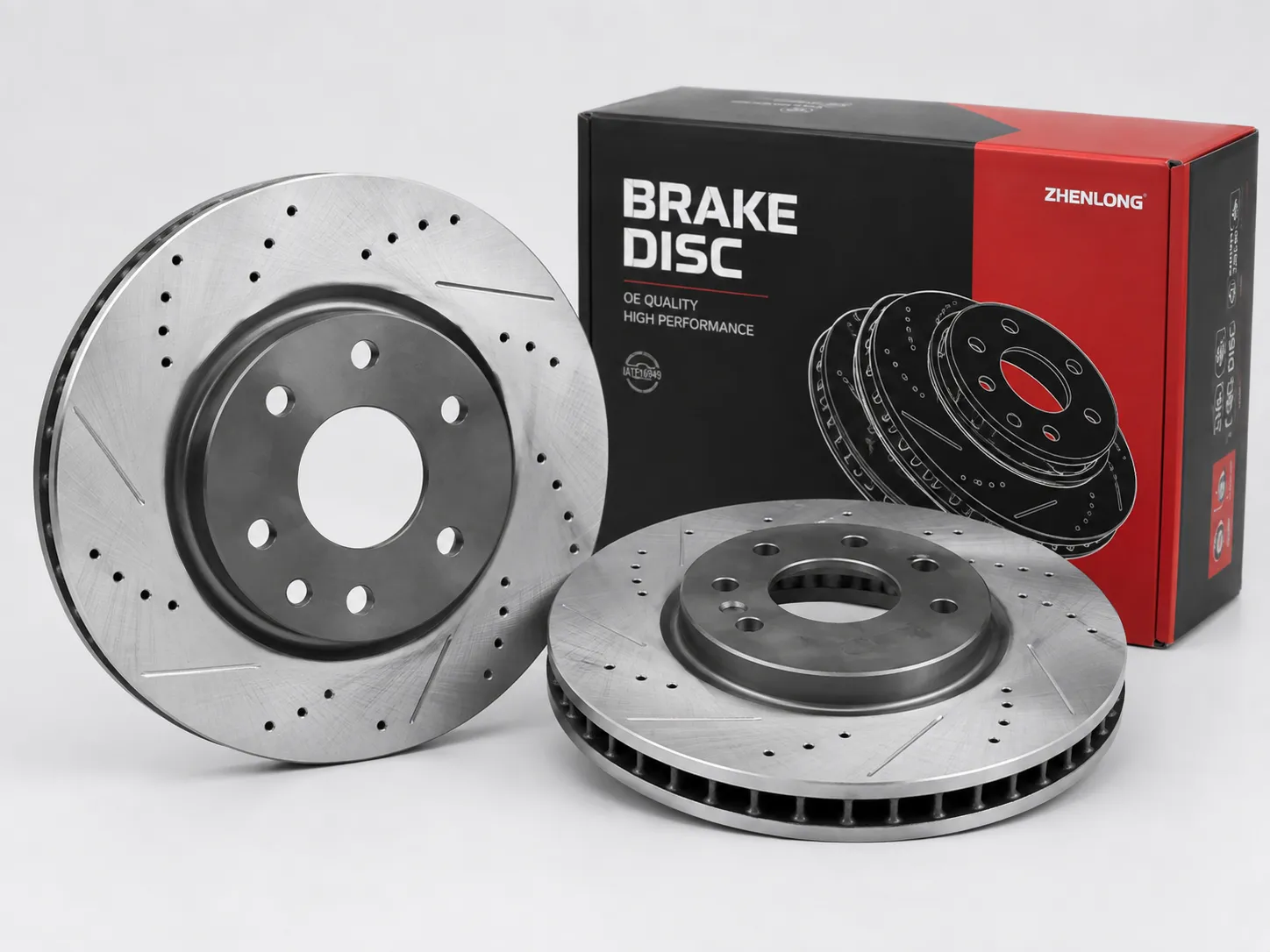
Source standard replacement brake rotors for passenger cars, SUVs and light trucks directly from a brake rotor manufacturer.
As a brake disc manufacturer, we supply solid and vented brake rotors for auto parts distributors, importers, parts stores, repair shops and aftermarket brake programs.
You do not need to search through hundreds of rotor references manually. Send us your OE numbers, vehicle applications, VINs, current supplier numbers or Excel purchasing list. We can help verify the application, rotor type and critical dimensions before quotation.
What you can send us
- OE / OEM Numbers
- Make, Model & Year
- VIN Information
- Existing Supplier Numbers
- Rotor Dimensions
- Product Photos
- Physical Samples
- Excel Purchasing Lists
DF4364Front axleVentedBG3021Rear axleSolid09.5509.10Front axleVentedVIN · WBA…To confirmVentedStart from the problem
What Problem Are You Trying to Solve With Your Brake Rotor Order?
Price Is the Last Question, Not the First
Not every rotor buyer has the same problem. Some distributors already know exactly which references they need. Others are dealing with vibration complaints, inconsistent machining, incorrect applications or too many slow-moving SKUs.
Before discussing price, it is useful to identify what is actually creating risk in your current brake rotor program.
I Need the Correct Rotor for My Vehicle List
The same vehicle generation can sometimes use different brake rotor sizes or braking systems. A rotor that looks similar may still differ in:
If you already have an OE list, vehicle list or current supplier catalog, send it to us. We can review the applications before quotation instead of relying only on visual similarity.
Best for
- Distributors changing suppliers
- New aftermarket brake programs
- Parts stores adding more vehicle coverage
- Buyers with outdated cross-reference lists
I Am Getting Too Many Brake Vibration Complaints
Customers may describe vibration as “warped rotor”, “shaking steering wheel”, “pulsating brake pedal” or simply “rotor problem”.
But these symptoms do not automatically prove that the rotor is physically warped. Brake vibration can also involve:
Our approach is to review measurable evidence rather than classify every vibration complaint as a defective rotor.
I Need More Consistent Rotor Quality
For repeat wholesale orders, consistency is often more important than how impressive one sample looks.
Typical buyer concerns include:
A good rotor supply program therefore needs control over both machining accuracy and repeat production consistency.
I Need a Better Multi-SKU Purchasing Program
Wholesale rotor orders often contain many references. You may need 30, 50, 100 or more different rotor numbers in one purchasing cycle.
Instead of sending one inquiry per rotor, send your complete purchasing list. We can review the references together and prepare the quotation around the complete order.
- One list instead of one inquiry per rotor
- Duplicate references identified before production
- Unclear applications flagged for confirmation
- Order structure reviewed as a whole
Fitment verification
Send Us the Vehicle or Part Number — We Help Match the Rotor
Fitment Should Be Confirmed Before Production
A similar appearance does not mean two rotors are interchangeable.
Critical dimensions determine whether the rotor sits correctly on the hub, aligns with the caliper and works with the intended brake system.
OE / OEM Number Matching
If you already purchase rotors using OE numbers, send the complete reference list. OE numbers provide an important starting point for identifying the corresponding aftermarket brake rotors. If you buy OEM brake rotors today, the same OE list lets us quote OE-spec replacement brake rotors.
For high-volume purchasing, using an existing OE list is usually faster than selecting products one at a time from a catalog.
Vehicle Make, Model & Year
If the OE number is unavailable, vehicle information can be used as another fitment reference.
Some vehicles may use different rotor sizes depending on engine, trim, production date or brake package. Front brake rotors and rear brake rotors are usually different references — in the UK and Europe the same parts are listed as front brake discs and rear brake discs.
Useful information
VIN Verification
VIN information can provide additional vehicle identification when one vehicle platform has multiple brake configurations.
VIN should be treated as an additional verification method rather than the only source of dimensional information.
Existing Supplier Number
Already purchasing this rotor from another supplier? We can use the available information to identify the corresponding rotor before confirming the quotation.
Send us
Rotor Dimension Matching
If the reference number is unclear, several physical dimensions can help identify the rotor.
Most useful dimensions
Existing Sample Matching
For difficult applications, a physical rotor sample can provide additional verification.
A sample is especially useful when the buyer has an old supplier number, limited vehicle data, or an application that has been cross-referenced differently by multiple catalogs.
Product range
Rotor Types: Solid vs Vented Rotors
Standard Replacement, Not Catalog Padding
Our main brake rotor range focuses on standard solid and vented replacement rotors with a plain friction face, often listed as blank brake rotors. We do not build the product page around drilled, slotted or motorsport rotors simply to make the catalog look larger.
For wholesale replacement markets, the correct standard rotor is usually more important than adding unnecessary rotor styles.

Solid Brake Rotors
Solid brake rotors use a single-piece friction ring without internal cooling vanes. They are commonly found on selected passenger-car and rear-axle applications where thermal demand is lower.
Their relatively simple structure does not remove the need for dimensional accuracy. Critical dimensions still need to match the vehicle correctly.
Vented Brake Rotors
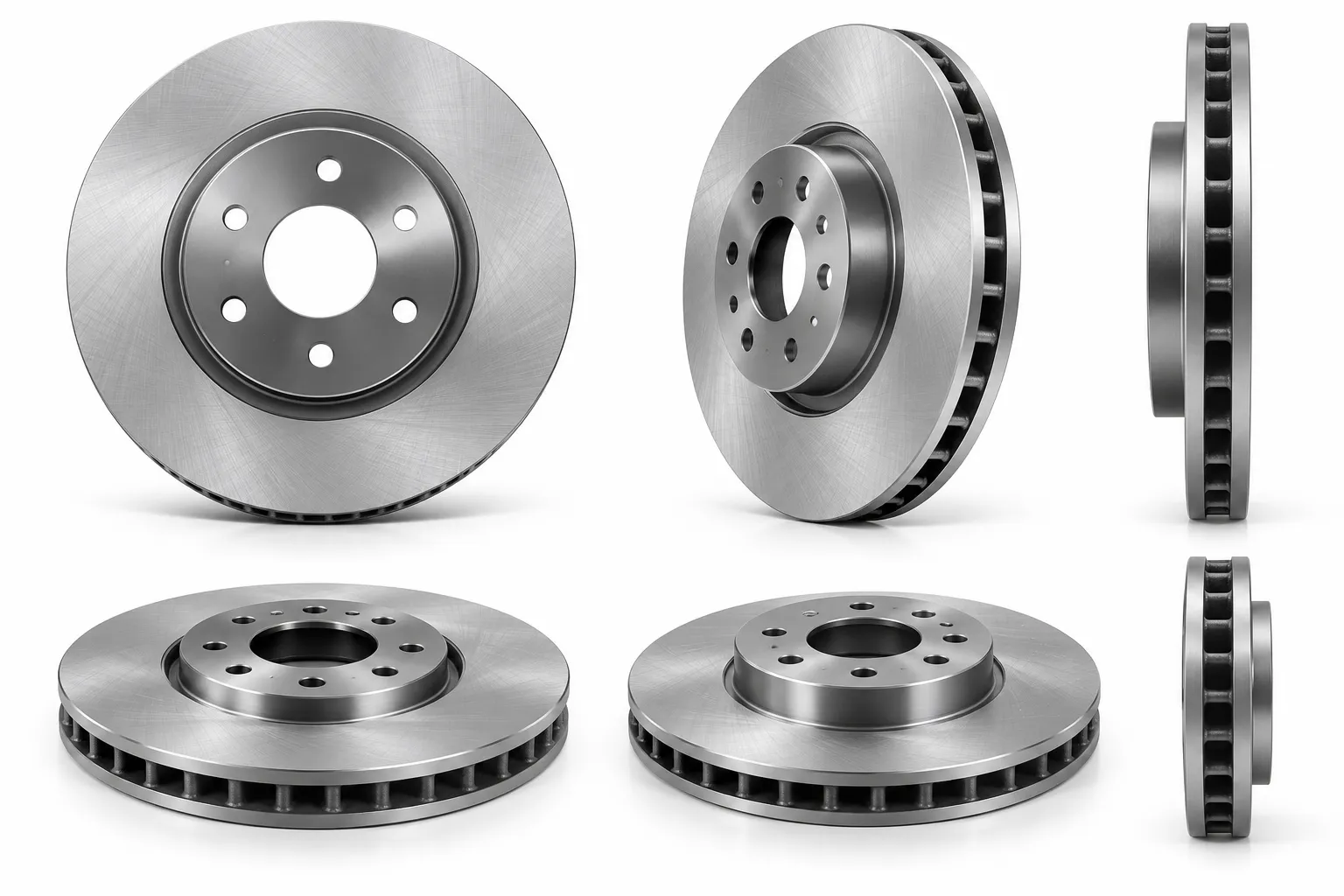
Vented brake rotors contain internal cooling passages between the friction surfaces. They are commonly used where the braking system experiences greater heat load.
Vented rotor quality depends not only on the outer machining. Internal vane consistency and casting condition also matter.
- External precision
- Internal casting quality
For this reason, our inspection looks at both external precision and internal casting quality.
Technical reference
7 Critical Brake Rotor Dimensions Buyers Should Confirm
A Rotor Can Have the Correct Shape and Still Be the Wrong Part
For fitment verification, several dimensions deserve particular attention.
Select a dimension to highlight it on the drawing.
Click a dimension
Outer diameter determines the size of the friction ring and its relationship with the caliper and brake pad.
A rotor with the wrong diameter may not align correctly with the braking system even when the bolt holes appear to match.
Nominal thickness is the rotor thickness when new. This dimension must match the intended brake system.
It should not be confused with the minimum service thickness.
Minimum thickness indicates the service limit at which the rotor should no longer remain in use.
For wholesale buyers and repair networks, clear thickness information helps reduce confusion during inspection and replacement.
Overall height affects the axial position of the friction ring relative to the hub and caliper.
This is one of the most important rotor fitment dimensions. Even a small difference can make an otherwise similar rotor unsuitable for the vehicle.
The center bore determines how the rotor locates on the hub.
Incorrect center-bore dimensions can prevent installation or create fitment problems.
The number, position and diameter of mounting holes must match the vehicle hub.
Depending on the application, additional retaining or locating holes may also be present.
A solid and vented rotor may share several external dimensions while still belonging to different brake applications.
Construction type should always be verified as part of the fitment check.
Not sure about the dimensions? Send us the OE number, vehicle information or existing sample.
Diagnosis before blame
Brake Vibration Does Not Always Mean the Rotor Is “Warped”
Separate Manufacturing Issues From Installation and Vehicle Issues
Brake vibration is one of the most misunderstood aftermarket rotor complaints. When a customer feels steering-wheel shake or pedal pulsation, the rotor is often immediately described as “warped.”
In practice, the symptom can come from several different conditions.
Excessive Lateral Runout
Lateral runout describes side-to-side movement of the rotor friction surface during rotation. Excessive runout can create uneven contact between the brake pad and rotor.
Possible sources
The rotor should therefore be measured in the installed condition when investigating a vehicle complaint.
Disc Thickness Variation — DTV
DTV means the rotor friction ring does not have exactly the same thickness at all measured positions.
When brake pads pass over areas of different thickness, braking force can vary cyclically. The driver may feel this as pedal pulsation or vibration.
DTV is therefore one of the most useful measurements when investigating a recurring brake judder complaint.
Hub Surface Contamination
Rust, dirt or debris trapped between the rotor mounting surface and hub can prevent the rotor from sitting flat.
This can create installed runout even when the rotor itself was machined correctly.
For this reason, the hub mounting surface should be cleaned before rotor installation and before measuring installed runout.
Uneven Friction Transfer Layer
Brake pads leave a friction-material transfer layer on the rotor during normal braking.
If this layer becomes uneven, the friction condition around the rotor surface can vary.
The driver may perceive the result as vibration even when the rotor is not physically bent.
Installation and Wheel-End Conditions
Vibration can also be affected by wheel-nut tightening, hub condition, bearing condition, caliper movement, brake-pad behavior and installation practices.
This is why a useful quality claim should include measurements and installation information.
Not enough“The rotor shakes.”
Useful“Installed runout 0.09 mm, DTV 0.03 mm, hub face cleaned, 14,000 km.”
Inspection focus
What We Inspect on a Brake Rotor
Different Areas Create Different Downstream Risks
A brake rotor should not be evaluated only by weight or surface appearance.
Our inspection focus is divided into several functional areas.
Friction Surface Finish
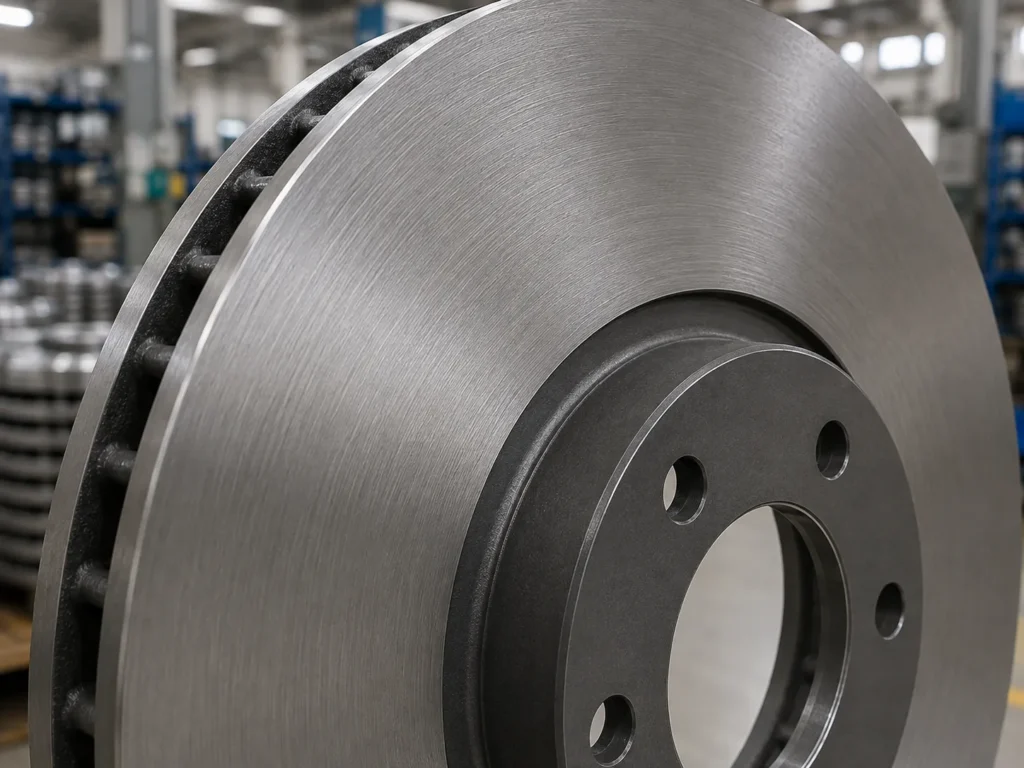
The friction surface is one of the first areas a buyer notices, but appearance alone is not enough.
- Machining consistency
- Abnormal grooves
- Damaged surfaces
- Irregular finish
- Visible defects
The goal is not the shiniest surface — it is a controlled and repeatable friction surface.
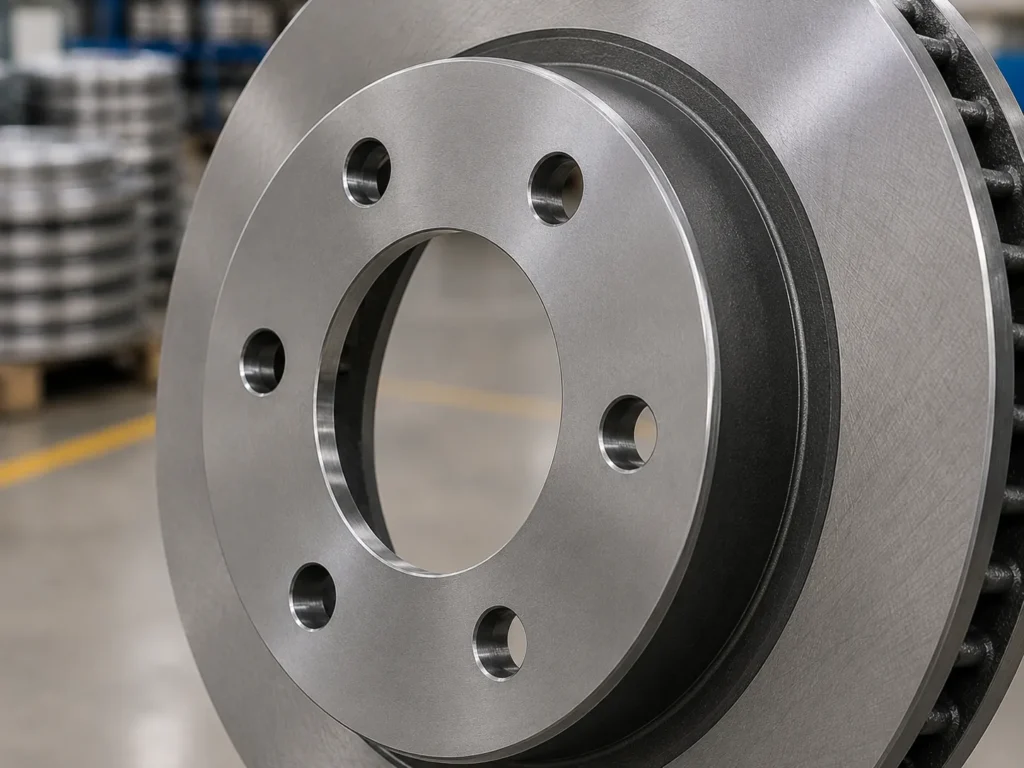
Hub Face & Mounting Surface
The mounting area determines how the rotor sits on the vehicle hub.
- Mounting-face condition
- Center bore
- Bolt-hole machining
- Visible dimensional problems
A problem here can directly affect fitment or installed runout.
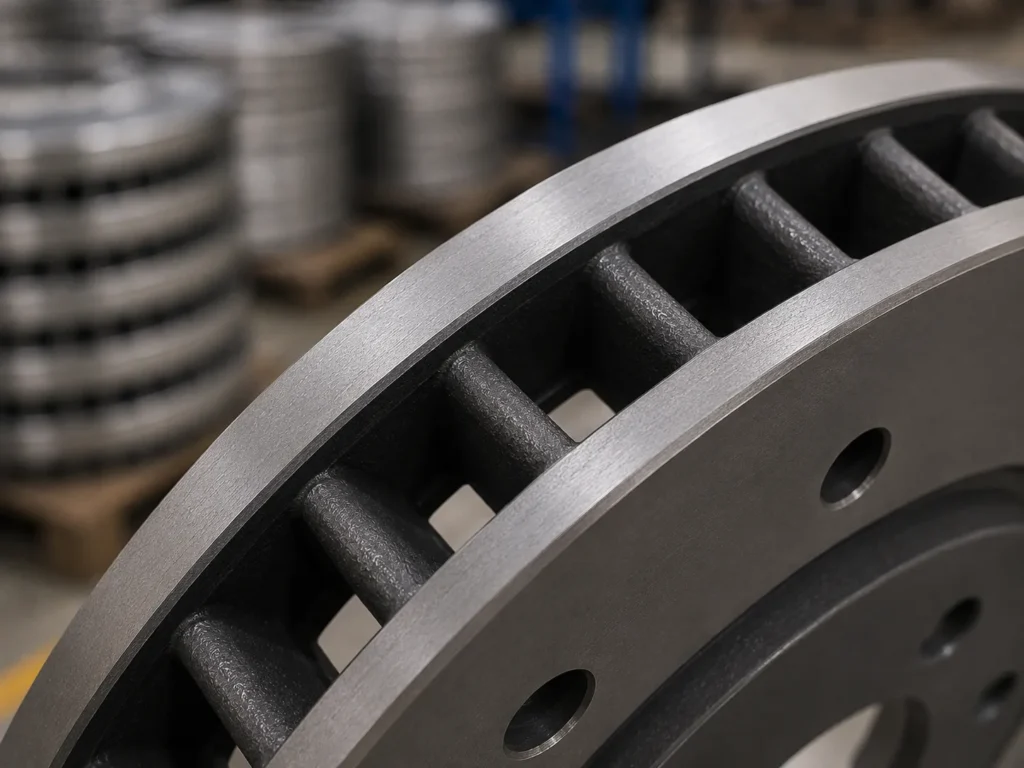
Cooling Vanes
For vented rotors, the internal cooling structure should also be inspected.
- Vane completeness
- Casting consistency
- Blocked passages
- Obvious casting defects
Internal vanes should not be ignored simply because they are less visible after installation.
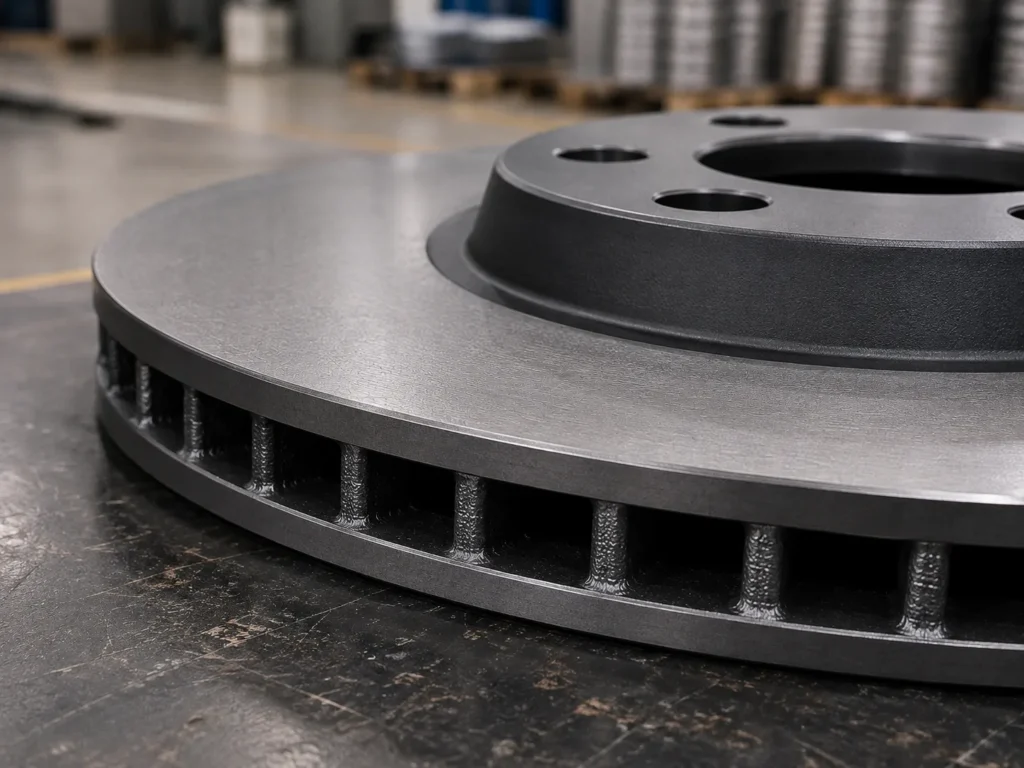
Casting Edge
Casting edges can reveal production problems that are easy to overlook.
- Excessive flash
- Broken edges
- Casting residue
- Unusual surface defects
Cleaner and more controlled casting also improves handling during packaging and installation.
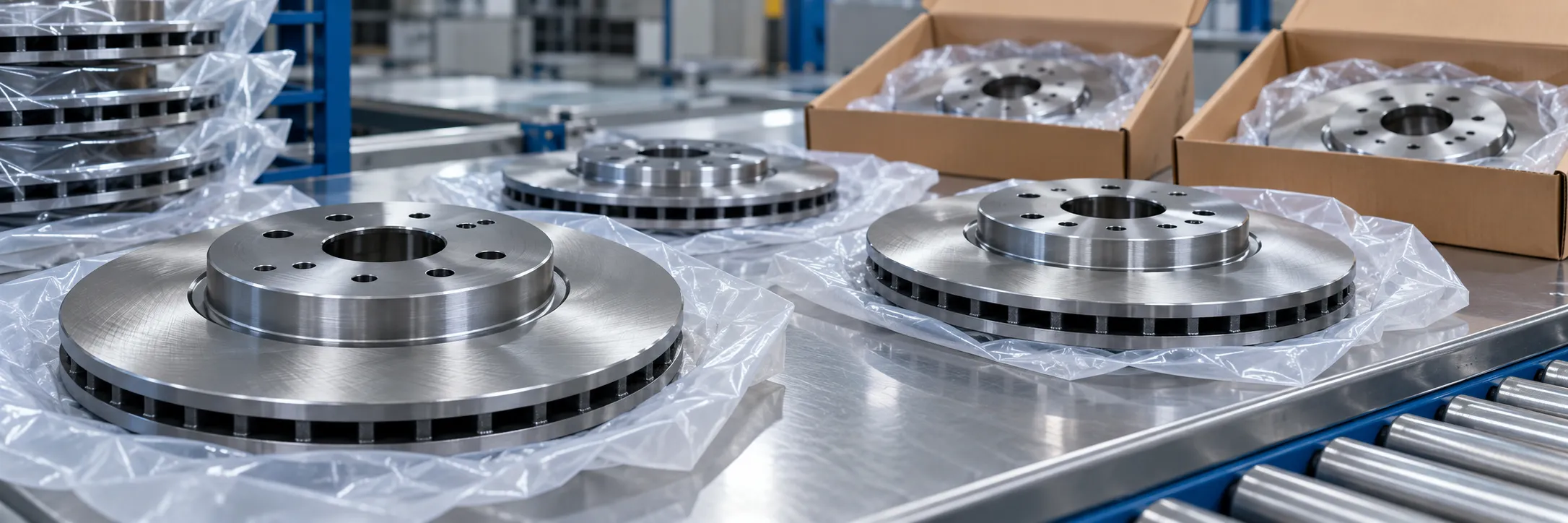
Rust-Preventive Oil & Corrosion Protection
Finished rotors are protected with rust-preventive oil before packing. The oil film should be even across the machined surfaces and should not create handling or fitment problems.
- Hub appearance
- Exposed surfaces
- Even oil film
- Mounting-face clearance
- Bolt-hole clearance
- Consistency across batch
Measured, not judged
Precision Checks Before Shipment
Dimensional Consistency Reduces Installation Complaints
Brake rotor quality should be supported by measurement rather than only visual inspection.
For wholesale programs, dimensional consistency helps reduce installation complaints and improves repeat-order stability.
Runout inspection measures lateral movement of the friction surface as the rotor rotates. Our quality page explains our brake rotor runout inspection in more detail.
DTV is checked by comparing rotor thickness at multiple positions around the friction ring. Consistent thickness is particularly important for reducing the risk of pedal pulsation and brake judder complaints.
Rotor Thickness Inspection
Nominal rotor thickness is checked against the intended specification. Thickness control also helps confirm that the correct rotor reference has entered the correct packaging and production batch.
Overall Dimensional Inspection
Depending on the product: outer diameter, overall height, center bore, bolt-hole position and mounting features. Even a well-machined friction surface does not solve an incorrect fitment dimension.
Visual and Casting Inspection
Friction surface, cooling vanes, hub, casting edge, rust protection and physical damage. A complete rotor QC process needs measurement + visual inspection.
* These figures should be understood as factory inspection targets for the relevant product programs, not as universal limits for every rotor in every vehicle application.
Production control
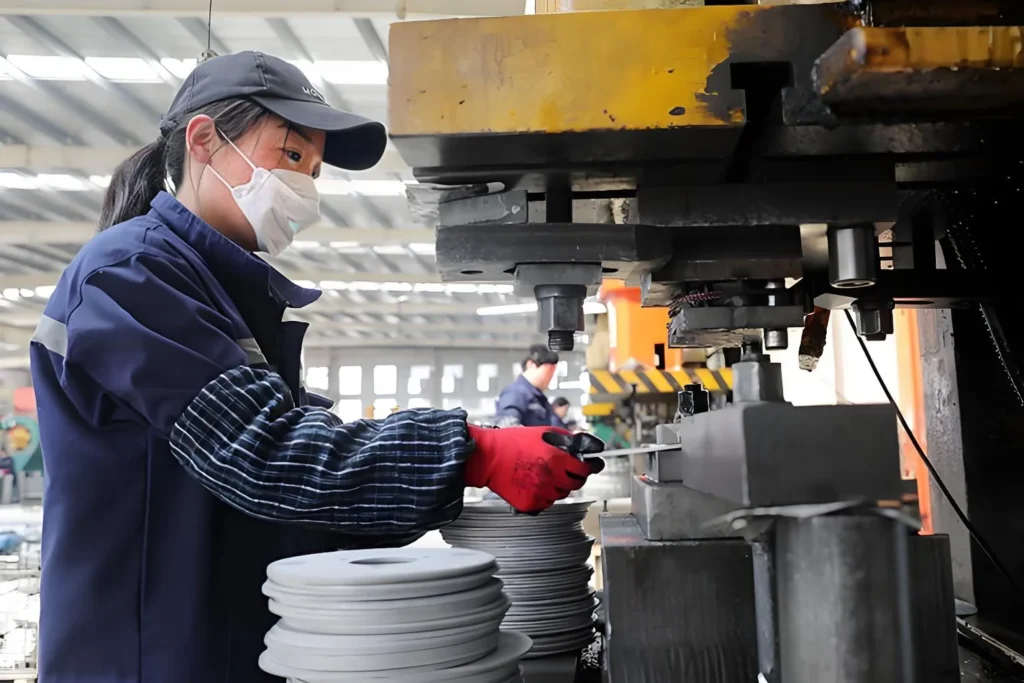
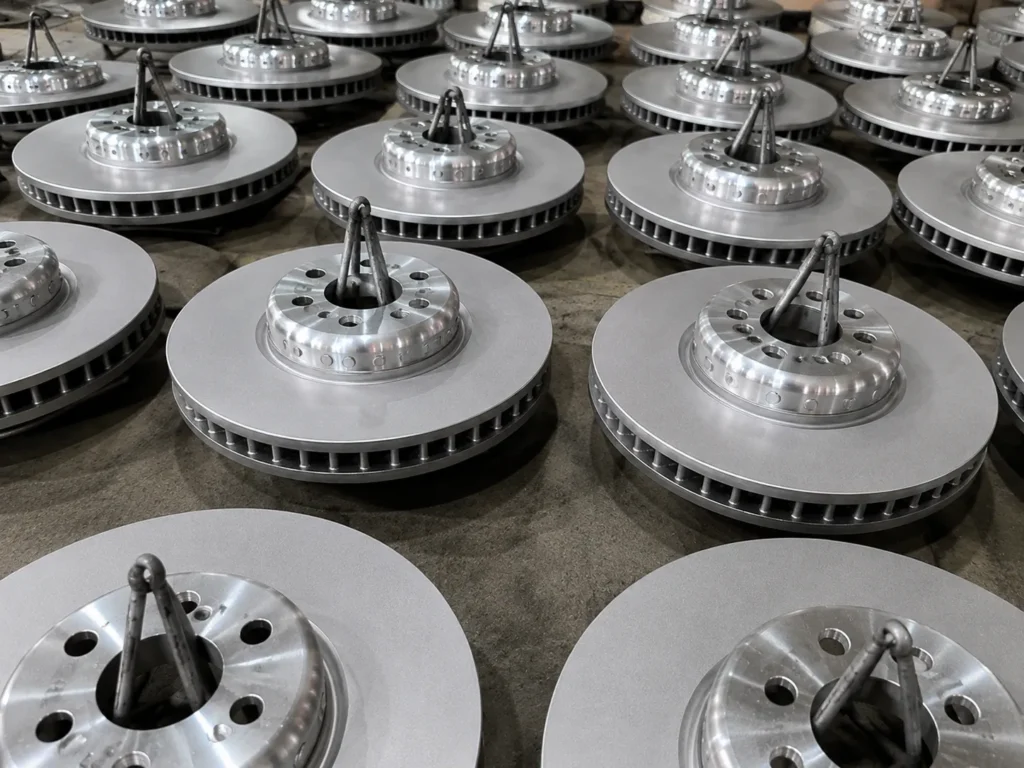
Manufacturing Controls That Affect Rotor Quality
Which Operations Actually Affect Fitment, Vibration and Consistency?
Buyers do not need a factory tour just to see machines.
The more useful question is which manufacturing operations actually affect fitment, vibration risk, appearance and product consistency. For photos of each step, see how brake rotors are made in our factory.
Six operations, each with a different downstream risk
Casting Quality
The casting creates the main rotor structure, so brake rotor material consistency is controlled at this stage.
- Friction ring
- Hub structure
- Internal cooling vanes
- Material consistency
For vented rotors, poor internal casting can create vane defects that are not visible from a standard product photo.
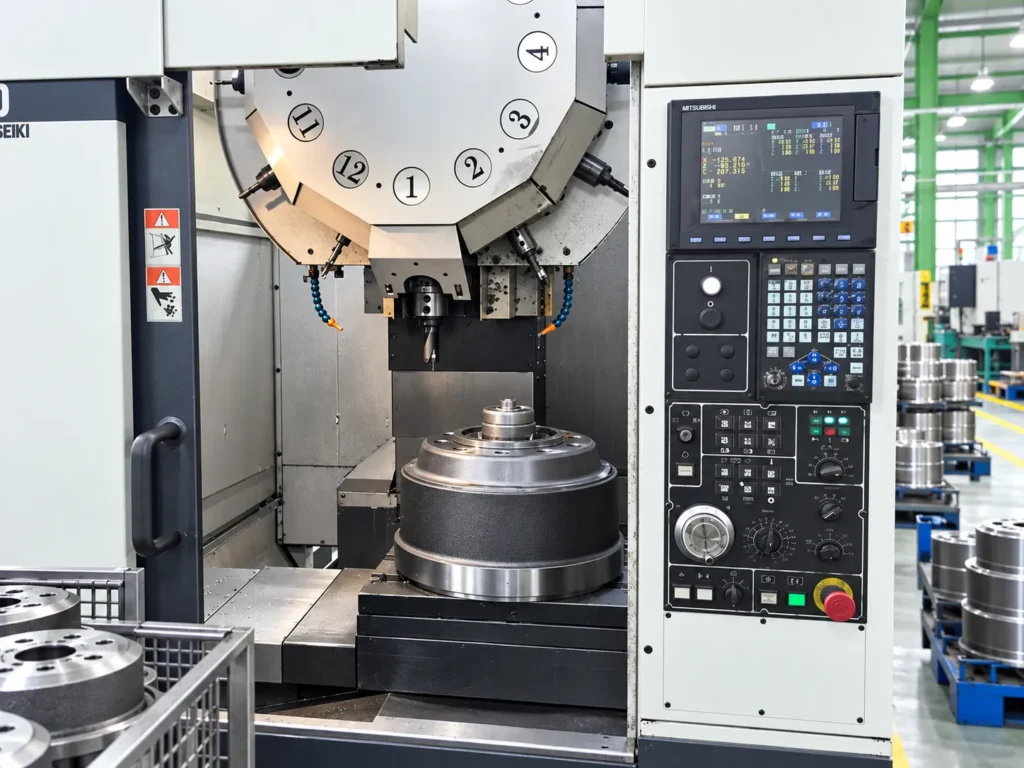
Precision Machining
One of the most important stages in rotor production. It directly affects:
- Thickness
- Friction surface
- Runout
- Hub dimensions
- Overall geometry
Poor machining accuracy can turn a structurally sound casting into a problematic finished rotor.
Hub & Bolt-Hole Machining
The mounting area must match the vehicle hub correctly. Center bore and bolt-hole machining play a direct role in fitment accuracy.
This is one reason we do not recommend selecting rotors only from a front-view product photo.
Friction Surface Finishing
The friction surfaces must be finished consistently. Surface finishing influences the initial contact condition between the rotor and brake pad.
For repeat wholesale orders, a stable machining process is more valuable than one unusually polished sample.
Rust-Preventive Oil & Anti-Corrosion
Cast iron brake rotors are naturally susceptible to surface corrosion. Before packing, protection includes:
- Rust-preventive oil on all machined surfaces
- Moisture-resistant inner packaging
- Other agreed treatment
The level of protection depends on the shipping route and expected storage time.
Final Inspection & Marking
Before packing, rotors should be checked against the required SKU and specification.
- Part number
- Dimensions
- Visible condition
- Batch marking
- Packaging accuracy
Especially important for orders containing many similar-looking rotor references.

Packaging
Rotor Packaging Designed for Heavy Cast-Iron Parts
A Rotor Can Damage Itself and Its Neighbours
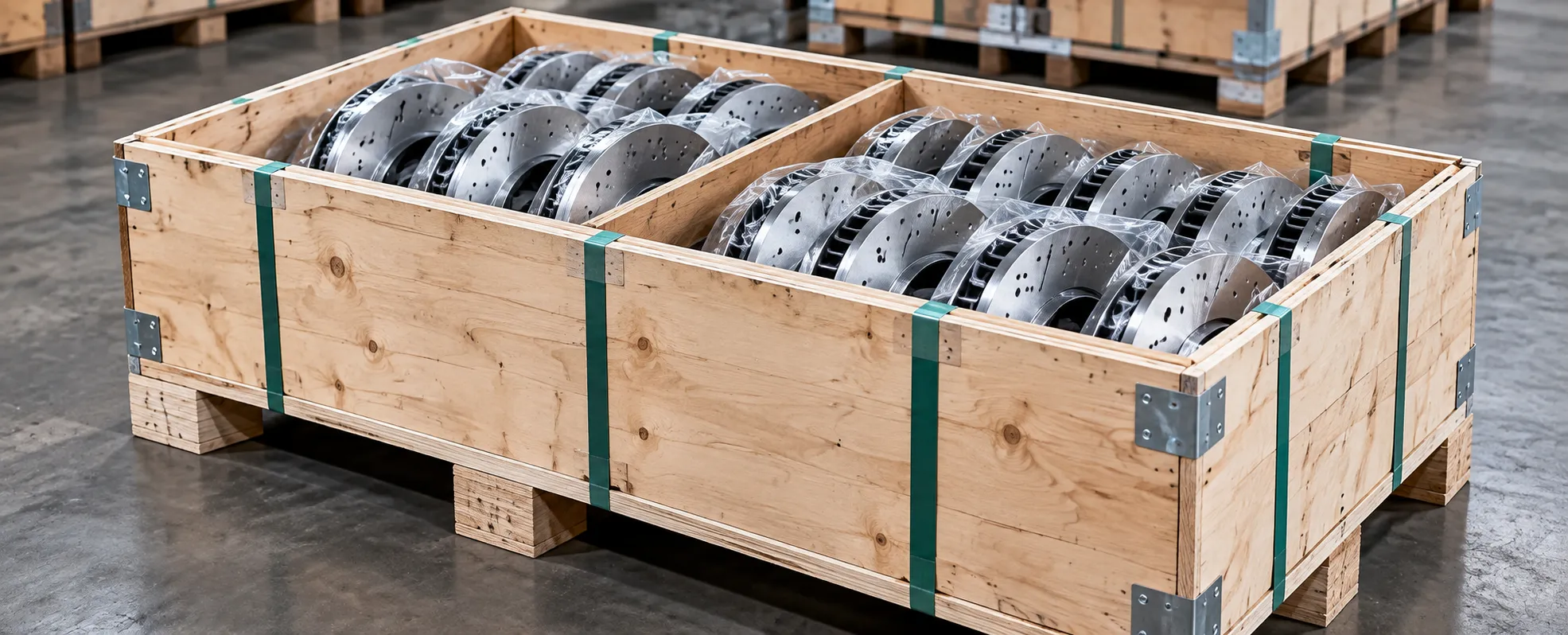
Brake rotor packaging has a different job from brake pad packaging. A rotor is heavy, rigid and capable of damaging both itself and nearby products if it moves inside the carton.
Packaging must therefore protect against impact, moisture, surface damage and SKU confusion.
Surface Protection
Depending on the rotor specification, corrosion control can include suitable protective treatment before packing.
For long-distance shipping — especially ocean freight — the packaging system should consider moisture exposure and warehouse storage conditions.
Friction Surface Protection
Protected from avoidable impact, scratches and contamination during transportation.
Packaging materials should not leave the rotor free to move excessively inside the box.
Edge Protection
Rotor edges can damage cartons or strike nearby rotors during rough handling. Suitable internal support reduces:
- Edge damage
- Carton failure
- Product movement
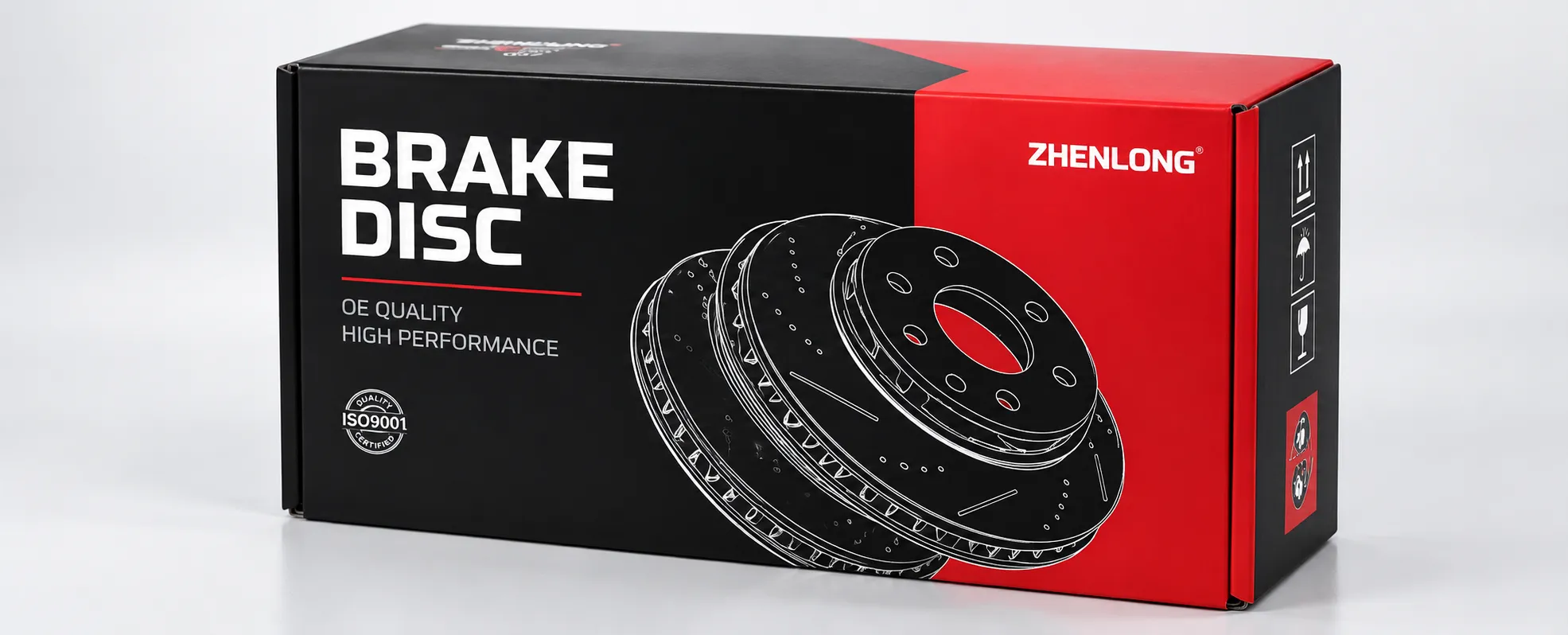
Individual Product Box
Each product box should clearly identify the SKU.
- Part number
- Customer number
- Barcode
- Application information
- Branding
Accurate labeling matters just as much as strong cartons.
Master Carton & Pallet Control
Brake rotors create substantial shipment weight. Pallet arrangement needs to consider carton stacking, total weight, stability and handling.
A package that looks good individually can still fail if the pallet structure is poor.
Range planning
Build a Practical Brake Rotor Inventory
The Best Program Is Not the One With the Largest SKU Count
For many distributors, the better strategy is to stock the references their customers actually buy — and then expand based on demand.
Start With Your Existing Sales List
If you already sell brake rotors, your current sales history is one of the most useful starting points. Send us the existing SKU list — we can work from those applications instead of replacing your range with an unrelated catalog.
Start With Your Vehicle Market
If you are entering a new market, your rotor range can be organized around the vehicles commonly serviced by your customers — Japanese, Korean, American or European applications. The objective is not to stock every possible rotor immediately. It is to create relevant coverage.
Start With Fast-Moving Applications
For a new distribution program, a smaller set of higher-turnover applications can reduce inventory risk. Start with selected references, review sales movement, then expand the range — usually safer than buying a very large quantity of hundreds of untested SKUs.
Keep Repeat Orders Consistent
Once a rotor reference performs well in the market, repeat orders should maintain the agreed specification. For distributors, consistency between the first, second and third order is often more valuable than finding a slightly lower price on every purchase.
Troubleshooting
Common Brake Rotor Complaints — What Should Be Checked First?
A Complaint Should Lead to a Diagnosis, Not an Assumption
This type of troubleshooting is useful for distributors because it helps separate product problems from vehicle and installation problems.
| Customer complaint | Do not immediately assume | Check first |
|---|---|---|
| Steering wheel vibration | Rotor is physically warped | Runout, DTV, hub surface |
| Brake pedal pulsation | Bad rotor material | DTV, transfer layer, runout |
| Scraping noise | Rotor failure | Pad, backing plate, shield, installation |
| Uneven surface wear | Bad casting | Caliper, pad contact, rotor condition |
| Surface rust | Defective rotor | Storage, humidity, rust-preventive oil |
| Rotor does not fit | Machining defect | OE reference, dimensions, vehicle application |
| Noise after installation | Rotor material problem | Pad, rotor surface, caliper, installation |
| Repeated judder | Same bad rotor again | Hub runout, DTV growth, installation conditions |
After-sales
How We Handle a Brake Rotor Quality Claim
More Than a Photo of a Returned Rotor
A useful B2B warranty process needs more than a photo of a returned rotor.
The more complete the information, the easier it is to identify whether the issue is related to the product, fitment, installation or the vehicle.
- 1Identify the RotorPart no. · batch · PO · label
- 2Confirm ApplicationVehicle · axle · VIN
- 3Record the SymptomVibration · noise · rust · fitment
- 4Measure the RotorRunout · DTV · thickness
- 5Review InstallationHub face · torque · caliper
- 6Review the BatchProduction & inspection records
- 7Corrective ActionBased on the evidence
What makes a claim reviewable
For vibration-related claims in particular, measurement data makes the investigation much more reliable.
- Part number
- Production batch
- Vehicle information
- Axle position
- Mileage
- Installation information
- Rotor runout
- DTV
- Photos
- Symptom description
Depending on the case, corrective action may involve technical guidance, replacement, commercial adjustment or production correction. The goal is not only to close one complaint. The goal is to reduce the chance that the same problem appears again.
Before you place a bulk order
What Buyers Should Check Before Sourcing Brake Rotors From China
A Low Price Becomes Expensive If the Product Creates Returns
A low rotor price can become expensive if the product creates returns, fitment complaints or warehouse problems.
Several risks are particularly important for brake rotor purchasing.
Incorrect Critical Dimensions
Matching only the overall appearance is not enough. Important fitment dimensions should be verified before placing a bulk order.
Excessive Runout
Poor machining or mounting-surface problems can contribute to runout. For buyers receiving repeated vibration complaints, runout control should be part of the quality discussion.
Excessive DTV
Thickness variation can contribute to pedal pulsation and braking inconsistency. DTV should be evaluated separately from simple nominal-thickness inspection.
Poor Friction Surface Machining
Inconsistent or damaged friction surfaces can affect the initial braking interface. Compare machining consistency between batches rather than judge only one sample.
Poor Cooling-Vane Casting
For vented rotors, internal casting quality matters. Incomplete or visibly defective vanes should not be ignored simply because the outside looks acceptable.
Poor Hub Machining
Center bore, bolt-hole and mounting-face problems can create immediate fitment issues. These areas deserve the same attention as the visible friction ring.
Inadequate Corrosion Protection
Brake rotors may spend weeks in ocean freight and additional time in a warehouse. Packaging and corrosion protection should be matched to the transportation and storage environment.
Weak Packaging
A rotor is a heavy cast-iron component. If packaging allows uncontrolled movement, one rotor can damage another during transportation.
- Edge damage to neighbouring rotors
- Carton failure under pallet weight
- Surface damage on the friction ring
- Loss before the rotor reaches the repair shop
Checkable, not claimable
What You Can Verify Before Ordering
A Purchasing Decision Should Be Based on Things That Can Actually Be Checked
We do not expect a buyer to rely only on statements such as those below.
Rotor Fitment Verification
Check OE references, vehicle applications and critical dimensions before confirming the bulk order.
Dimensional Inspection
Where applicable, review measurement methods for runout, DTV, thickness and other important dimensions.
Inspection Photos
Factory inspection photos can show friction surface, cooling vane, hub face, rust protection and casting edge.
Sample Verification
For new applications or supply programs, samples confirm fitment, dimensions, finish and packaging.
Batch Traceability
Batch identification helps connect a later customer claim to a specific production lot.
Purchasing List Review
For large orders, send the whole list — duplicate references, unclear applications and items needing confirmation get flagged before production.
Standard Replacement Rotor Focus
Our rotor supply focuses primarily on standard solid and vented aftermarket replacement rotors. This allows the purchasing process to concentrate on application coverage, machining consistency and supply reliability rather than unnecessary special designs.
Questions
Frequently Asked Questions About Wholesale Brake Rotors
Eleven questions we get most often from distributors, importers and parts stores.
Yes. Send the OE numbers with the required quantities. We can use them as the primary reference for application checking and quotation.
VIN information can be used as additional vehicle identification where required. It is particularly helpful when one vehicle generation has multiple brake system configurations.
Useful dimensions include outer diameter, nominal thickness, overall height, center bore, bolt pattern, bolt-hole quantity and solid/vented construction.
Photos or an existing sample can also help.
Yes. Our main brake rotor supply focuses on standard solid and vented replacement rotors for passenger cars, SUVs and light trucks.
Our main supply program is focused on standard replacement solid and vented rotors.
If you require a special rotor design, confirm the exact specification before ordering rather than assuming it is part of the standard range.
Multi-SKU wholesale orders can be arranged according to the required references, quantities and production conditions. Send the complete list so the order structure can be reviewed together. The same order can include matching brake pads — we are also a brake pad manufacturer — and brake shoes for drum brake axles.
Runout is checked using a controlled measurement process on applicable rotor programs. For the product programs using our current internal target, runout is controlled to ≤ 0.03 mm.
Rotor thickness is measured at multiple positions around the friction ring to compare variation. For applicable production programs, the internal DTV control target can be ≤ 0.015 mm.
Private-label packaging can be discussed according to the order quantity and project requirements.
Options can include custom boxes, product labels, customer part numbers and barcodes.
Rotors are protected with rust-preventive oil on the machined surfaces, plus moisture-resistant transport packaging.
For ocean freight, the final packaging should also consider humidity and storage time.
The most useful information includes part number, production batch, vehicle information, mileage, installation information, rotor runout, DTV, photos and a description of the symptom.
The more complete the evidence, the easier it is to identify the likely cause.
Get a quote
Send Your Brake Rotor List for Quotation
You Do Not Need to Search Our Entire Catalog First
If you already have a purchasing list, send it directly. If you do not know the exact rotor number, send the vehicle information or measurements.
Our team can review the available information before preparing the quotation.
Information you can send
Need 20, 50 or 100 Different Rotor References?
That is normal for a wholesale brake rotor order.
You do not need to send a separate inquiry for every rotor. Upload the complete purchasing list and let us review the references together.
You send the references. We help verify fitment, critical dimensions and specifications before quotation.
Upload Your Brake Rotor List & Get a Quote
Send us the references. We help verify fitment and critical dimensions.