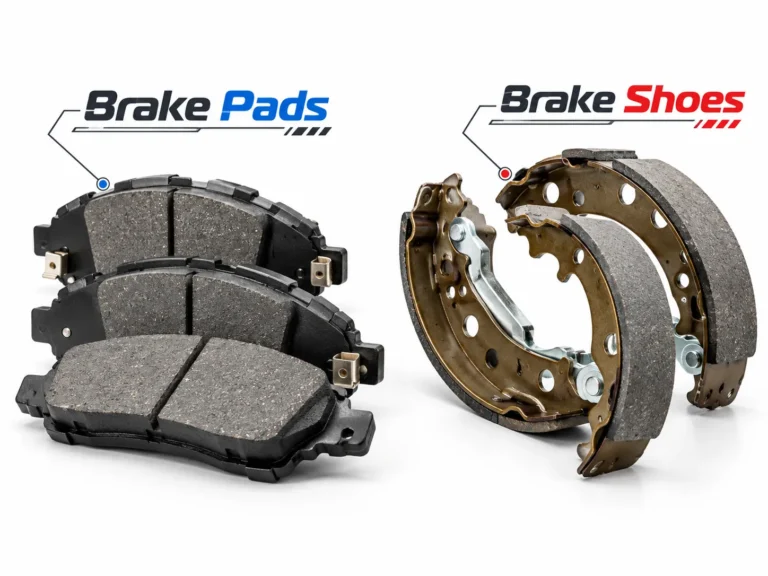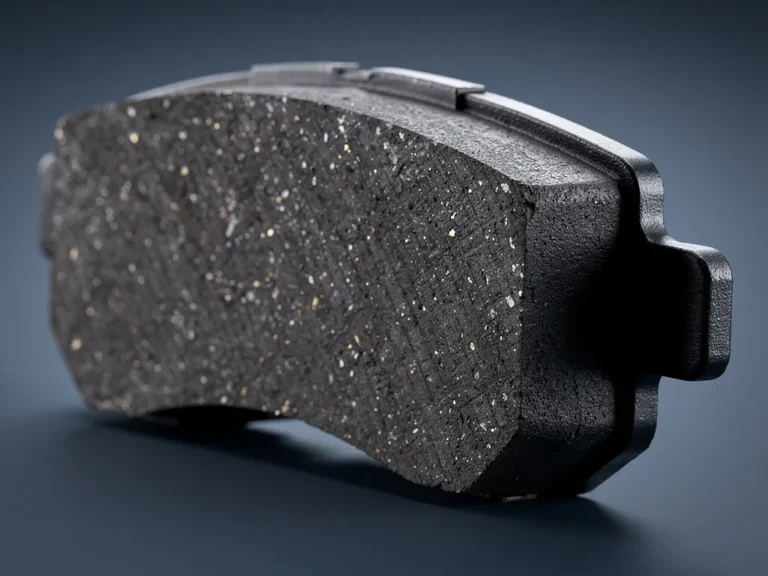

Economy vs premium brake pads is rarely a question of “cheap versus good.” Brake pad grades describe what a pad is designed and tested to do: economy pads meet a price point and basic fitment, premium pads add comfort and performance features, and OE-equivalent pads are built and verified against a defined original-equipment requirement. For a distributor, the right grade is the one your customers will buy, install and not bring back.
This guide is written for auto parts stores, repair shops and warehouse distributors that buy brake pads by the carton. It explains what separates the three grades in materials, construction and testing; how each grade performs on noise, dust, rotor wear and fade; how grade choice changes landed cost, margin and warranty exposure; how to verify quality before a bulk order; and how to build and order a mixed range without tying up cash in slow stock.
Our Qingyuan factory makes ceramic, semi-metallic and low-metallic pads for programs at all three grades, plus rotors and shoes; the production notes and order-planning examples below are drawn from that work.
Three Grades Side by Side
01
What Are the Differences Between Economy, Premium, and OE-Equivalent Brake Pads?
Economy, premium and OE-equivalent brake pads differ in their design target, not just their price. Economy pads aim for correct fit and safe braking at the lowest cost. Premium pads add features that improve noise, dust, feel and life. OE-equivalent pads are specified against a particular original-equipment pad and verified to match its friction level, construction and features. The grade label only means something when the supplier can show what is behind it.
There is no industry standard that defines “economy,” “premium” or “OE-equivalent.” Each brand and each supplier draws the lines differently, which is why two “premium” lines from different suppliers can perform very differently. Use the descriptions below as a framework, then ask every supplier to show, part number by part number, what their grade label actually includes.
In practice, the economy vs premium brake pads decision comes down to four questions: which features are included, which tests were run, how close the friction level is to OE, and how consistently the supplier makes the same pad batch after batch. Quality brake pads exist at every grade; what changes between grades is the feature set and the depth of evidence, not whether basic safety is met.
Economy Brake Pads: Price-Focused Products
Economy brake pads are built to a price. They use a friction formula and construction that fit the vehicle and stop it safely under normal use, with fewer features that add cost.
What is typically reduced or removed in economy brake pads:
- Noise-control parts: no shim, a single-layer shim or a painted insulator instead of a multilayer shim; fewer chamfers or slots.
- Hardware: abutment clips and anti-rattle springs often not included.
- Friction material: a cost-optimized formula, often semi-metallic or a basic NAO/ceramic blend, with less tuning for noise and dust.
- Testing depth: dimensional checks and basic friction testing, but less dynamometer and NVH work per application.
- Packaging: plain boxes, fewer installation instructions.
What should never be reduced, whatever the price: correct dimensions, bond strength between the friction material and the backing plate, and a friction level suited to the application. An economy pad that fails on any of those is not an economy pad; it is a defective one.
Ask What the Economy Line Leaves Out
Ask the supplier which features are removed from the economy line compared with its premium line. A supplier that cannot answer clearly may be cutting costs in places you cannot see.
Premium Brake Pads: Performance and Comfort
Premium brake pads add features that customers notice: quieter stops, cleaner wheels, a firmer pedal and longer life. In most aftermarket programs, the premium line is where the supplier’s best friction formulas and noise-control parts are used.
Features that usually define premium brake pads:
- Tuned friction formulas: low-dust ceramic, low-metallic for European applications or refined semi-metallic for trucks.
- Multilayer shims: rubber-coated or steel-rubber-steel shims, often mechanically attached.
- Chamfers and slots: cut to reduce squeal and to let gases and debris escape.
- Hardware included: clips and springs in the box.
- Wear indicators: acoustic or electronic, matching the vehicle.
- More test data: friction, wear and noise results available per compound.
Premium does not automatically mean “closest to OE.” A premium ceramic pad may deliver less dust than the OE low-metallic pad it replaces, but it will also change pedal feel. That trade-off can be a selling point, as long as the counter explains it.
OE-Equivalent Brake Pads: Matching Defined OE Requirements
OE-equivalent brake pads are designed to match a specific original-equipment pad: the same friction type and level, the same backing plate, shim, chamfer, slot and wear-indicator configuration, and comparable performance under defined tests. The word “equivalent” is a claim, and it should be supported by comparison data against the OE part.
OE-equivalent is not the same as OEM or OES:
- OEM brake pads are the pads fitted by the vehicle manufacturer at the factory.
- OE brake pads or OES pads are the same parts sold through the vehicle manufacturer’s service channel.
- OE-equivalent brake pads are aftermarket brake pads built to match the OE pad’s specification and performance.
In Europe and other markets that apply UN Regulation No. 90, approved replacement pads must perform within defined limits relative to the original equipment parts. That is the closest thing the aftermarket has to an official definition of “OE-equivalent” performance, and it applies per approved part number.
Comparison Table: Cost, Performance, Durability, and Target Market
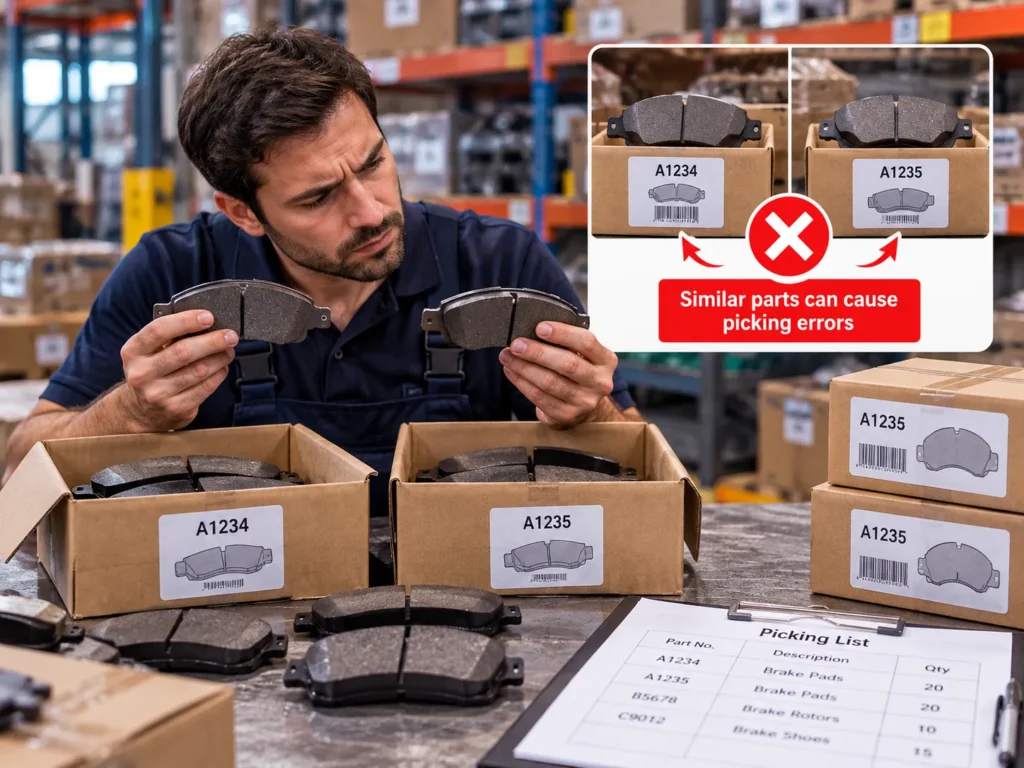
For the products behind these grades—ceramic, semi-metallic and low-metallic formulas, application coverage and packaging options—see our brake pads range.
02
How Do Brake Pad Grades Compare in Performance?
In a brake pad performance comparison, grade affects consistency more than peak stopping power. A correctly specified economy pad can stop a car as well as a premium pad in a single test. The differences appear over repeated stops, at high temperature, at low speed and over thousands of miles: fade resistance, friction stability, noise, dust and rotor wear. Those differences come from the formula, the construction and how consistently the factory makes both.
Where a Grade Is Really Decided
At our brake components factory in Qingcheng District, Qingyuan, China, in operation since 2014, we run three production lines covering brake pads, rotors and shoes. Our combined daily capacity exceeds 2,500 components, with a workforce of about 60 people.
In brake pad production we control friction-material mixing, hot pressing, curing, grinding and chamfering in-house, because manufacturing consistency matters more than an Economy or Premium label. A grade only means something if every batch of that grade comes off the line with the same formula, density, cure and geometry as the approved sample.
Braking Performance, Heat Resistance, and Friction Stability
Three properties decide how a pad grade performs under load:
- Friction level: the coefficient of friction, usually printed as a two-letter edge code. Under the SAE J866 coding, F covers μ 0.35–0.45. A replacement pad should sit close to the friction level of the OE pad, whatever its grade.
- Heat resistance: how well friction holds during repeated hard stops. When friction falls with temperature, the driver feels fade.
- Friction stability: how much friction changes with speed, pressure and temperature. Stable friction means predictable pedal effort.
Peak stopping power is rarely where economy vs premium brake pads differ. Premium and OE-equivalent pads usually differ from economy pads in the third point. A low-cost formula may meet a cold friction target but lose more friction when hot, or vary more from batch to batch. For buyers, that means a single friction number on a datasheet is not enough. Ask for friction across temperature and for fade and recovery results.
Putting Friction Targets in Writing
Write the target edge code and ask for the test method, for example: “Edge code [FF]; friction per SAE J661; fade and recovery per SAE J2522 dynamometer report for compound [XXX].”
Noise, Dust, and Rotor Wear
Noise, dust and rotor wear are where customers notice grade differences first, and where most comebacks start.
- Noise: stiff, abrasive formulas excite vibration in the pad, rotor and caliper. Shims, chamfers and slots damp or break up that vibration. Economy pads often save cost here.
- Dust: iron-rich and abrasive formulas leave more dark dust on wheels. Low-dust ceramic formulas are common in premium lines.
- Rotor wear: abrasive and metal-rich formulas remove more rotor material. Pairing a cheap aggressive pad with a soft rotor shortens rotor life quickly.
Grade does not decide noise on its own: in one of our NVH projects, a change of chamfer and shim—with the same friction material—cut low-speed squeal from most stops to almost none, as described in our guide to brake pad shims. That is why the noise-control specification belongs on the purchase order for every grade.
Ceramic vs Semi-Metallic vs NAO Friction Materials
Friction material and grade are separate decisions. Every friction family can be made at economy, premium or OE-equivalent level.
Friction Family First, Grade Second
Choose the friction family by vehicle and duty first, then choose the grade by customer and price. Ceramic does not mean premium, and semi-metallic does not mean economy.
For a full head-to-head of the two most common families, see Ceramic vs Semi-Metallic Brake Pads: 8 Key Differences. For European applications, our guide What Are Low-Metallic Brake Pads? explains why many of them need a high-friction pad.
03
Which Brake Pad Grade Should Distributors Choose for Their Market?
Choose the grade by who installs the pad, what vehicles they work on and what a comeback costs them. Price-driven retail and older vehicles suit economy lines. Customers who complain about noise and dust pay for premium. Repair shops, fleets and late-model vehicles—where a comeback costs more than the pad—need OE-equivalent pads. Most distributors serve all three groups and need a clear rule for which grade each part number gets.
Economy Grades for Price-Sensitive Markets
Economy grades fit markets where the buyer compares shelf prices and the vehicle is older or lower in value.
Good fits for economy brake pads:
- Cash retail customers doing their own brake jobs on older vehicles.
- Markets where the average vehicle age is high and price competition is strong.
- Secondary vehicles and low-mileage use.
- Promotional lines that bring customers into the store.
Where economy is a risky fit:
- Late-model vehicles with electronic wear sensors and tight NVH expectations.
- Fleets, taxis and delivery vehicles that brake constantly.
- Shops that give labor warranties, because one comeback erases the price saving.
Economy Minimums That Never Move
Keep correct fitment, a documented friction class and bond strength testing as non-negotiable minimums for economy brake pads. Only noise and comfort features should be optional.
When you source economy brake pads for distributors’ own catalogs, write the minimum specification down before asking for prices. Suppliers quoting against a vague request will meet the price by removing whatever you did not ask for. A one-page economy specification—compound type, edge code range, backing plate thickness, shim or insulator type, shear test per batch and box marking—lets you compare quotes on the same basis and keeps the cheapest quote from also being the weakest pad.
Premium Grades for Customers Seeking Higher Performance and Comfort
Premium brake pads suit customers who notice the difference and will pay for it: owners of newer passenger cars and SUVs, drivers who complain about wheel dust, and shops whose customers expect a quiet car after a brake job.
Where premium brake pads earn their price:
- Late-model passenger cars where noise complaints are common.
- European cars whose owners want less dust than the OE low-metallic pad.
- Shops that sell a “better” option at the counter and need a clear reason to recommend it.
Premium must be visible to sell. Make the features obvious on the box and in the catalog: low-dust formula, multilayer shim, hardware included, wear sensor included. A premium pad that looks like an economy pad on the shelf will be priced like one.
OE-Equivalent Grades for Buyers Requiring Verified OE-Level Performance
OE-equivalent grades are for buyers who need the vehicle to behave exactly as it did when new: repair shops that warranty their work, fleet maintenance departments, dealership-adjacent service and distributors supplying them.
When OE-equivalent is the right choice:
- The vehicle is late-model and under or near its original warranty period.
- The shop wants to avoid any change in pedal feel, noise or dust behavior.
- The fleet tracks cost per mile and needs predictable pad life.
- The market requires ECE R90 approval, which compares replacement pads with the original parts.
An OE-Equivalent PO Line
“OE-equivalent grade; friction type and edge code to match OE part [number]; shim, chamfer, slot and wear indicator per OE configuration; OE comparison data to be supplied for each part number.”
04
How Do Brake Pad Grades Affect Distributor Profit Margins?
Brake pad profit margins depend less on the unit price than on landed cost, sell-through and returns. Economy pads usually have the lowest landed cost but the thinnest gross margin per set and the highest return exposure. Premium pads usually carry the best margin per set if customers see the value. OE-equivalent pads earn their margin through low comeback rates and repeat business from shops and fleets.
Purchase Price, Landed Cost, and Gross Margin
Landed cost is what a set really costs you on the shelf.
Calculate it before comparing grades
- Start with the unit price from the supplier, per set, at your order quantity.
- Add freight per set: total ocean or air freight divided by the number of sets in the shipment.
- Add duty and import fees according to the tariff classification and origin rules for your market.
- Add inland freight, handling and warehousing to your distribution center.
- Add packaging or labeling costs if private-label boxes are produced separately.
- Divide the total by sellable sets after allowing for damaged or unsellable units.
- Compare gross margin for each grade: (selling price − landed cost) ÷ selling price.
A simple illustration with assumed numbers shows why the lowest price is not always the best margin:
Margin after returns = gross margin per set − (return rate × selling price), assuming a returned set is credited in full. These are worked examples to show the calculation, not market prices. Replace them with your own quotes, freight and selling prices.
Inventory Turnover and SKU Selection
Good brake pad SKU management decides whether a grade makes money. A grade with a strong margin but slow sales ties up cash; a grade with a thin margin but fast turns can still be profitable.
How to set grade by SKU
- Export 12 months of sales by part number and rank SKUs by units sold.
- Split the list into fast movers (top 20% of units), medium movers and slow movers.
- Give fast movers two grades where demand supports it, usually economy plus premium or premium plus OE-equivalent.
- Give medium movers one grade that matches the main customer group for that vehicle.
- Keep slow movers in one grade only, usually OE-equivalent for late-model vehicles or economy for older ones.
- Review every six months and move SKUs between grades based on sell-through and returns.
Warranty Claims and After-Sales Costs
The cost of a warranty claim is rarely the pad. It is the shop’s labor, the customer’s lost trust and your time handling the claim.
Typical claim causes by grade:
Watch Returns by Grade
Track returns by SKU and by grade every month. A grade that looks profitable on paper but returns 5% of units is costing more than it earns.
A simple claim routine keeps after-sales costs under control and gives your supplier evidence it can act on
- Collect the returned pads, the box and the repair order, not just a photo.
- Record the part number, grade, batch code and vehicle (year, make, model, mileage at installation and at complaint).
- Classify the complaint: noise, dust, short life, fitment, or a physical defect such as cracking or delamination.
- Check installation factors before blaming the pad: rotor condition, slide pins, shims, bedding.
- Group claims by batch code each month; three similar claims from one batch justify a formal report to the supplier.
- Agree the remedy in writing with the supplier—credit, replacement or corrective action—and confirm the fix on the next batch.
For counter-level tactics that reduce brake comebacks and returns in a parts store, see our auto parts store solutions.
05
How Can Distributors Verify Brake Pad Quality Before Bulk Ordering?
Verify brake pad quality in three layers before the first bulk order: test data for the compound and the part, documented certification and approvals that match your market, and physical samples checked against OE references. A grade claim is only useful if the supplier can show test results for that grade and part number, and if the samples you approve are the same as the pads you receive later.
Friction, Wear, NVH, and Shear Strength Testing
Brake pad quality testing should cover four things, whatever the grade:
According to ISO 6312, the shear test for disc brake pad assemblies applies a load until the friction material separates from the backing plate and records the force at failure. As described in ISO 6310, compressive strain testing measures how much the lining compresses under a defined pressure. Both should be run per production batch, not only on the approved sample, because bonding and density are where cost-cutting first shows up.
Same Test, Same Bedding: Lessons From Metals (2023)
In February 2023, researchers published a comparative brake friction study in Metals (13(2), Article 300), examining friction behavior on an SAE J2522 (AK Master) based dynamometer protocol. The bedding procedure braked from 80 to 30 km/h at pressures varying between 15 and 51 bar, from an initial temperature of 100 °C, in 6 cycles of 32 brake applications—192 applications in total.
The researchers repeated the full bedding twice, for 384 brake applications per friction pair. With a grey cast iron disc and a standard ECE pad, friction rose step by step through the first 192 applications before settling at about 0.50–0.54; with the coated disc, friction was still not stable after 384 applications. For buyers comparing grades, the lesson is simple: friction results are only comparable when bedding and test conditions are the same.
When you compare two suppliers’ data, check that both used the same test method, the same bedding and the same rotor type. A “higher” friction figure from a shorter bedding is not a better pad.
ISO 9001, ECE R90, and Relevant Compliance Requirements
Certificates prove different things, and buyers often confuse them:
- ISO 9001 or IATF 16949 shows that the factory runs a certified quality management system. It does not prove that a specific pad performs well.
- ECE R90 brake pads are approved for specific replacement applications after type testing against the original parts. The approval covers the listed part numbers only, not the factory or the whole range.
- U.S. market requirements typically include friction material registration with its edge code and copper-content compliance, documented per formulation.
A small number of our part numbers hold ECE R90 approval. For R90 markets we confirm coverage part number by part number before you order, because an R90 approval on one reference says nothing about another.
Reading a Certificate Properly
For each certificate, confirm the holder name, the site address, the scope and the validity date. For each product approval, confirm the part numbers listed.
You can see the certificates and approvals we hold, with their scope, on our certifications page.
Sample Testing and OE Reference Verification
Samples are where grade claims become measurable. Before ordering in bulk, check samples against your references and against the supplier’s own data.
What an FMSI Number Does—and Doesn’t—Prove
Founded in 1948 and headquartered in Auburn Hills, Michigan, the Friction Materials Standards Institute (FMSI) maintains a standardized part numbering system for brake friction products. FMSI numbers let manufacturers, distributors and repair shops reference the same pad shape across catalogs and brands.
For economy, premium and OE-equivalent programs alike, an FMSI reference confirms fitment identity, not performance. Two pads with the same FMSI number can carry very different friction materials, shims and test results, so grade claims always need separate technical evidence.
Step-by-step sample verification
- Send your reference list with OE and FMSI numbers, target grade and market for each SKU.
- Order samples for your top-selling SKUs in every grade you plan to stock.
- Check dimensions against the OE pad or drawing: backing plate outline, thickness, friction thickness, chamfers and slots.
- Check features against the grade definition: shim type, hardware, wear indicator and markings.
- Read the edge code and batch code on every sample and match them to the supplier’s test reports.
- Fit-test two or three samples on real vehicles in a partner shop, including bedding and a low-speed noise check.
- Approve in writing with the compound code, grade definition and packaging artwork, and keep one approved sample as your reference for future batches.
For a complete supplier check—business license, factory audit, certificates, test reports and batch records—follow the seven checks in How to Verify a Chinese Brake Pad Manufacturer.
06
Should Distributors Stock Multiple Brake Pad Grades?
Most distributors should stock more than one brake pad grade, but not every grade for every SKU. A good-better-best range lets the counter match price to customer, keeps price-sensitive buyers in the store and sells up where the vehicle and customer justify it. The risk is inventory: three grades across hundreds of part numbers multiply stock. The answer is to assign grades by SKU and order them together in mixed-SKU orders.
Building an Economy, Premium, and OE-Equivalent Product Range
A practical three-grade range follows a few rules:
- One clear promise per grade. Economy: correct fit at the best price. Premium: quieter, cleaner, hardware included. OE-equivalent: matches the original pad.
- Visible differences on the box. Customers and counter staff should see the difference without opening the box.
- Consistent friction logic. Within each grade, use the same friction family for similar vehicles so behavior is predictable.
- Documented specifications. Every SKU in every grade has a written spec: compound, edge code, shim, hardware, wear indicator, packaging.
- A clear price ladder. Counter staff need a simple reason to recommend the next grade up, and the price step should match the visible difference.
For brake pads for distributors that supply both shops and retail customers, the range usually works best when economy and premium cover the widest part of the catalog and OE-equivalent is limited to the vehicles where shops ask for it by name. That keeps the number of stocked SKUs manageable while still giving the counter a complete answer for every customer type.
September 2026: Planning a 30-SKU, Three-Grade Order
In September 2026, our sales and production teams in Qingyuan, Guangdong, China, evaluated a proposed 30-SKU brake pad purchasing program for a U.S. aftermarket distributor. The illustrative plan allocated 15 SKUs to Economy, 10 to Premium and 5 to OE-Equivalent, with 100 sets per SKU and a total purchase quantity of 3,000 sets.
Using a 25–35-day mixed-SKU production lead time, the model showed how a distributor can cover price-driven, comfort-driven and OE-driven customers in one order, while keeping the inventory investment for the OE-equivalent grade limited to the five part numbers where shops actually ask for it.
Matching Product Grades to Vehicle Coverage and Customer Demand
Assign grades with a simple matrix: vehicle age on one axis, customer type on the other.
Step-by-step, building the range from your sales data
- Tag each SKU with vehicle age and the main customer type buying it.
- Apply the matrix to give each SKU one or two grades.
- Check coverage: make sure each grade covers your top vehicles, not only a few.
- Check price ladders: premium should sell at a clear step above economy, and OE-equivalent close to premium.
- Set reorder points per grade, with lower safety stock for the grade that sells least.
Managing Mixed-SKU Orders and Inventory Risk

Mixed SKU brake pad orders are how a multi-grade range stays affordable. Instead of ordering each grade from a different supplier at high quantities, one order combines all grades and part numbers you need.
How to manage inventory risk with mixed orders
- Order fast movers in larger quantities and slow movers in smaller trial quantities within the same order.
- Keep grades on the same compound code across reorders so a new batch behaves like the last one.
- Stagger orders so the next mixed order arrives as safety stock runs down, using the supplier’s lead time.
- Track sell-through by grade and cut grades that do not sell for a given SKU.
- Keep batch codes on every box so a quality issue can be isolated to one batch instead of a whole grade.
We accept mixed orders across brake pads, rotors and shoes from 100 sets per order in total, with a lead time of 25–35 days for mixed orders.
07
What Should Distributors Look for in a Brake Pad Manufacturer?
Look for a brake pad manufacturer that can make every grade consistently, prove it with records, and support you with packaging, data and realistic order terms. Consistency is the main requirement: a supplier whose economy and premium lines both drift from batch to batch is worse than one with fewer grades made the same way every time. Batch traceability, private-label capability and clear MOQ and lead times come next.
Consistent Manufacturing Quality and Batch Traceability
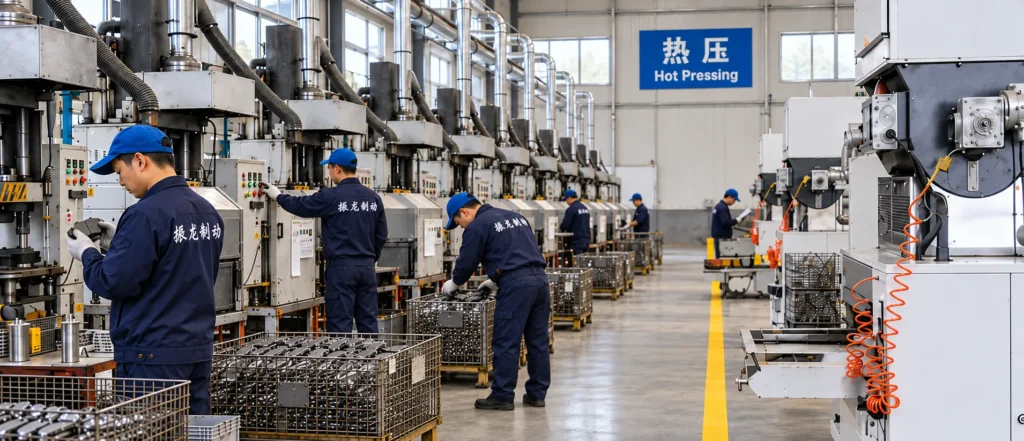
Grade consistency depends on process control at every stage: incoming raw materials, mixing, pressing, curing, grinding and final inspection. Ask brake pad suppliers how each stage is controlled and recorded.
What Two-Stage ISO 9001 Audits Look For
Our manufacturing operation in Qingyuan, Guangdong, China, holds ISO 9001 among its quality certifications. As the ISO 9001 Auditing Practices Group guidance on two-stage initial certification audits (ISO and IAF, January 13, 2016) explains, Stage 1 reviews the documented quality management system and readiness, and Stage 2 evaluates how the system is implemented in practice.
For our brake pad production, the evidence that matters most at Stage 2 is the same evidence a buyer should ask for: material identification, production inspections, control of nonconforming product and batch traceability from raw material to finished box.
What batch traceability should look like:
- A batch or date code printed on every pad and every carton.
- Records linking that code to the friction mix, press settings, cure profile and inspection results.
- Retained samples from each batch for a defined period.
- A procedure for isolating and recalling one batch if a defect appears.
WorkSafe Victoria’s 2025 Asbestos Alert
On November 28, 2025, WorkSafe Victoria issued a safety alert after asbestos was found in imported brake pads used in wind turbine lift motors and hoists. Asbestos has been banned in Australia since the end of 2003, and the regulator warned that some overseas manufacturers still use low levels of asbestos even in products described as “asbestos-free.”
These were industrial brakes, not automotive pads, but the lesson applies directly to any distributor buying low-cost friction products: a supplier declaration is not evidence. The regulator told importers to require certification from the manufacturer, obtain product test results and set up testing before shipping and before installation. For economy brake pads, where cost pressure is highest, material testing and batch records protect your business as much as your customers.
You can see how we apply incoming, in-process and final checks from raw materials to shipment in our quality inspection process.
Private-Label Packaging and Product Customization
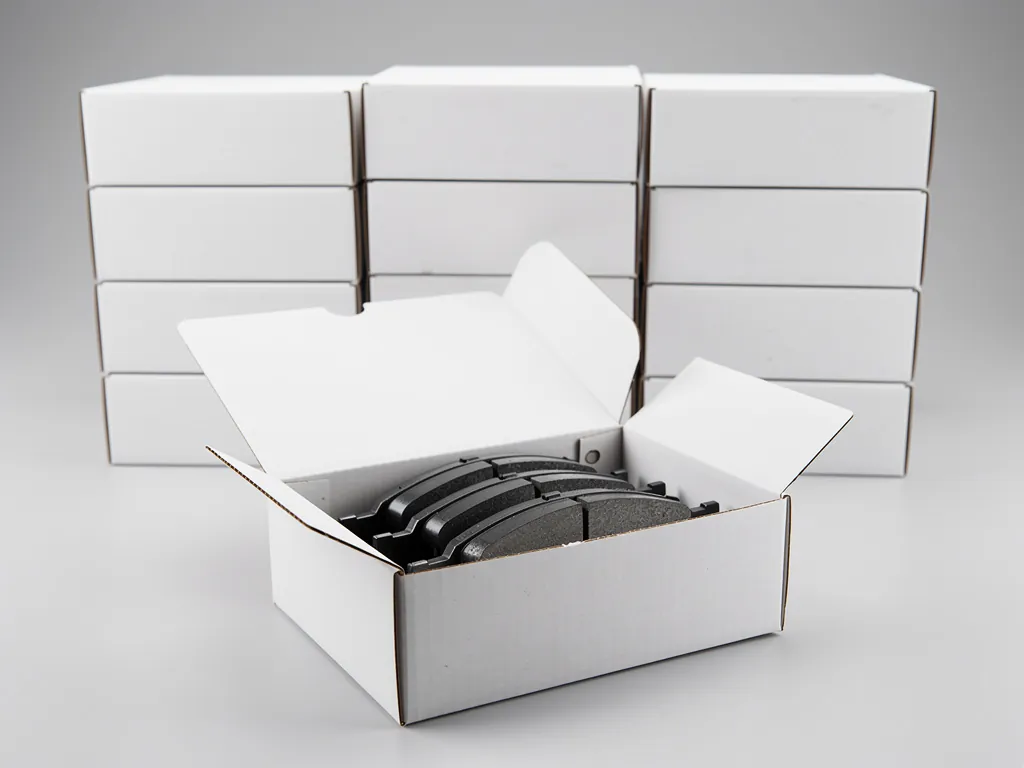
Many distributors sell private label brake pads under their own brand, often with a separate box design for each grade.
Confirm these points with the manufacturer
- Box artwork per grade, with clear grade naming and feature callouts.
- Label content: part number, application, grade, edge code, batch code and barcode.
- Inserts and instructions in the languages of your market.
- Hardware and accessories packed per grade definition.
- Approval process: printed proof, sample box and written approval before production.
- Consistency: the same packaging specification on every reorder.
A Private-Label Box, Specified
“Private-label box, [brand] artwork version [X], grade [Premium]; label with part number, application, edge code, batch code and EAN/UPC; hardware kit included; packed 1 set per box, [N] boxes per carton.”
MOQ, Lead Times, and Technical Support
For wholesale brake pads, order terms decide whether a multi-grade range is practical:
Our terms are designed for mixed, multi-grade programs: mixed orders from 100 sets per order across pads, rotors and shoes, and 25–35 days lead time for mixed orders. Our team can prepare a cross-reference and a grade proposal for your SKU list before you order.
Send your part list and target grades, and we will map each reference to a friction type and grade from our brake pads range.
08
Frequently Asked Questions About Brake Pad Grades
Are Premium Brake Pads Always Better Than Economy Brake Pads?
No. Premium brake pads add comfort and performance features, but a well-made economy pad with the right friction level can be the better choice for an older vehicle or a price-driven customer. What matters is that the grade matches the vehicle, the duty and the customer’s expectations.
Are OE-Equivalent Brake Pads the Same as OEM Brake Pads?
No. OEM brake pads are the parts fitted by the vehicle manufacturer. OE-equivalent brake pads are aftermarket brake pads built to match the OE pad’s friction, construction and features. Ask for comparison data against the OE part to support the claim.
Can Ceramic Brake Pads Be Economy Grade?
Yes. Ceramic is a friction family, not a grade. Economy ceramic pads use a basic formula and fewer noise-control features; premium ceramic pads use tuned low-dust formulas, multilayer shims and included hardware.
Which Brake Pad Grade Is Most Profitable for Distributors?
Usually premium, because it carries the best margin per set when customers see the value. But profitability depends on landed cost, sell-through and returns, so calculate margin after returns for each grade and SKU.
Do Premium Brake Pads Last Longer?
Often, but not always. Premium ceramic pads usually last longer in daily driving than economy semi-metallic pads, but pad life depends mostly on vehicle weight, driving style and the friction formula.
What Does “OE-Equivalent” Mean on a Brake Pad Box?
It means the supplier claims the pad matches the original-equipment pad in fit, friction and features. There is no universal standard for the term outside approvals such as ECE R90, so ask what tests support it.
How Should Distributors Test Brake Pad Samples Before a Bulk Order?
Check dimensions and features against the OE pad, match edge and batch codes to the supplier’s friction, wear, noise and shear reports, then fit-test samples on real vehicles before approving them in writing.
Can I Mix Brake Pad Grades in One Wholesale Order?
Yes, if the supplier accepts mixed-SKU orders. We accept mixed orders across grades, brake pads, rotors and shoes from 100 sets per order, with 25–35 days lead time.