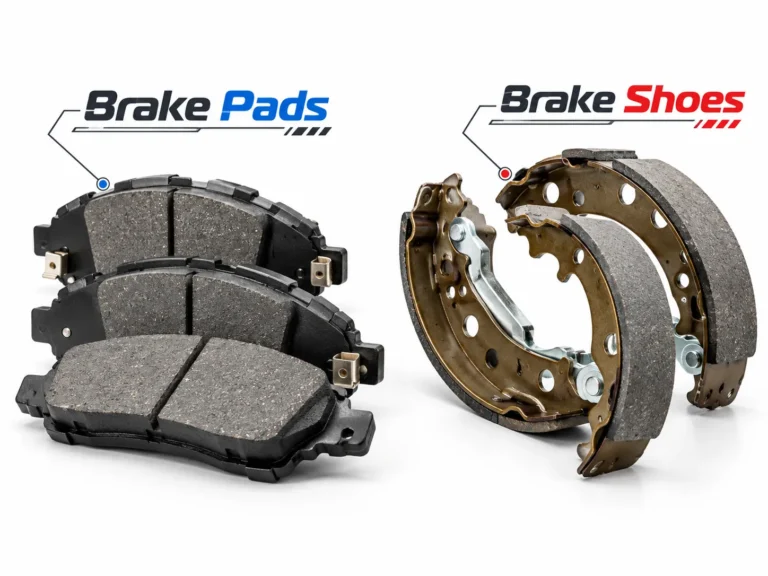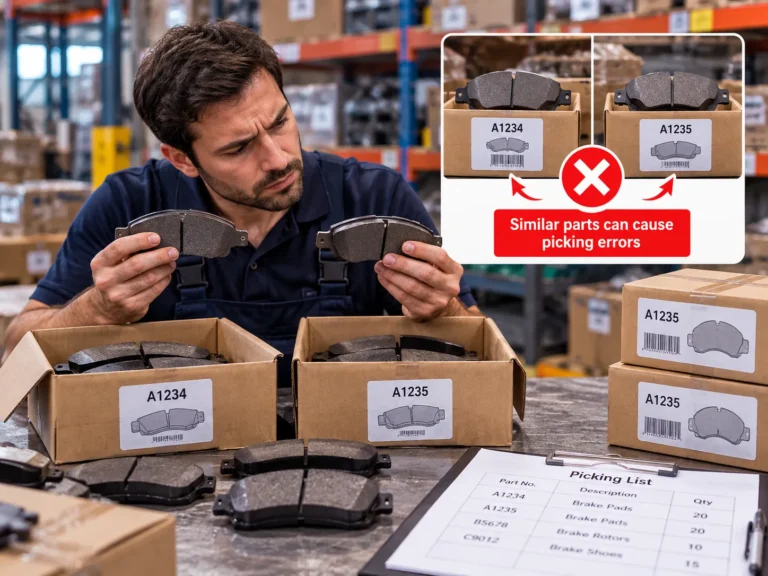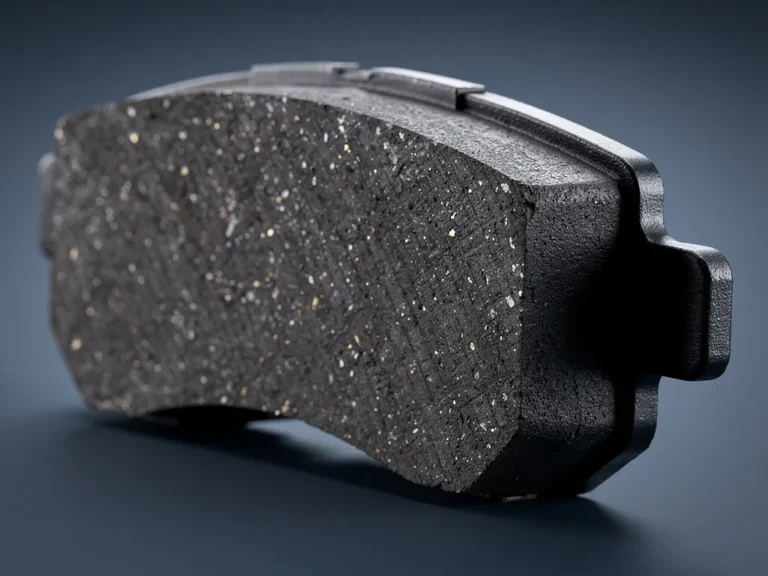

To verify a Chinese brake pad manufacturer, check seven things in order: the legal entity behind the quote, the factory that actually presses the pads, its capability for your part numbers, the certificates and approvals for those exact parts, test reports that match an approved sample, the controls that keep bulk production identical to that sample, and the order terms that decide what happens when something goes wrong. Each check has a document or a record behind it, and each record can be compared with something independent: an official registry, a certification database, a measurement you take yourself.
This guide is written for auto parts stores, repair shops and warehouse distributors who buy brake pads from China and want a repeatable way to separate real brake pad manufacturers from sellers who only look like one. It explains what each document means, what it does and does not prove, how to check it step by step, and what to write into your purchase order so the answer stays true after the deposit is paid.
Importers audit our pad, rotor and shoe lines most months, so we see these checks from the other side of the table; the audits and records described here come from that work.
The Seven Checks in One Table
01
How Do You Verify a Chinese Brake Pad Manufacturer?
The short answer to how to verify a Chinese supplier is to stop judging the supplier by what it says and start judging it by what it can show and what you can check. A website, a catalog and a factory video are claims. A business registration record, a certificate number in an official database, a batch code that leads to a production record, and a sample you measured yourself are evidence.
The order matters. Identity comes first because every later document must carry the same company name. Manufacturing and capability come next because there is no point reviewing test reports from a seller who cannot make your parts. Certificates, reports and samples then establish what “good” looks like, and the last two checks make sure every shipment matches it. Brake pad quality is decided by the friction formulation, the pressing and curing process and the consistency of both, so a verification plan that stops at the sample stage is only half finished.
A Quick Manufacturer Verification Checklist
Use this checklist as a supplier audit checklist for any new brake pad supplier; it is the quickest way to verify Chinese brake pad manufacturer claims against independent records. Each line should end with a document in your file, not a verbal answer.
Brake Pad Manufacturer Verification Checklist
✓Chinese legal name and 18-character unified social credit code match the contract, the invoice and the bank account
✓Registration status is active and the business scope includes manufacturing of brake or friction products
✓Production address is a real factory and matches the certificates
✓Live walkthrough shows mixing, hot pressing, curing, grinding and packing for your part numbers
✓Outsourced operations are named and controlled
✓Your OE, FMSI and aftermarket references are confirmed against drawings or samples
✓IATF 16949 or ISO 9001 certificate is valid and its scope and site match the factory
✓Product approvals such as ECE R90 cover your exact part numbers
✓U.S. compliance is documented: AMECA edge code registration and LeafMark copper level
✓Test reports match the formulation and sample batch you approved
✓A golden sample and a written specification are signed by both sides
✓Batch codes link to production and inspection records
✓Pre-shipment inspection criteria and the claim procedure are written into the PO
Documents and Evidence to Request Before Ordering
Ask for these documents before you pay a deposit. A genuine factory can provide most of them within a few days; the ones it cannot provide tell you where to look harder.
One Name, One Address, Every Document
Every document should carry the same legal name and the same production address. When names change between the license, the certificate and the bank account, stop and ask why before you go further.
02
1. Verify the Manufacturer’s Legal Identity
Most supplier problems start with a company that is not the company you think it is. In China a trading company, a group company, a factory and an export agent can all use similar English names, and the English name on a website has no legal standing. The Chinese registered name and the unified social credit code do.
Check the Chinese Business License and Registered Company Name
Every company registered in mainland China has a business license (营业执照) showing its Chinese legal name, its 18-character unified social credit code, its legal representative, its registered capital, its date of establishment, its registered address and its business scope.
Check the license step by step
- Ask for a clear scan or photo of the full license, not a cropped image of the company name.
- Copy the Chinese legal name and the unified social credit code exactly as printed.
- Read the business scope (经营范围). A manufacturer’s scope normally includes words for production or manufacturing (生产 or 制造) of brake parts, friction materials or auto parts. A scope that only lists sales, import and export, or technical services describes a trading company.
- Note the date of establishment. A company founded last year that claims twenty years of brake pad experience needs to explain the history, for example a new legal entity for an older factory.
- Keep the scan in your supplier file. You will compare it with every document that follows.
Cross-Check Registration Details and the Production Address
A license can be edited; the official registry cannot. China’s National Enterprise Credit Information Publicity System is the public business registry run by the State Administration for Market Regulation, and anyone can search it by the Chinese legal name or the unified social credit code.
To cross-check the registration
- Search the registry using the unified social credit code from the license.
- Confirm that the Chinese name, the code, the legal representative and the registered address match the license exactly.
- Check the status. It should read as active (存续 or 在业), not cancelled or revoked.
- Compare the registered address with the production address on the IATF 16949 or ISO 9001 certificate and with the address you will visit or see on video.
- If the addresses differ, ask for the reason in writing. A registered office in a city center and a plant in an industrial park can both be legitimate, but the plant should appear on the certificate and in the factory walkthrough.
Confirm the Manufacturer, Exporter and Payment Beneficiary
Three roles appear in an import transaction: the company that makes the pads, the company that exports them and the company that receives your money. In the cleanest case they are the same legal entity. In many legitimate cases they are not, for example a factory that exports through a related trading company, or a group that invoices from one entity and produces in another.
Verify all three
- Ask the supplier to name the manufacturer, the exporter on the commercial invoice and the beneficiary on the bank account.
- Check each name in the registry and ask for the legal relationship between them, such as shared ownership.
- Ask for the exporter’s customs registration and confirm that the exporter name will appear on the commercial invoice and the bill of lading.
- Confirm that the beneficiary account is held in a company name that appears in the contract. Payment to a personal account should end the process.
- Write all three names into the purchase order and the proforma invoice.
Lock the Production Site
Name the manufacturing site and state that production may not move to another site without written approval. This one sentence protects you against the most common form of silent subcontracting.
03
2. Confirm the Supplier’s Manufacturing Operations
A legal entity that is allowed to manufacture is not yet a factory that manufactures your pads. Some brake pad manufacturers in China own presses but buy mixed compound, and some traders show a partner’s plant as their own. This step, the core of any China factory audit, confirms that the critical processes happen under the supplier’s own control.
Request a Live Factory Walkthrough
A live walkthrough, either on site or by real-time video, is the fastest way to confirm manufacturing operations. A pre-recorded video can show any factory; a live call lets you choose where the camera goes.
Run the walkthrough step by step
- Schedule the call for a normal working day and ask the supplier not to stop production for it.
- Start at the gate or the factory sign so you can match the location with the registered and certificate addresses.
- Ask the camera to follow one of your part numbers from raw material to packed box: mixing, preforming, hot pressing, curing, grinding, slotting and chamfering, coating, shim fitting, marking and packing.
- At each station, ask to see the work order or batch card for the parts on the machine.
- Ask an operator, not the salesperson, to explain what is being checked at that station.
- End in the warehouse and ask to open a packed carton so you can read the batch code on the pads.
July 2023: A 30-Part-Number Walkthrough
In July 2023, I guided a warehousing distributor in the United States through our factory in Qingyuan, Guangdong, for a brake pad sourcing project.
I asked the buyer to select 30 part numbers and check their pressing, curing, inspection and packing stages.
We then matched 30 finished-product batch codes to the corresponding production and inspection records.
My advice is to request this evidence trail during an audit, rather than judge manufacturing capability from equipment photos alone.

Verify Mixing, Hot Pressing, Curing and Finishing Processes
These four processes decide brake pad quality. If a supplier controls them, it is a manufacturer; if it does not, it is assembling or reselling someone else’s pads. Here is what each process does and what to ask about it.
The questions that matter are simple: is the formulation code on the mix record the same one you approved? Are press and oven settings written on the work order, or set by memory? Does someone measure thickness on the line, and is that measurement recorded? A factory that controls these steps can answer immediately and show you the paper.
For a closer look at how these stages run in a working plant, our walkthrough of the brake pad manufacturing process at our Qingyuan factory shows each station from mixing to packing.
Identify In-House and Outsourced Operations
No brake pad factory makes everything itself. Backing plates are often stamped by specialist suppliers, shims are usually bought from shim makers, and some factories outsource powder coating. Outsourcing is normal; hidden outsourcing is the problem.
Ask the supplier to complete a simple table and keep it on file:
If Mixing Is Outsourced
If mixing, pressing or curing is outsourced, you are dealing with a trading company or an assembler, whatever the website says. That may still be acceptable, but your verification must then extend to the real producer.
04
3. Verify Capability for Your Required Brake Pads
A real factory can still be the wrong factory for you. A Chinese brake pad manufacturer that specializes in heavy-truck linings may struggle with a passenger-car range, and the reverse is just as common. This step checks whether the supplier can make your references, in your materials and configurations, at the quantities you actually order.
Confirm OE, FMSI and Aftermarket References
Brake pads are identified by three kinds of reference. The OE number belongs to the vehicle maker’s part. The FMSI number is a standardized shape number used across the North American aftermarket; it describes the backing plate outline, so pads from different brands with the same FMSI number fit the same caliper. Aftermarket brand numbers are cross-references to other suppliers’ catalogs.
Confirm references step by step
- Send your part list with OE numbers, FMSI numbers and the vehicle applications you sell.
- Ask the supplier to return each line with its own part number, the matching FMSI number, the friction material type and whether a mold and drawing already exist.
- For any reference without an existing mold, ask for the tooling time and cost before you go further.
- Ask for drawings with key dimensions (length, width, thickness, backing plate outline and hole positions) for a sample of your references, and compare them with OE parts or your current supplier’s pads.
- Flag every line where the supplier changes your requested FMSI number or application. That is where fitment problems start.
Review Friction Materials, Dimensions, Shims and Hardware
Two pads with the same FMSI number can still behave very differently. Ask the supplier to state for each reference: the friction material family (ceramic, semi-metallic, low-metallic NAO), the formulation code, the friction class printed on the edge, the shim type, the wear indicator and any hardware included in the box.

If your range mixes material types, our comparison of ceramic and semi-metallic brake pads explains where each one fits by vehicle and duty, which helps you decide which formulation each reference should carry.
You can see our full range of brake pad specifications and applications, including materials and hardware options, when you prepare your own specification list.
What the Spec Sheet Must Pin Down
List the formulation code, edge code, thickness tolerance, shim type and included hardware for every reference. A spec sheet that only says “ceramic, OE quality” gives the supplier freedom to change all of these.
Assess Capacity for Your SKU Mix and Order Quantities
Capacity is not a single number. A plant can press millions of pads a year and still struggle with 400 SKUs in small quantities, because every reference needs its own mold change, curing batch and packing setup.
The U.S. Aftermarket in Numbers
On June 13, 2025, the Auto Care Association announced its 2026 Auto Care Factbook from Bethesda, Maryland.
The report recorded U.S. light-duty aftermarket sales of $413.7 billion in 2024, an increase of 5.7%.
These figures cover the broader light-duty aftermarket, not brake pads alone, and do not verify any individual supplier.
For a U.S. sourcing project, use this market context alongside your own SKU demand and replenishment requirements.
Source: Auto Care Association — 2026 Auto Care Factbook announcement
Assess capacity for your real order pattern
- Share your SKU list with expected quantities per SKU and per year, split into fast, medium and slow movers.
- Ask for the minimum order quantity per SKU and whether different SKUs can be mixed in one order.
- Ask for the lead time of a standard order and of a mixed-SKU order, and when the clock starts.
- Ask how many molds exist for your list and how many must be made.
- Ask for an example of a past order with a similar number of SKUs, with its batch records.
- Compare the answers with your replenishment cycle. A supplier that only works with large runs of a few references will leave gaps on your shelf.
05
4. Verify Certificates and Product Approval Documents
A certificate scan proves very little until you check who holds it, who issued it, whether it is still valid and what exactly it covers.
Check the Certificate Holder, Issuer, Validity and Scope
Read every certificate for four things: the holder (legal name and site address), the issuer (the certification body or approval authority), the validity (issue and expiry dates, and current status), and the scope (which products and activities are covered).
For IATF 16949, the automotive quality management standard, the check is straightforward. IATF certificates are recorded by the IATF oversight offices, and the IATF Global Oversight website links to the official certificate validity check.
To verify an IATF 16949 certificate
- Ask for the certificate and note the IATF certificate number and the site name and address.
- Search the number in the official IATF certificate check reached through IATF Global Oversight.
- Confirm that the status is valid, not suspended or withdrawn, and that the expiry date matches the scan.
- Confirm that the certified site is the factory you audited, not a sister plant or a group head office.
- Read the scope line. It should describe the design or manufacture of brake pads or friction products. A scope covering only another product does not cover your pads.
- Check that the certification body named on the certificate is one recognized by IATF.
Distinguish Quality Management Certification From Product Approval
This is the most important distinction in this guide. ISO 9001 and IATF 16949 certify a management system at a site. They say how the factory plans, controls and improves its work. They do not say that a particular brake pad meets a particular performance level.
The question of ISO 9001 vs IATF 16949 is therefore a question of depth, not of product approval. IATF 16949 builds on ISO 9001 and adds automotive requirements such as advanced product quality planning, production part approval, failure mode analysis, measurement system analysis and statistical process control. A brake pad supplier with IATF 16949 has accepted a stricter system and stricter audits; one with only ISO 9001 may still be well run, but the system is less specific to automotive parts.
Product approval is different. UN Regulation No. 90 (often written ECE R90) approves replacement brake lining assemblies for specific vehicle applications after type testing. According to the UNECE text of Regulation No. 90, approved replacement pads must perform within defined limits relative to the original equipment parts, and the approval is granted for a defined product, not for a company as a whole.
Which Part Numbers Does the Approval Cover?
Ask “which of my part numbers are covered by this approval?” for every product approval. If the supplier answers with a general certificate rather than a list of part numbers, the approval may not cover your parts.
Match Compliance Documents to Your Products and Target Market
Compliance depends on where you sell: ECE R90 approval matters in Europe and other UNECE markets, while U.S. buyers usually ask for two other things.
The first is AMECA registration. AMECA registers brake friction materials and their edge codes for U.S. compliance programs. The edge code printed on the pad identifies the manufacturer, the formulation and the friction class, so a registered edge code ties the pad in your box to a registered formulation.
The second is copper content. Under the Better Brakes laws in Washington and California, brake pads manufactured from January 1, 2025 must contain less than 0.5% copper by weight. The industry LeafMark symbol shows the level met; three leaves (level N) means the pad meets the 2025 limits. The Washington State Department of Ecology publishes the requirements. In practice most U.S. distributors now ask for copper free brake pads, or at least LeafMark N, across the whole range.
To match compliance documents to your products
- List your target markets for each SKU.
- For Europe and UNECE markets, ask for the R90 approval documents and the list of part numbers they cover.
- For the United States, ask for the AMECA edge code of each formulation and the LeafMark level.
- Check that the edge code on the sample pads matches the registered formulation.
- Ask for an asbestos-free declaration and, for new suppliers, an independent test.
Australia, 2012: Asbestos in Imported Vehicle Parts
In August 2012, about 23,000 Great Wall and Chery vehicles were recalled in Australia after asbestos was found bound in engine and exhaust gaskets.
The problem was found by Australian Customs officers who detected asbestos in imported spare parts, which triggered a safety investigation. Australia had prohibited the import of asbestos since 2004.
For brake buyers the lesson is direct: friction products are one of the oldest uses of asbestos, and a composition declaration is only as good as the testing behind it. Ask for asbestos-free test evidence for each formulation, not a single letter covering the whole catalog.
Source: IndustryWeek — Asbestos Found in Chinese-made Cars in Australia
You can review the certificates we hold, with their validity dates, on our factory and certification information overview, and ask for the certificate numbers so you can check them yourself.
06
5. Review Test Reports and Validate Samples
Brake pad testing turns claims about friction, strength and noise into numbers. A test report is only useful when you know which product it tested, how, and against what limit.
Match Reports to the Product, Formulation and Sample Batch
The most common problem with test reports is not fake data; it is the right data about the wrong product, such as a report on a mature formulation attached to a quote for a cheaper one.
Match every report step by step
- Find the sample identification on the report: part number, formulation code, edge code and sample batch.
- Compare them with the part and formulation you are buying.
- Check the report date. A formulation can change after the test.
- Check who ran the test: the supplier’s own lab, an independent lab or a certification body.
- Ask for the same test on your approved sample if the report covers a different part or batch.
Review Test Methods, Conditions and Results
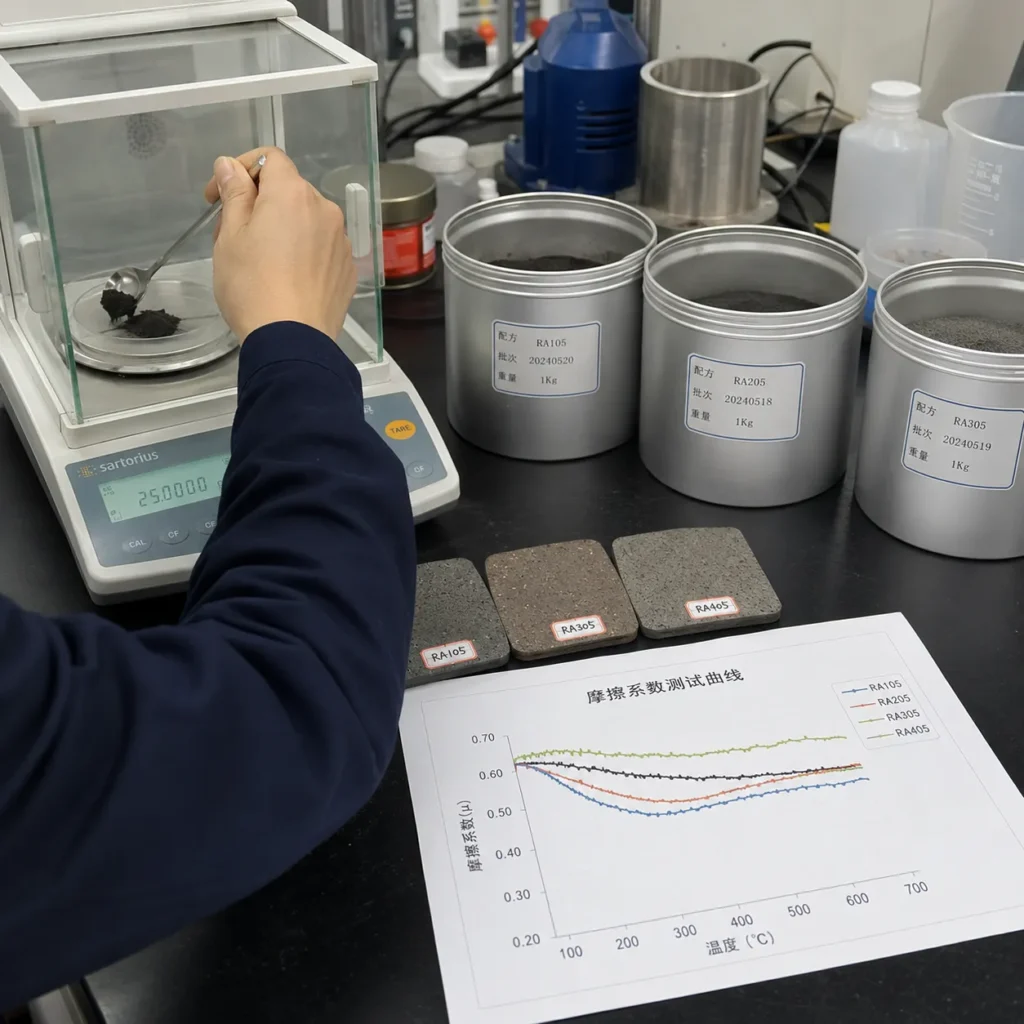
Read the method before the result. A friction coefficient means nothing without the test procedure, the temperature range and the number of stops.
As described by ISO, ISO 26867 defines an inertia-dynamometer procedure for assessing how pressure, temperature and speed influence the friction coefficient of a friction material against a specific rotor or drum, and it is intended for comparing materials under the same conditions or controlling them against a specification. That is exactly how a buyer should use it: compare the report on your approved sample with the report on later batches, under the same procedure.
How Mercedes-Benz StarTuned Reads Edge Codes
In its June 2019 “Friction 2019” article, Mercedes-Benz StarTuned explained brake-pad friction classifications for its technician readership.
Its published table identifies F as a coefficient above 0.35 and up to 0.45, and G as above 0.45 and up to 0.55.
For a brake pad evaluation project, buyers should compare these classifications with the supplier’s supporting test report.
SAE J866 identifies friction classifications; it does not establish a universal brake-pad friction requirement or overall performance rating.
Publication source: Mercedes-Benz StarTuned — Friction 2019, pp. 6–7. Standard reference: SAE J866_201903.

When the Edge Code and the Report Disagree
If the edge code on the sample reads FF but the supplier’s friction report shows values that would place the material in another class, ask which one is correct before you approve anything. A mismatch between the printed code and the measured friction is one of the clearest warning signs in brake pad testing.
For a view of how a working plant organizes these checks, our brake pad quality inspection and testing page shows the measurements made at incoming, in-process and final inspection.
Check Sample Fitment, Dimensions and Product Configuration
Test reports cover performance; your own inspection covers fit. Measure every sample before you approve it.

Check samples step by step
- Compare each sample with the OE part or your current pad for the same FMSI number: outline, ear shape, hole positions and abutment surfaces.
- Measure total thickness and friction material thickness at several points with a micrometer, and check parallelism.
- Check slots, chamfers and the wear indicator position against the drawing.
- Check the shim: type, coverage and bonding. Try to lift an edge with a fingernail; a bonded shim should not peel.
- Read the edge code and batch code on every pad and photograph them.
- If possible, fit one set on a vehicle and confirm that the pads slide freely in the bracket.
- Record everything in a sample inspection report signed by the person who measured.
Approve a Reference Sample and Written Specification
Once a sample passes, turn it into a golden sample: a physical reference set, sealed and labeled, kept by both you and the supplier. The golden sample is what future production is compared against, so it must be identified as carefully as an engineering drawing.
Tie Every Shipment to the Golden Sample
State that every shipment must match the approved golden sample and specification revision, and that any change in formulation, materials, shim, plate supplier or production site requires written approval before shipment.
07
6. Verify Sample-to-Production Consistency
The golden sample proves what the factory can make once. This step proves that it will make the same thing again on every order, and it is where good-looking suppliers most often fail: a Chinese brake pad manufacturer can pass every document check and still drift after the third shipment.
Check Batch Identification and Traceability
Every pad should carry a batch code that leads back to a production date, a press and curing record, the formulation mix and the inspection results. Without it, a quality problem on one SKU cannot be contained, and a claim cannot be investigated.
Test the traceability system yourself
- Pick three finished pads at random, in a warehouse or from a past shipment.
- Read the batch code on each pad and on its box.
- Ask the supplier to produce, for each code, the mixing record, the press and curing record and the final inspection record.
- Check that the formulation code on the mix record matches the approved one and that the dates follow a logical sequence.
- Time the response. A factory with a working system can answer within a day.
Our page on batch traceability and quality control shows how a four-level trace from finished pad back to raw material lots works in practice.
Review Material, Formulation and Component Change Controls
Most consistency problems are not mistakes; they are changes. A resin supplier changes, a fiber becomes expensive and is replaced, a shim supplier is swapped, a press is replaced. Each change can move friction, noise or wear even when dimensions stay the same.

Ask the supplier how changes are controlled:
Ask for a Past Change Notice
Ask to see one example of a past change notification. A supplier that has never issued one either never changes anything, which is unlikely, or never tells its customers.
Confirm In-Process and Pre-Shipment Inspection Requirements
Agree on inspection in writing before production starts. Two levels matter: the checks the factory runs itself, and a pre-shipment inspection by you or a third party.
For the factory’s own checks, ask for the inspection plan: what is measured at incoming, in-process and final inspection, how often, with which gauge and against which limit. For the pre shipment inspection, decide who will do it. Your own staff, a buying agent or a third party inspection company in China can all do the job; what matters is that the inspector works from your specification and golden sample.
A pre-shipment inspection for brake pads should cover the following, step by step
- Quantity and SKU count against the packing list.
- Random sampling by an agreed sampling plan (for example a general inspection level and an acceptable quality limit written into the PO).
- Dimensions of sampled pads against the specification.
- Appearance: cracks, chips, delamination, coating defects, shim position.
- Markings: edge code, batch code, part number on pad and box.
- Comparison of sampled pads with the golden sample.
- Packaging, labeling and carton marks.
- A written report with photos before the balance payment is released.
08
7. Confirm Order Terms and After-Sales Responsibilities
Verification ends where the contract begins. The last step turns what you have checked into commercial terms that both sides sign.
Confirm MOQ per SKU, Lead Times and Payment Terms
Ask the supplier to state its terms in writing and check that they match your order pattern:
Release the balance payment only after the pre-shipment inspection report is accepted. That single rule gives your inspection real consequences.
Before you sign, turn the answers into clauses.
A purchase order for brake pads should include at least the following
- The manufacturing site by name and address, with no change of site without written approval.
- The specification number and revision, and the golden sample reference, for every SKU.
- Quantity per SKU, unit price, currency, trade term and named place.
- Production start date, ship date and the consequence of a delay.
- Payment schedule, with the balance due after an accepted pre-shipment inspection.
- Ownership of tooling paid for by the buyer.
- The claim procedure and the deadline for raising a claim.
Agree on Packaging, Labeling and Acceptance Criteria
Packaging and labeling are part of the product for a parts store or a distributor. A correct pad in a wrongly labeled box is a return.
Write into the specification:
- Box artwork and label content, including part number, application, edge code and batch code
- Barcode type and content
- Hardware and instructions included in the box
- Carton quantity, carton marks and pallet requirements
- Acceptance criteria: the sampling plan, the AQL for major and minor defects, and which defects are critical (for example missing shims, wrong part in box, cracked friction material)
Name the Spec Revision and Sampling Plan
Reference the specification number and revision, the golden sample and the sampling plan by name, so that “acceptable” has the same meaning on both sides.
Define Quality Claim Evidence and Resolution Procedures
Agree on how claims work before you need one. Brake complaints are often caused by installation, rotors or hardware rather than the pads, so both sides need a fair way to decide responsibility.
Define the claim procedure step by step
- List the evidence required for a claim: part number, batch code, photos of pads and box, vehicle details and mileage, rotor condition and a description of the complaint.
- Set a deadline for submitting claims after delivery.
- Set a response time for the supplier’s technical review.
- Agree on the investigation method: retained samples from the same batch, measurement, and retesting where needed.
- Agree on remedies when supplier responsibility is confirmed: replacement, credit or refund, and who pays freight.
09
What Warning Signs Require Further Supplier Verification?
None of the signs below proves that a supplier is dishonest; each means the evidence is not there yet. Honest brake pad manufacturers can explain every one of them with a document.
Unexplained Company Names or Payment Details
If the license shows one name, the certificate another, the invoice a third and the bank account a fourth, ask for an explanation and supporting documents for each link. A sudden request to pay a new account, especially by email, should be confirmed by phone with a contact you already know. Payment fraud through hijacked email is a bigger risk to importers than poor quality.
Manufacturing Claims Without Supporting Evidence
A large factory video, a list of equipment and a claim of “20 production lines” cost nothing to produce. What costs effort is a production record for a specific batch.
April 2025: What a Two-Minute Video Missed
During a conversation in Qingyuan Yili Industrial Park in April 2025, an African distributor told me about a disappointing brake pad order.
Before purchasing 5000 sets across 400 SKUs, the buyer had accepted only a 2-minute video showing finished products.
According to the buyer, 2000 sets later had dimensional discrepancies and unstable friction coefficients, and the supplier could not provide the relevant batch records.
The missed check was simple: the buyer had never connected the products shown on video to production and inspection evidence.
Certificates and Reports That Do Not Match the Products
Watch for certificates issued to a different site, approvals that list other part numbers, test reports on a different formulation, and edge codes on the samples that do not match the friction classification in the reports. Each mismatch has an innocent explanation in some cases; none should be accepted without one in writing.
Unclear Specifications, Inspection or Claim Procedures
A supplier that resists a written specification, will not commit to an inspection plan, or answers questions about claims with “no problem, we will take care of it” is asking you to rely on goodwill. Goodwill rarely survives the first large claim. The best brake pad suppliers usually ask for more detail in the specification, not less, because it protects them as well.
10
Frequently Asked Questions
Can a Trading Company Be a Reliable Brake Pad Supplier?
Yes, if it is transparent about the factory behind it and lets you verify that factory. In the trading company vs manufacturer question, transparency matters more than the label. A good trading company can consolidate SKUs, manage quality and handle communication, but its value depends on the manufacturer it buys from, so ask for the factory’s name and run the same checks on it.
Is ISO 9001 Enough to Verify Brake Pad Quality?
No. ISO 9001 shows that a site has a documented quality management system, not that a specific brake pad performs to your requirements. Combine it with IATF 16949 where possible, product approvals for your market, test reports on your sample and a pre-shipment inspection.
Can a Video Factory Tour Replace an On-Site Audit?
A live video tour can replace a first visit if you control the camera, follow your own part numbers and link the parts you see to batch records. A pre-recorded video cannot. For large programs, an on-site or third-party audit before the first big order is still worth the cost.
Does Every Brake Pad Require ECE R90 Approval?
No. ECE R90 approval is required for replacement pads sold in Europe and other markets that apply UN Regulation No. 90, and it covers specific approved part numbers. For the United States, buyers usually ask for AMECA edge code registration and LeafMark copper compliance instead.
Can Approved Samples Guarantee Consistent Bulk Orders?
No. A sample shows what the factory can make; consistency depends on formulation control, change notification, batch traceability and inspection. Keep a golden sample, write the specification into the PO and inspect before shipment to connect bulk orders back to the sample.
What Documents Should Buyers Request Before Paying a Deposit?
Request the business license and registry record, the IATF 16949 or ISO 9001 certificate with its number, product approvals listing your part numbers, U.S. compliance documents if you sell there, test reports on your sample, a sample inspection report and one example of a batch record.
How Do You Check an IATF 16949 Certificate?
Search the certificate number in the official IATF certificate validity check linked from IATF Global Oversight. Confirm that the status is valid, that the certified site is the factory you audited and that the scope covers brake pads or friction products.
Do Replacement Brake Pads Sold in the U.S. Need FMVSS Certification?
There is no federal certification that individual replacement brake pads must carry; the federal brake standards apply to vehicles. U.S. buyers therefore rely on AMECA edge code registration, LeafMark copper compliance and supplier test reports to qualify aftermarket pads.
11
Request Information for Your Brake Pad Sourcing Project
If you are working through these checks with a supplier in China, the fastest way to compare suppliers is to give each of them the same information and ask each of them for the same evidence. We are happy to be checked the same way: ask us for our unified social credit code, our certificate numbers and the batch records behind our samples, and verify them in the official sources linked in this guide.
Send Your Part References, Quantities and Target Market
Send us your OE, FMSI or aftermarket references, the quantity you expect per SKU and the markets you sell in. We will return each line with our part number, the friction material and edge code, the shim and hardware configuration, and whether the part needs new tooling.
Discuss Samples, Specifications and Supporting Documents
Once the references are confirmed, we can prepare samples, a written specification for each SKU and the supporting documents for your market: certificates, approvals, compliance declarations and test reports linked to the sample batch. To start, send your brake pad sourcing requirements with your part list, and our team will reply with the references we can supply and the documents available for each.