
Ceramic vs Semi-Metallic Brake Pads
When it comes to automotive braking systems, one of the most frequent debates among repair shop owners, parts distributors, and everyday drivers is choosing between ceramic vs semi metallic brake pads. Both materials dominate the modern aftermarket, yet they serve entirely different driving profiles, vehicle weights, and performance expectations.
The B2B Impact: Why The Right Choice Matters
For B2B auto parts buyers and repair shop managers, understanding the granular technical differences between these two friction materials is not just about answering customer questions—it is about reducing warranty claims, eliminating noise complaints, and improving your shop’s reputation. Recommending the wrong pad formulation can lead to premature rotor wear, excessive brake fade under heavy loads, or frustrating low-speed squeals that bring angry customers back to your service bays.
Ultimate Guide Overview
In this ultimate B2B guide, we will break down the engineering, manufacturing, and practical application differences between ceramic and semi-metallic friction materials. Whether you are drafting a purchase order (PO) for your warehouse or guiding a customer at the counter, you will learn exactly how to match the right friction material to the right vehicle.
Quick Reference: Consequences of Mismatched Materials
What Are Ceramic Brake Pads?
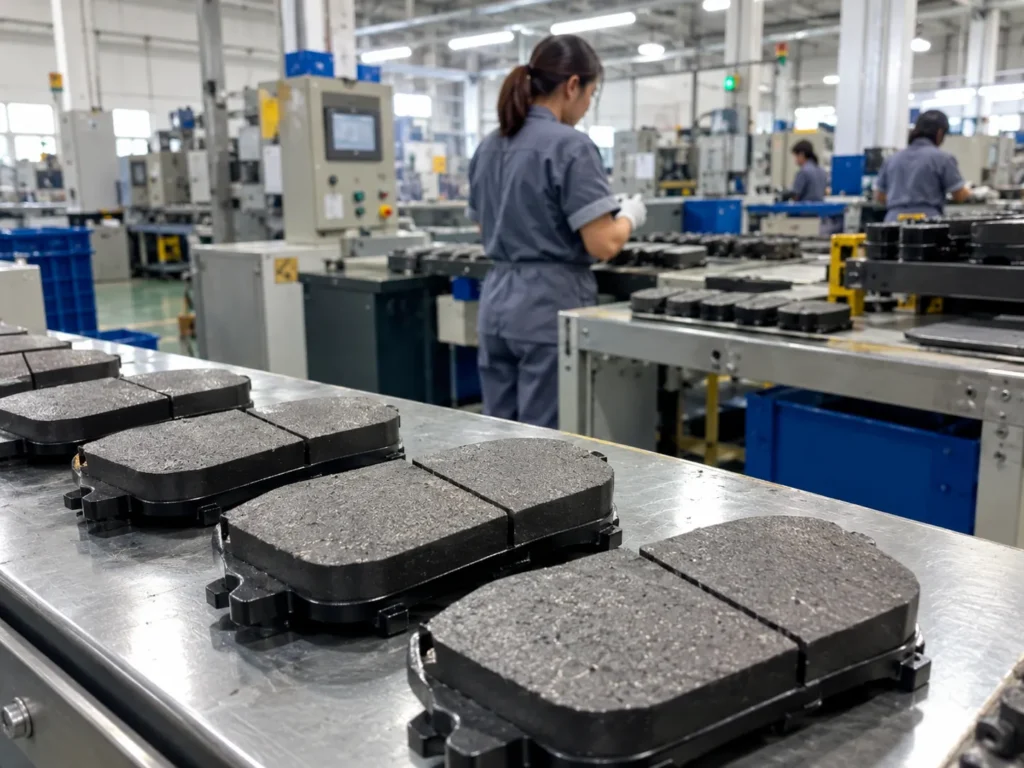
To understand how ceramic pads function, we must first look at their construction. You can read our foundational guide on What Are Ceramic Brake Pads for an introductory overview, but for procurement and technical analysis, the details lie in the exact formulation.
What Ceramic Brake Pads Are Made Of
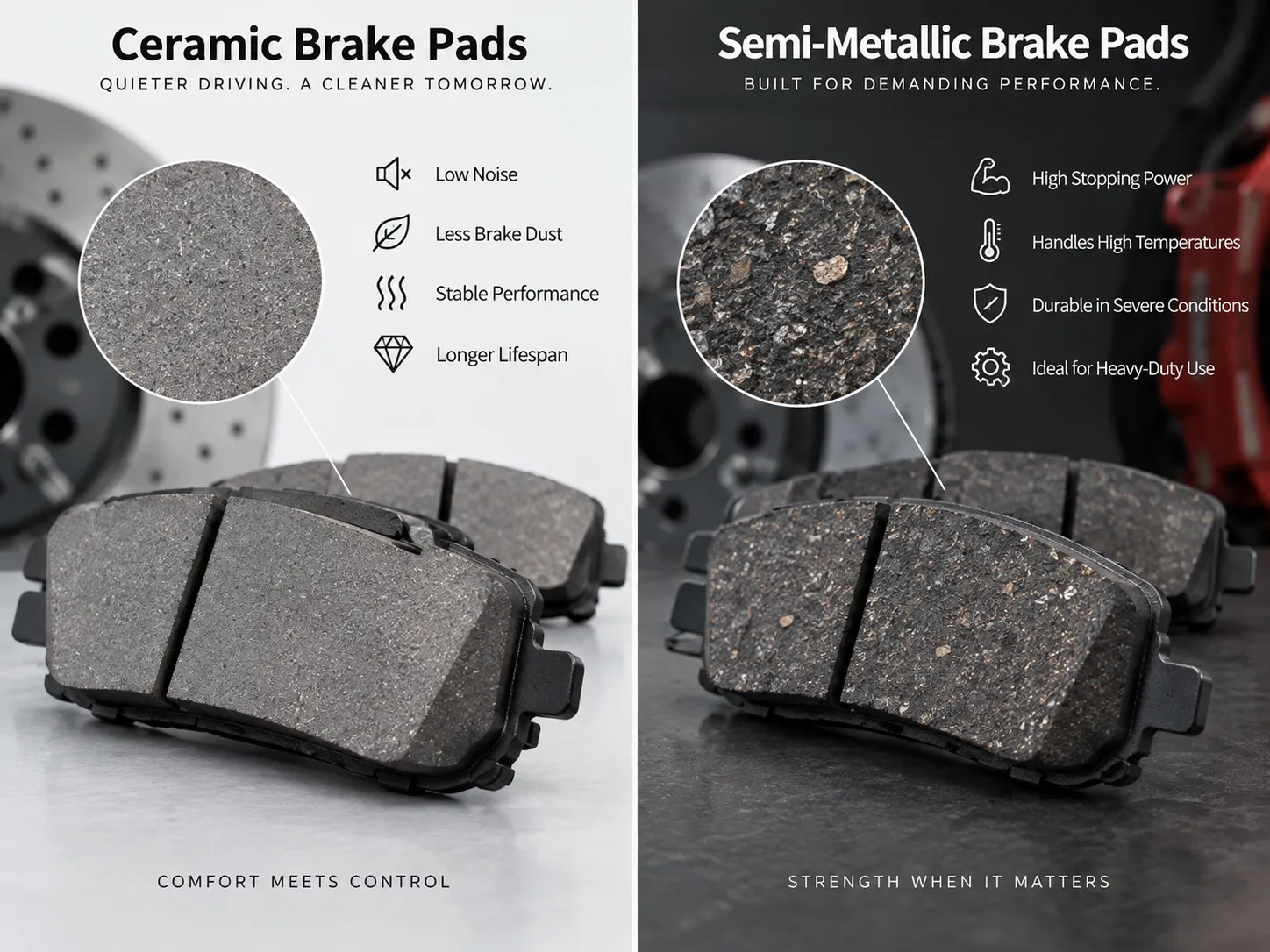
Ceramic brake pads are not made of the same ceramic used in coffee mugs or floor tiles. In the automotive industry, “ceramic” refers to a friction formulation composed primarily of dense ceramic fibers, bonding resins, non-ferrous fillers, and varying amounts of copper or brass fibers (though modern regulations are changing this). They are generally lighter than metallic pads and have a much finer, tighter grain structure.
Industry Example: Why Modern Formulations Are Different
The transition toward low-copper brake friction materials in the United States is a good example of why brake-pad categories should not be defined by an old ingredient list. California’s Motor Vehicle Brake Friction Material Law was introduced after copper released from brake wear became an environmental concern in urban waterways.
The change had a measurable effect on the industry. For buyers, the lesson is not that one friction category became automatically better than another. It is that formulations evolve. A modern ceramic, NAO, or semi-metallic pad may use a different combination of fibers, fillers, lubricants, and friction modifiers than an older product carrying the same general material label.
For current replacement products, the actual formulation specification and application matter more than relying on a decades-old description of what a “ceramic pad” contains.
Legislative Impact: Evolution of Copper Limits (California Law)
How Ceramic Friction Material Affects Braking
Because of their unique composition, high quality ceramic brake pads offer a distinct braking profile. The ceramic compound absorbs and dissipates heat effectively under normal driving conditions, but it does not conduct heat away from the rotor as quickly as metal.
For B2B buyers evaluating a spec sheet, ceramic formulations typically showcase a highly stable friction coefficient across low to medium temperature ranges (usually up to 300°C – 400°C). This makes them incredibly quiet, remarkably low on visible dust, and exceptionally gentle on brake rotors. However, they are not designed to handle the extreme thermal loads generated by heavy towing or track racing.
What Are Semi-Metallic Brake Pads?
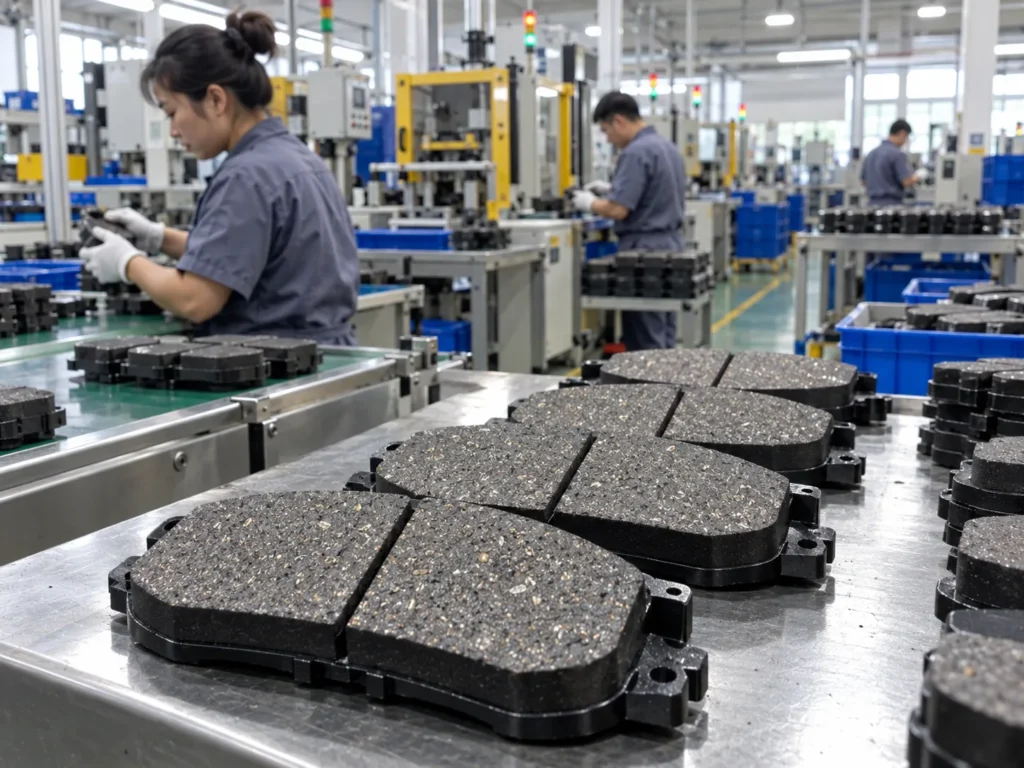
When heavy duty performance is required, the industry turns to metallic formulations. For a deep dive into their basic history, check out our resource on What Are Semi-Metallic Brake Pads.
What Semi-Metallic Brake Pads Are Made Of
Semi-Metallic Brake Pads contain anywhere from 30% to 65% metal by weight. This metal content typically consists of chopped steel wire, iron powder, copper, or steel wool, bound together with graphite lubricants, friction modifiers, and specialized resins.
When you hold a semi-metallic pad in your hand on the warehouse floor, you can physically feel the difference. It is noticeably heavier than a ceramic pad, and under a bright light, you can easily spot the reflective metallic flakes embedded in the friction block.
How Metal Content Changes Brake Performance
The heavy metal content completely changes the thermodynamic properties of the brake pad. Metals are excellent conductors of heat. Therefore, semi-metallic pads pull heat away from the rotor interface rapidly, allowing the braking system to survive much higher operating temperatures without experiencing brake fade.
From a purchasing perspective, when you order semi-metallic pads, you are buying thermal capacity. They provide a firmer, more aggressive bite (higher initial friction coefficient) than ceramic pads. The trade-off is NVH (Noise, Vibration, and Harshness). The aggressive metal-on-metal contact with the cast-iron rotor generates more noise, creates darker, stickier brake dust, and accelerates rotor wear over time.
Semi-Metallic Characteristics Summary
Ceramic vs Semi-Metallic Brake Pads: 8 Key Differences
To help you make the best procurement and recommendation decisions, we have broken down the difference in brake pads into seven critical performance metrics.
1. Friction Material
Ceramic Brake Pads
The formulation relies on ceramic compounds that provide stable friction at ambient and moderate temperatures. The absence of steel fibers means these pads are structurally less abrasive.
Manufacturing Note:
Material composition is not the only factor behind brake pad durability. The integrity of the complete pad assembly matters as well. For example, according to ISO 6312:2010, Road vehicles — Brake linings — Shear test procedure for disc brake pad and drum brake shoe assemblies (ISO 6312), the method measures the strength of the connection between the friction lining and its carrier. As a practical internal reference, many manufacturers set a minimum shear-strength target of approximately 2.5–5.0 MPa, depending on the pad design, backing-plate size, bonding system, and customer specification. A production control plan may also use a working target around 3.5 MPa, with sample results commonly expected to remain within approximately 3.0–4.5 MPa during routine verification.
These figures should be treated as reference values rather than universal ISO acceptance limits. A ceramic formulation may have good wear characteristics, but the finished product still depends on backing-plate preparation, bonding, pressing, and other manufacturing controls. For example, a supplier may investigate a batch if shear strength falls below 3.0 MPa, or if separation occurs at the friction-material interface.
Semi-Metallic Brake Pads
The high steel and iron content provides immense structural integrity. The friction material is inherently robust, capable of gripping the rotor violently to stop immense kinetic energy.
2. Braking Feel
Ceramic Brake Pads
They deliver a very smooth and progressive pedal feel. The driver does not feel a harsh “grab” when pressing the brake pedal. This makes ceramic pads highly desirable for luxury vehicles where comfort is the primary goal.
Semi-Metallic Brake Pads
Semi-metallic pads offer a much firmer and more immediate initial bite. When the driver steps on the pedal, the vehicle decelerates aggressively. This firm feel is critical for heavy trucks, where the driver needs confidence that a heavy load will stop promptly.
3. Brake Noise
Ceramic Brake Pads
Ceramic pads are famous for being virtually silent. Because the materials resonate at a frequency higher than human hearing, drivers do not perceive the friction noise. However, achieving this silence requires precise manufacturing.
A Noise Issue We Traced Beyond the Friction Material:
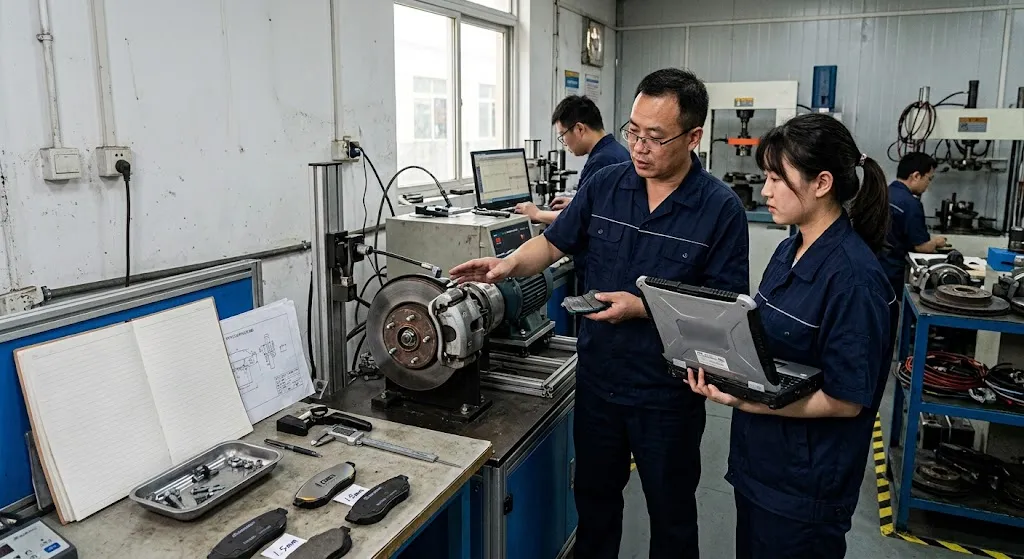
On June 18, 2024, we investigated a low-speed squeal issue on ceramic brake pads for a Toyota Corolla passenger-car project. The noise appeared during light braking at approximately 10–20 km/h after bedding-in. The initial squeal rate was 6 occurrences in 10 stops.
After reviewing the friction formulation, pad geometry, and shim assembly, we found that the original 1.0 mm chamfer and shim fit were allowing excessive vibration at low braking pressure. We changed the chamfer to 1.5 mm and replaced the original shim with a tighter-fitting multi-layer shim. In the repeat test, the squeal rate decreased from 6 occurrences in 10 stops to 1 occurrence in 10 stops.
This confirmed that ceramic material alone does not guarantee quiet braking. Pad geometry, shim design, rotor condition, and the vehicle’s brake system also affect final NVH performance. When drafting a PO, ensure your supplier is utilizing premium multi-layer constrained shims, not just a good friction puck.
Semi-Metallic Brake Pads
The steel fibers scraping against a cast-iron rotor will inherently produce audible noise. Drivers often experience low-speed squeals, grinding, or groaning sounds. While anti-noise shims and chamfers help mitigate this, semi-metallic pads will never be as quiet as ceramic options.
4. Brake Dust
Ceramic Brake Pads
A massive selling point for ceramic pads is the lack of visible dust. They do produce dust, but it is extremely fine, light-colored, and does not stick to alloy wheels. Customers who spend money on expensive aftermarket wheels will almost always demand ceramic pads for this reason.
Semi-Metallic Brake Pads
They are notorious for covering wheels in dark, black dust. Furthermore, because the dust contains iron, it can actually oxidize (rust) and chemically etch into clear-coated alloy wheels if not cleaned regularly.
5. Heat Handling
Ceramic Brake Pads
While ceramic pads handle the heat of daily stop-and-go traffic perfectly, they act as insulators. Instead of pulling heat away, they force the heat into the rotor and brake caliper. Under extreme, repetitive heavy braking (like descending a steep mountain with a loaded SUV), ceramic pads can glaze over, leading to brake fade.
Semi-Metallic Brake Pads
Semi-metallics are heat-handling champions.
From Our Production Experience:
In one semi-metallic pad test, the friction coefficient dropped from 0.42 to 0.35 after repeated high-temperature stops. We checked the formulation and found that the metallic fibers had not dispersed evenly during mixing. After changing the feeding sequence and extending mixing time from 8 to 12 minutes, the coefficient recovered to 0.40 in the repeat test.
This showed us that fade resistance depends not only on metal content, but also on mixing consistency and production control.
This is also why friction-material labels should not be treated as complete performance ratings. According to ISO 26867:2009, Road vehicles — Brake lining friction materials — Friction behaviour assessment for automotive brake systems (ISO 26867), this standard evaluates friction behavior under controlled changes in pressure, temperature, and linear speed while the friction material operates against a specified rotor. The standard therefore focuses on measured friction behavior across test conditions rather than assigning a universal performance ranking to labels such as “ceramic” or “semi-metallic.”
In practical terms, two pads both described as semi-metallic can produce different friction curves as temperature rises. The formulation, rotor pairing, and operating conditions must be evaluated together.
6. Rotor Interaction
Ceramic Brake Pads
Because the ceramic material is softer than the cast iron rotor, the pad takes the brunt of the wear. This significantly extends the life of the brake rotors.
Semi-Metallic Brake Pads
The heavy steel content makes these pads highly abrasive. While the pads themselves may last a long time under heavy stress, they will inevitably chew into the brake rotors faster, reducing rotor lifespan and requiring more frequent rotor replacements or resurfacing.
7. Typical Application
Ceramic Brake Pads
Perfect for 90% of civilian passenger vehicles. If the vehicle is used for commuting, school runs, or highway cruising, ceramic is the preferred choice.
Semi-Metallic Brake Pads
Reserved for vehicles doing hard work. Taxis, police interceptors, heavy-duty pickup trucks (Ford F-250, Chevy Silverado 2500), tow rigs, and high-performance track cars require the thermal stability of semi-metallic compounds.
8. Cost
Ceramic Brake Pads
Generally, ceramic pads are more expensive to manufacture. The raw materials (copper, ceramic fibers, advanced resins) and the complex curing processes drive up the cost. However, they command a premium retail price, offering parts stores excellent profit margins.
Semi-Metallic Brake Pads
Often more cost-effective to produce due to the abundance of steel and iron raw materials. However, premium heavy-duty semi-metallic formulations with advanced anti-corrosion backing plates can still be priced similarly to mid-tier ceramic pads.
Which Brake Pad Is Better for Different Applications?
To determine are ceramic brake pads better or if semi-metallic reigns supreme, you must look strictly at the vehicle’s application. “Better” is entirely subjective to the driving environment.
Daily-Driven Passenger Cars
For a Honda Civic, Toyota Camry, or a daily-driven Audi A4, ceramic is undeniably better. These are brake pads for daily driving. The driver wants a quiet ride, clean wheels, and smooth stopping power. Using semi-metallic pads on a lightweight commuter car will result in customer complaints about noise and dirty wheels.
SUVs and Light Trucks
This is the crossover zone. For a lightweight SUV (like a Toyota RAV4 or Honda CR-V), ceramic is still the best choice. However, for a larger, heavier three-row SUV (like a Chevy Tahoe or Ford Expedition) that is frequently loaded with passengers and cargo, a high-quality semi-metallic pad provides the extra stopping confidence required for the increased kinetic energy.
Towing and Heavy-Load Use
If your customer drives a Ram 3500 and routinely tows a 10,000-pound trailer, ceramic pads are a safety hazard. The extreme heat generated by stopping that much weight will instantly glaze a ceramic pad. Semi-metallic is mandatory here. They will bite hard, shed the heat, and prevent dangerous brake fade down steep grades.
Performance and High-Temperature Driving
Track cars, autocross vehicles, and aggressive canyon carvers require semi-metallic or dedicated carbon-metallic track pads. They need the pads to perform exceptionally well when rotor temperatures exceed 500°C.
Which Should Repair Shops Recommend?
If you are a service advisor at an auto repair shop, minimizing customer comebacks is your number one priority. A comeback destroys profitability. When advising customers on ceramic brake pads pros and cons versus Semi-Metallic Brake Pads pros and cons, follow this step-by-step advisory framework.
Start with Vehicle Application
Pull up the OEM specifications for the vehicle. If the car came from the factory with ceramic pads, strongly advise the customer to replace them with ceramic pads. Changing the friction chemistry from OEM can throw off the brake bias and pedal feel the customer is used to.
Ask How the Vehicle Is Used
Never assume. Ask the customer directly:
- Do you ever tow a boat or a trailer with this vehicle?
- Are you an aggressive driver, or do you mostly commute in traffic?
- Do you haul heavy tools or cargo in the back?
If they answer yes to towing or heavy loads, pivot your recommendation to a premium semi-metallic pad, even if they ask for ceramic. Explain why (thermal capacity and safety) to build trust.
Consider Customer Priorities
Ask the customer what annoyed them most about their old brakes:
- If they say, “My wheels are always black and covered in dust,” sell them ceramic.
- If they say, “My brakes squeal every morning,” sell them premium ceramic with high-end hardware.
- If they say, “I feel like the car doesn’t stop fast enough when I have my family inside,” lean towards a high-friction semi-metallic or hybrid pad.
Can You Replace Semi-Metallic Pads with Ceramic Pads?
Many customers walk in asking to “upgrade” their dusty semi-metallic pads to clean ceramic pads. While possible, you must proceed with caution as an installer.
Check Vehicle Compatibility
First, ensure that a high-quality aftermarket manufacturer actually produces a ceramic pad for that specific caliper. If the vehicle is a 1-ton dually truck, reputable manufacturers might not even offer a ceramic option because it is unsafe for the vehicle’s Gross Vehicle Weight Rating (GVWR).
Check Rotor Condition
If you are switching a vehicle from semi-metallic to ceramic, never slap new ceramic pads onto old, used rotors. The old rotors have a transfer layer of metallic friction material embedded in the iron pores. The new ceramic pads will not bed properly into this metallic layer, resulting in severe vibration, noise, and poor stopping power. You must either turn (resurface) the rotors on a brake lathe or install brand new rotors.
Bedding When Changing Compounds
Learning how to break in ceramic brake pads and rotors is crucial when making this switch:
- Accelerate the vehicle to 35 mph.
- Apply moderate brake pressure to slow down to 5 mph (do not come to a complete stop).
- Repeat this 4-5 times.
- Increase speed to 55 mph, brake aggressively down to 15 mph. Repeat 4-5 times.
- Drive around for 10 minutes with minimal braking to let the rotors cool evenly.
This process establishes a fresh, even transfer layer of ceramic material on the new rotor, ensuring quiet and vibration-free performance.
What Auto Parts Stores Should Know
For B2B auto parts buyers, inventory management is about stocking the right mix of materials to satisfy both wholesale (repair shops) and retail (DIY) customers.
Stock by Vehicle Coverage, Not Material Alone
Do not blindly order a 50/50 split of ceramic and semi-metallic pads. Analyze your local market. If your store is in a suburban area surrounded by commuter sedans, your inventory should be heavily weighted (70%+) toward ceramic pads. If you are located in a rural, agricultural, or industrial zone with lots of fleet trucks, you need a robust stock of severe-duty semi-metallic pads.
One Part Number May Have Multiple Friction Options
Parts professionals may also encounter SAE friction identification codes when comparing replacement pads. SAE J866, Friction Coefficient Identification and Environmental Marking System for Brake Linings (SAE J866), provides a standardized way to classify friction characteristics using test data (e.g., edge codes like FF, GG, or EE).
However, SAE specifically cautions that these codes are not complete brake-performance ratings and should not be used by themselves to predict how a brake system will perform.
For an auto parts store, that is an important distinction: an edge code is useful technical information, but it should not replace vehicle fitment, formulation requirements, operating conditions, and complete product specifications when recommending a pad. Ensure your warehouse management system distinguishes between D1000-Ceramic and D1000-SemiMet so counter staff don’t hand out the wrong formulation.
Reduce Customer Comebacks Through Better Matching
Educate your counter staff to ask the retail buyer the right questions. When a DIY mechanic asks, “how to tell what brake pads i need?”, train your staff to explain the difference between bad brake pads vs good applications. A “good” semi-metallic pad is “bad” for a customer who hates dirty wheels. Proper counter education drastically reduces the rate of returned, used brake pads.
What About Low-Metallic and NAO Brake Pads?
The market isn’t strictly limited to just ceramic and semi-metallic. To fully understand the global friction landscape, especially in European vehicles, you must understand Non-Asbestos Organic (NAO) and Low-Metallic formulations.
European Vehicle Preference
European automakers (like BMW, Mercedes-Benz, and Audi) traditionally favor Low-Metallic pads. These pads contain a small amount of metal (10%-30%) mixed with organic materials. They offer a phenomenal, aggressive bite at high speeds (perfect for the Autobahn) but produce massive amounts of black dust.
B2B Purchasing Ecosystem
For a complete breakdown of how these fit into the B2B purchasing ecosystem, read our in-depth comparison on Low-Metallic vs NAO Brake Pads.
Final Comparison
So, are ceramic brakes the best? There is no universal “best.”
When to Choose Ceramic Brake Pads
Choose ceramic brake pads if your priority is a quiet ride, clean wheels, low rotor wear, and you drive a commuter passenger car or light crossover.
When to Choose Semi-Metallic Brake Pads
Choose semi-metallic brake pads if your priority is maximum stopping power, high-heat fade resistance, and you drive a heavy truck, tow trailers, or participate in high-performance driving.
B2B Purchasing Strategy & Advisory Value
For B2B buyers, your purchasing strategy must reflect the vehicles your target market services. By understanding the intricate engineering differences, testing standards (like ISO 26867 and ISO 6312), and proper application rules, you can elevate your business from a simple parts vendor to a trusted technical advisor.
Frequently Asked Questions (FAQ)
Find quick, technical answers to common questions regarding ceramic versus semi-metallic brake pads, expected lifespan, rotor wear, and application selection.
1. Are ceramic brake pads better than semi metallic?
Ceramic pads are better for daily commuting because they are quieter and produce less visible dust. However, semi-metallic pads are superior for heavy-duty towing, extreme heat, and high-performance driving. Choose based on the vehicle’s specific application.
2. How long do ceramic brake pads last?
Under normal driving conditions, high-quality ceramic brake pads can last anywhere from 30,000 to 70,000 miles. Their longevity is excellent for daily drivers, but their lifespan will decrease rapidly if used for heavy towing, which causes them to overheat and degrade.
3. Are all brake pads the same?
No, brake pads vary wildly in friction material (ceramic, semi-metallic, organic), backing plate thickness, shim design, and shear strength (ISO 6312). Even within the same category, modern formulations use different blends of fibers, resins, and friction modifiers to achieve specific NVH and stopping targets.
4. How to break in ceramic brake pads and rotors?
To properly bed in new ceramic pads, perform 4-5 moderate stops from 35 mph to 5 mph, followed by 4-5 aggressive stops from 55 mph to 15 mph without coming to a complete halt. Finally, drive normally for 10 minutes to allow the rotors to cool evenly, establishing a smooth friction transfer layer.
5. Do semi-metallic brake pads wear rotors faster?
Yes. Because semi-metallic pads contain 30% to 65% steel and iron fibers, they are much harder and more abrasive than ceramic pads. While the pads themselves resist heat well, they will slowly grind down the cast-iron brake rotor faster than softer ceramic materials.
6. How to tell what brake pads I need?
Start by checking your OEM specifications. If your car came with ceramic, stick to ceramic (normal brake pads for daily driving). If you drive a heavy-duty truck, tow frequently, or experience brake fade on steep hills, you need the thermal capacity of semi-metallic pads.
7. Why do my semi-metallic brakes squeal?
Semi-metallic pads are inherently noisier because metal fibers are scraping against a metal rotor. While anti-noise shims help, low-speed squeals and groans are normal characteristics of this heavy-duty friction material, especially when cold.
8. Is it worth paying more for ceramic brake pads?
For the average commuter, yes. The slight increase in upfront cost pays for itself through cleaner wheels, a quieter ride, and extended brake rotor life. However, paying more for ceramic pads on a heavy tow rig is a waste of money, as they will overheat and fail prematurely.