
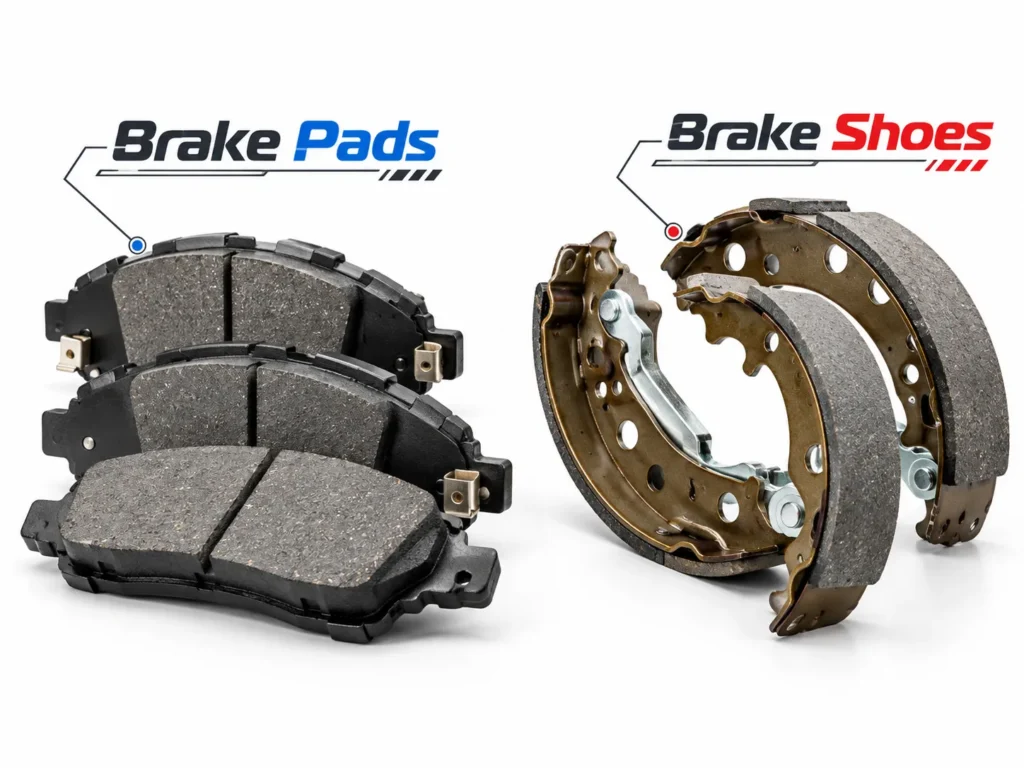
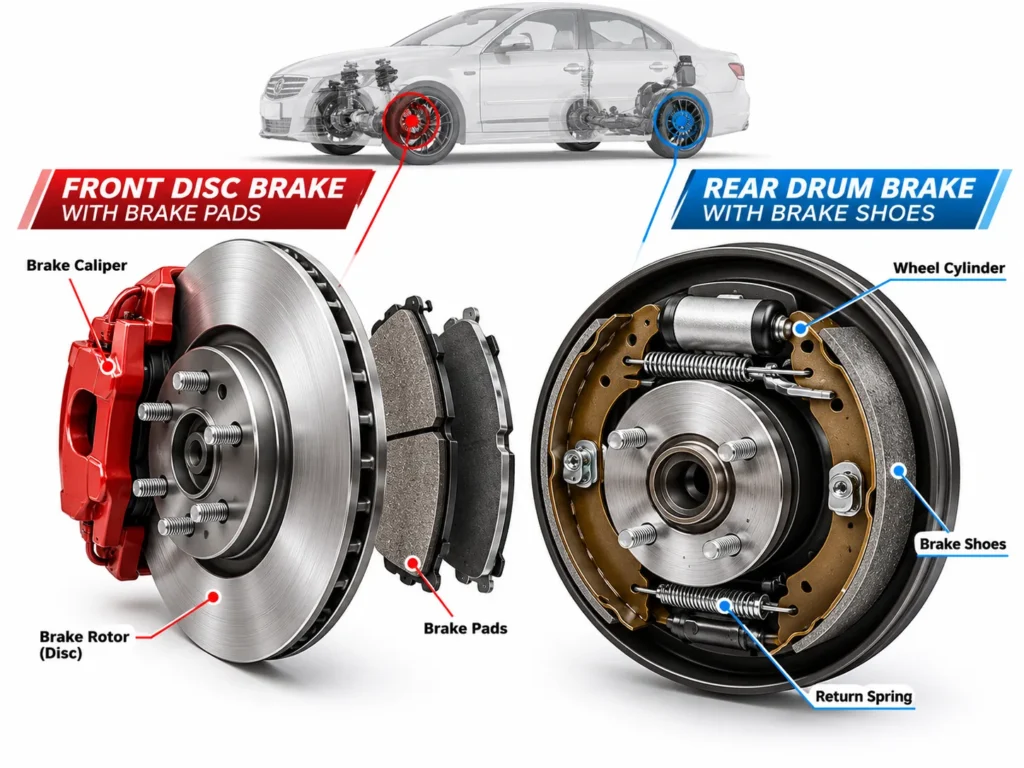
Brake pads vs brake shoes is a question about two different brake systems, not two versions of the same part. Brake pads squeeze a spinning disc from the outside. Brake shoes push outward against the inside of a spinning drum. Everything else that separates them — shape, heat behaviour, wear rate, price, where they sit on the vehicle — follows from that one difference in geometry.
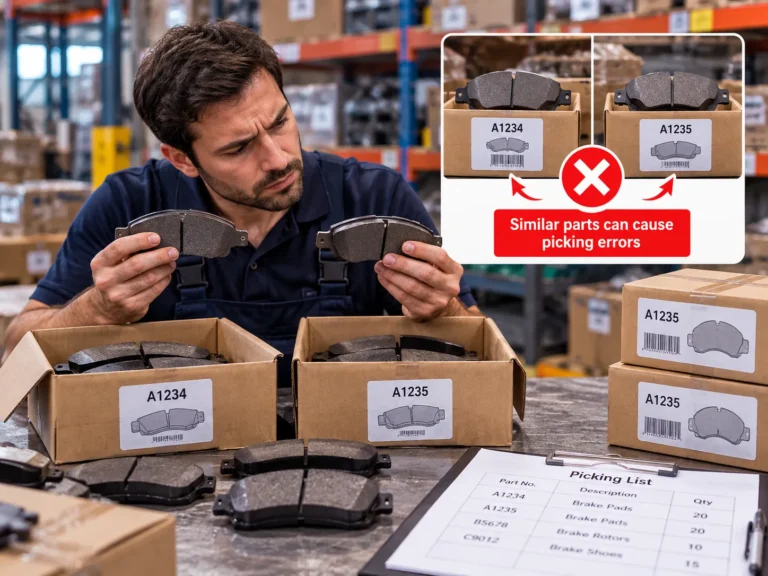
For an auto parts store, a repair shop or a warehouse distributor, the practical question is rarely “which is better.” It is “which does this vehicle use, which part number do I stock, and how do I check the one my supplier shipped.” A car that needs rear shoes will not accept rear pads, and no amount of quality in the pad will change that.
This guide covers both parts at the level you need to buy and sell them: what each one is, the ten differences that matter commercially, how each system makes braking force, how they compare on performance and wear, why most cars carry both, and how to specify and verify pads and shoes before a container ships.
Brake Pads vs Brake Shoes: The Short Answer
01
What Are Brake Pads and Brake Shoes?
Brake pads and brake shoes are both friction parts: each carries a block of friction material pressed against a rotating steel surface to turn motion into heat. The difference is the surface they work on. Pads work on a disc; shoes work inside a drum. That is the whole basis of the brake shoe vs brake pad comparison.
Both parts are consumable, both are sold by vehicle application rather than by size, and both are replaced in axle sets. In both cases the part number — not the look of the part — tells you whether it fits. So before any brake pads vs brake shoes judgement, settle what each part actually is.
What Are Brake Pads?
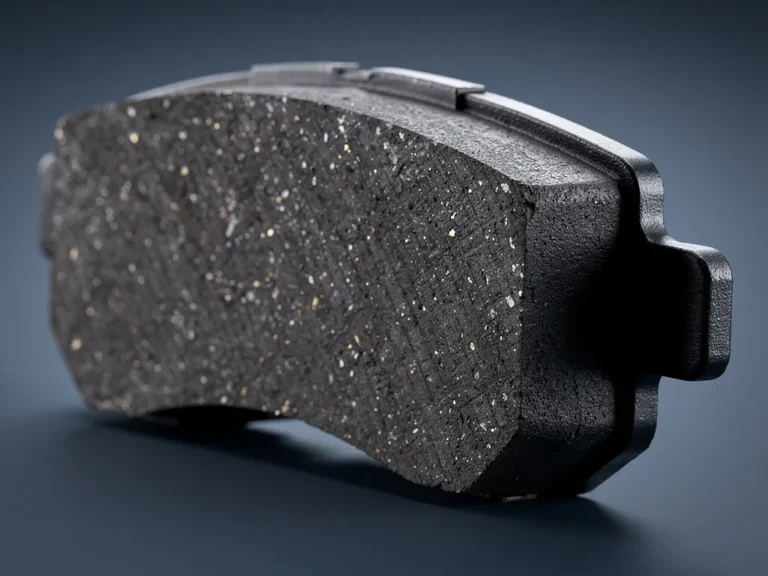
A brake pad is a flat friction block bonded or riveted to a steel backing plate, designed to be clamped against one face of a brake rotor by a caliper. Two pads work as a pair on each wheel, one on each side of the rotor.
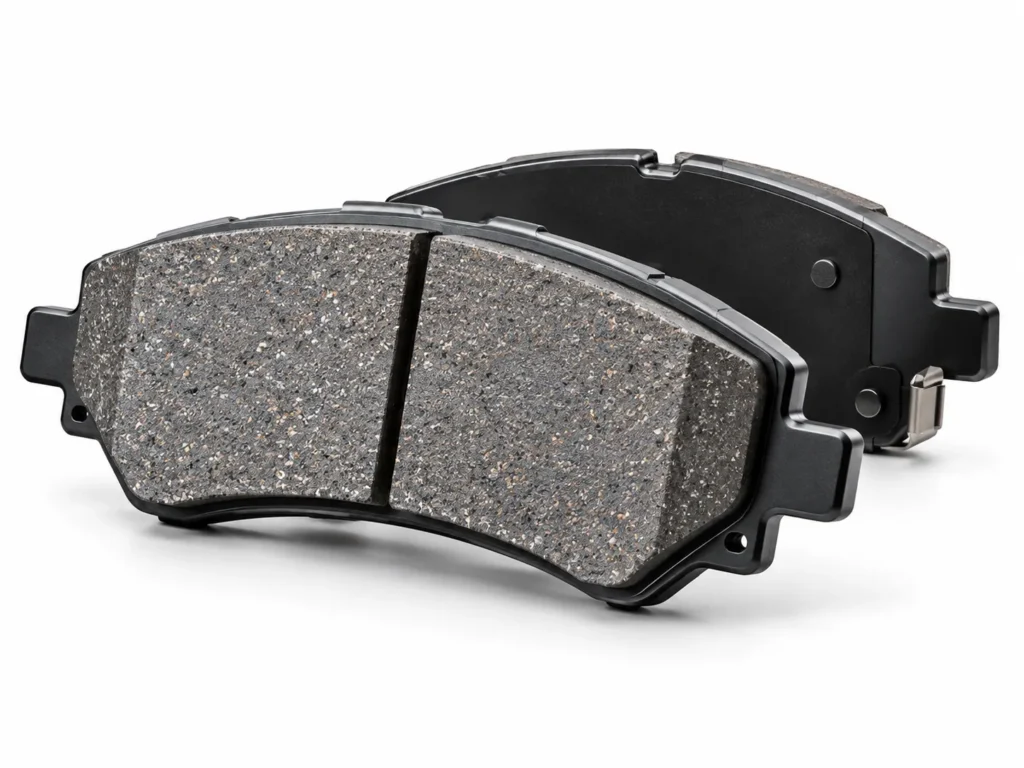
The brake pads definition most buyers actually need is a list of what is in the box, because that is what changes between part numbers:
- Backing plate: stamped steel that carries the friction material and transfers load into the caliper bracket. Its outline, ear positions and hole pattern define the fitment.
- Friction material: ceramic, low-metallic, semi-metallic or NAO. This sets friction level, dust, noise and rotor wear.
- Bonding layer: underlayer and adhesive that hold the friction material to the plate under heat and shear load.
- Chamfers, slots and shim: cut edges, grooves and a damping plate on the back of the pad, all there to control squeal.
- Wear indicator: a mechanical clip that squeals near end of life, or an electrical sensor that triggers a dash warning.
- Hardware: abutment clips and anti-rattle springs, included on some part numbers and not others.
So when someone asks what brake pads do, they convert kinetic energy into heat at the rotor face while keeping that heat, noise and wear inside limits the driver accepts. The friction is the easy part; the rest of the pad exists to manage its consequences.
What Are Brake Shoes?
What are brake shoes, in the terms that matter at the counter? A brake shoe is a curved steel shoe — a web welded to a crescent-shaped rim — carrying an arced block of friction material called the lining. Two shoes sit inside each brake drum and are pushed outward against the drum’s inner wall. The brake shoe definition that matters commercially includes the hardware around it, because automotive brake shoes are sold and fitted as a matched pair.
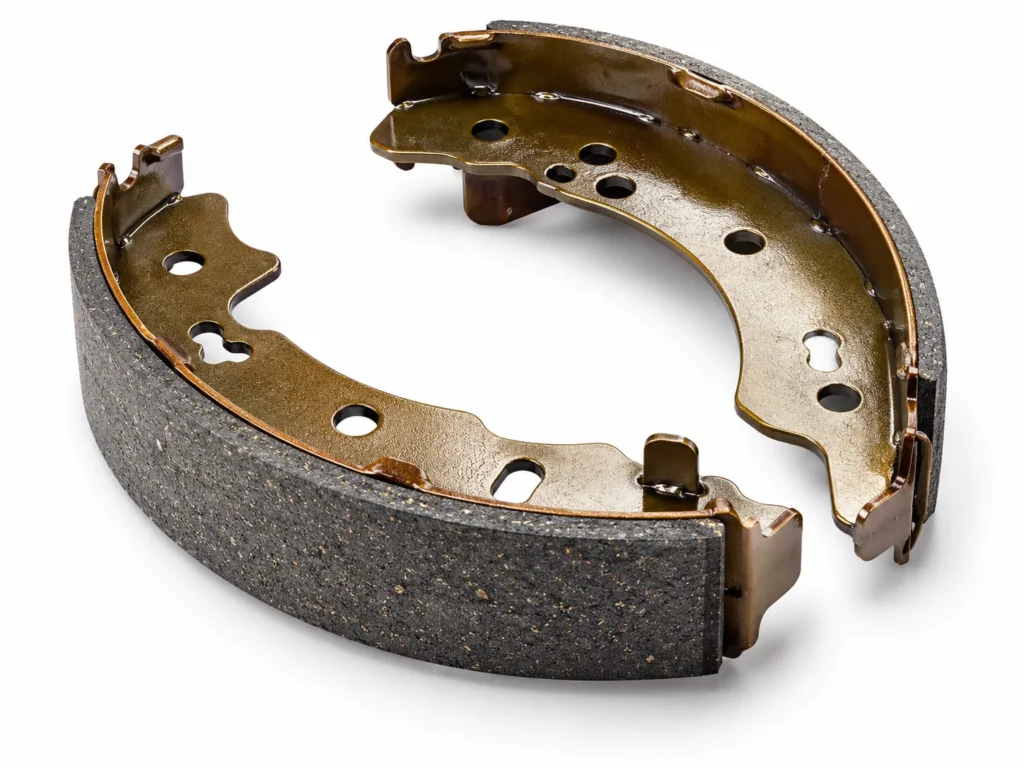
What makes up a shoe:
- Shoe web and rim: the stamped and welded steel structure. The web carries the anchor and actuation points; the rim carries the lining.
- Lining: the friction block, arced to match the drum’s inner radius. This is the part that wears out.
- Attachment: the lining is either bonded to the rim with adhesive or riveted with brass or steel rivets.
- Springs, hold-down hardware and adjuster: the return springs that pull the shoes off the drum on release, plus the mechanism that keeps shoe-to-drum clearance correct as the lining wears.
Brake shoes for car applications are smaller and lighter than truck shoes, but the principle is identical. Because a drum brake is closed, the shoe cannot be inspected without pulling the drum — which is why shoe wear is so often found late.
If you want the pad side of this in more depth — materials, layer construction and what each part of the assembly is for — start with our guide to what brake pads are and how they are built.
02
What Are the Key Differences Between Brake Pads and Brake Shoes?
The difference between brake pads and shoes runs through ten commercial and technical dimensions: brake system type, shape, working principle, heat dissipation, performance, service life, maintenance, cost, vehicle applications and installation position. Get the first one right and the rest follow.
Three of those drive almost every buying decision.
Geometry decides heat. A rotor is open to air on both faces, while a drum is a closed iron pot with the friction surfaces inside, so the disc system dumps heat and the drum system stores it.
Actuation decides feel and cost. A caliper applies pads hydraulically and self-adjusts as the pad wears, while a drum needs a wheel cylinder, two shoes, an anchor, springs and an adjuster — more parts, but a mechanical advantage that makes drums cheap for a given braking torque.
Position decides volume. Front axles have been disc-only for decades, so the rear axle is where the brake pads and shoes question is still live, and where your SKU mix gets decided.
Brake Pads vs. Brake Shoes Comparison Table
Reading This Table Before You Build a Stock List
Every row except cost is fixed by the vehicle, not chosen by you. The only real decision a distributor makes is grade and supplier within the correct part number. If a customer asks for “better rear brakes” on a drum-braked car, the honest answer is better shoes and a true drum, not pads.
03
How Do Brake Pads and Brake Shoes Work?
Both systems convert motion into heat through sliding friction, but they apply it in opposite directions. Disc brake pads clamp inward on a rotor from both sides. Drum brake shoes expand outward against a drum from the inside. The second arrangement multiplies its own input force; the first does not. That single fact explains most of the brake pads vs brake shoes comparison.
How Disc Brake Pads Work
A disc brake is a clamp. Hydraulic pressure pushes the caliper pistons against the inner pad, and the reaction either slides the caliper body so the outer pad contacts too (floating caliper) or acts on opposed pistons on the far side (fixed caliper). Both pads squeeze the rotor between them.
Step by step, inside one front wheel
- The driver applies the pedal and the master cylinder raises pressure in the brake line.
- Pressure acts on the caliper piston area, producing clamp force proportional to pressure and piston size.
- The inner pad contacts the rotor face; caliper or piston action brings the outer pad into contact.
- Friction between pad and rotor generates retarding torque at the wheel and turns kinetic energy into heat.
- Heat flows into the rotor, out through its faces and vanes, and into the surrounding airflow.
- On release, seal rollback pulls the pads clear by a few hundredths of a millimetre, leaving a light running clearance.
- As the friction material wears, the piston sits further out in its bore, so the system self-adjusts with no mechanism needed.
Two consequences matter for buyers. Clamp force is directly proportional to line pressure, so pedal feel is linear and easy for ABS and stability control to modulate. And because the system has no built-in force multiplication, discs need booster assist, larger pistons or a larger rotor to match the torque a drum makes from a small input — which is why discs cost more for equivalent stopping torque. It also means rotor condition is half of pad performance: thickness variation, runout or a glazed surface on the brake rotor will present itself as a pad complaint.
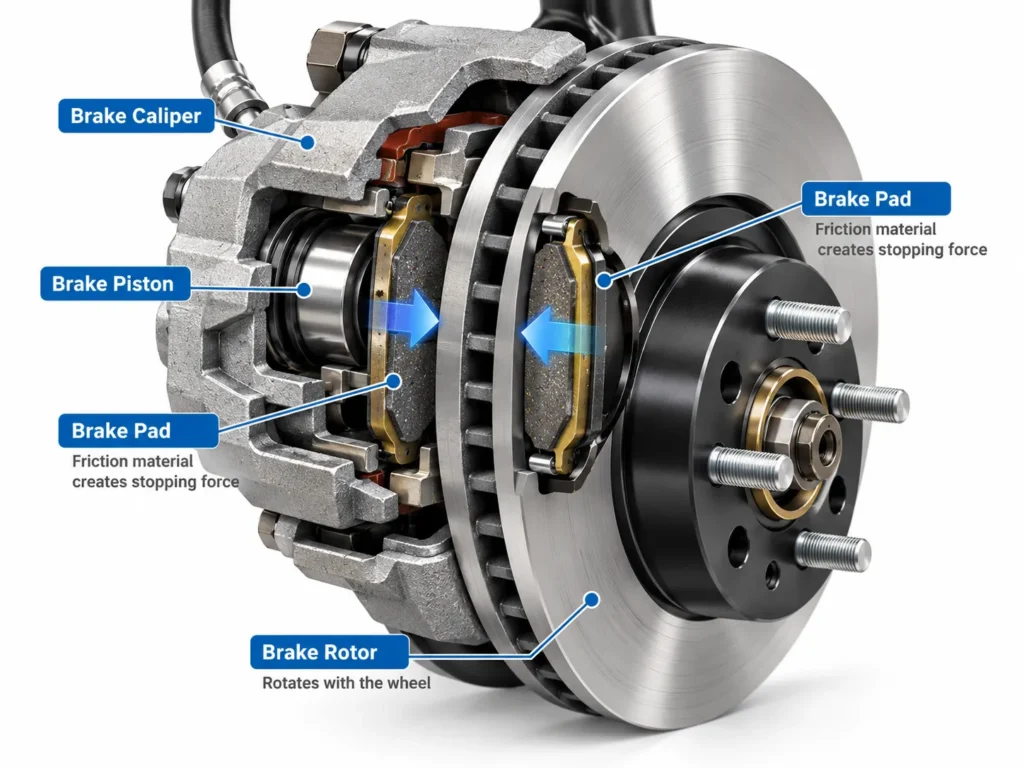
How Drum Brake Shoes Work
A drum brake is an expander. Brake shoes and drums work as a pair: the drum is a cast-iron pot bolted to the hub, and two shoes sit inside it on a fixed backing plate. Pedal pressure extends the wheel cylinder between the shoe tips and forces the shoes outward against the drum’s inner surface.
What makes drum braking different is self-energising action. On a leading shoe, drum rotation drags the lining in the direction that wedges the shoe harder into the drum, so the shoe amplifies its own applied force; on a trailing shoe, rotation pushes the shoe away instead. A leading-trailing design has one of each; a duo-servo design feeds the first shoe’s output into the second so both self-energise in forward motion.
Step by step, inside one rear wheel
- The driver applies the pedal and pressure reaches the wheel cylinder on the backing plate.
- The wheel cylinder pistons extend and push both shoe tips outward against the return springs.
- The linings contact the drum’s inner wall and generate retarding torque at the hub.
- Drum rotation drags the leading shoe further into contact, multiplying the applied force without extra pedal effort.
- Heat passes from the lining into the drum, then outward through the drum wall to the air.
- On release, the return springs pull both shoes off the drum and reset the wheel-cylinder pistons.
- As the lining wears, the adjuster takes up the extra travel so the shoes start closer to the drum next time.
That effect is why drum brakes are still specified: high torque from a small hydraulic input, and a cable-operated parking brake that holds a vehicle on a slope with no hydraulic assistance at all. It is also why drums are more sensitive to lining condition — because the shoe amplifies its own friction, any drop in friction coefficient gets amplified too, so a hot, wet or contaminated lining changes braking torque far more than it would in a disc system.
Arc, Rivet and Bond on Our Shoe Line
At our brake components factory in Qingcheng District, Qingyuan, Guangdong, we run a dedicated drum-shoe line alongside our pad and rotor lines. Three operations on it decide whether a shoe behaves correctly inside a customer’s drum: arc grinding the lining to the drum’s nominal inner radius, setting the bond or the rivets so the lining cannot lift at the ends, and checking the web-to-rim weld that carries anchor and cylinder loads.
We treat arc grinding as a controlled step rather than a finishing step because of the self-energising effect above. A lining that only touches at its centre starts with a fraction of the intended contact area, so the leading shoe wedges on a small patch, bites hard, then settles as that area grows in service. Buyers experience it as a shoe that “grabs when new and goes soft after a week.” Changing compound will not fix that — it is geometry, which is why lining arc and end thickness are inspected on the line, not inferred from friction testing.
Shoe geometry, lining attachment and hardware are easier to judge against real product than against a description — the range, sizes and lining options we build are on our drum brake shoe page.
04
Which Performs Better: Brake Pads or Brake Shoes?
Brake pads perform better where it matters most on a modern vehicle: repeatability. Drum brake shoes produce more braking torque per unit of input force and per dollar of hardware, but that torque is less stable as temperature, moisture and wear change. For a car that must stop the same way on the first stop and the tenth, pads win — which is why the front axle has been disc-only for fifty years. On brake shoes vs pads, then, the useful question is not which stops harder once, but which stops the same way every time.
Stopping Power and Braking Response
Brake pads:
- Clamp force rises in direct proportion to line pressure, so response is linear and easy to modulate many times per second.
- Produce less torque per unit of input force, relying on booster assist, piston area and rotor diameter instead of self-energising geometry.
- Recover from water almost immediately, because the pads wipe the exposed rotor faces clean within a stop or two, and give usable friction from cold.
Brake shoes:
- Deliver high braking torque from modest hydraulic pressure, and a strong initial bite many drivers read as “powerful” at low speed.
- Lose more of that torque when the lining is hot, wet or glazed, because self-energising action amplifies any drop in friction.
- Need correctly adjusted shoe-to-drum clearance to respond promptly; excess clearance shows up as a long, soft pedal.
What 80 Taurus Samples Showed Before Shipment
In September 2025 our team completed an aftermarket brake-component supply project for a U.S. automotive parts distributor, covering 8 brake pad SKUs compatible with the 2016 Ford Taurus. Before shipment on September 26, 2025, our quality team inspected 80 samples and recorded a 98.75% dimensional conformity rate — 79 of 80 samples. Friction-material verification was documented under internal report FP-TAU-2016-0922, and final dimensional inspection under QC-TAU-2025-0925.
The one sample outside tolerance is the part worth explaining to a buyer. It was a dimensional deviation, not a friction failure, and it was caught because the plan measured every sample against the drawing instead of sampling a percentage. A plate that sits proud on one ear produces taper wear and noise the customer will blame on the compound. We keep the measured-conformity figure in the shipment file so a complaint starts from recorded dimensions instead of opinion.
Heat Dissipation and Brake Fade
Brake pads:
- Work on a rotor with both faces exposed to airflow, and vented rotors add internal vanes that pump air through the disc.
- Fade mainly through the compound itself — binder decomposition and gas film at high temperature — which modern formulas and slots manage.
- Recover quickly once the heat is gone, because no closed mass holds temperature around the friction interface.
Brake shoes:
- Work inside a closed drum, so heat must travel through the iron wall before reaching the air.
- Face a second, geometric fade mechanism: as the drum heats it expands away from the shoes, increasing clearance until the adjuster or extra pedal travel compensates.
- Hold heat longer after a descent or a run of hard stops, so the second and third applications suffer most — but tolerate steady, moderate duty well, which is why drums persist on trailers.
The 70 m Stop That FMVSS 135 Actually Measures
The U.S. National Highway Traffic Safety Administration laboratory test procedure for FMVSS No. 135 specifies a stopping-distance limit of 70 m from 100 km/h under the applicable test conditions. The same procedure specifies six stops and a test-surface peak friction coefficient of 0.9 for the referenced test. The standard and its test procedures are published by NHTSA.
Two points matter when a figure like that appears in a supplier’s brochure. These are vehicle-level braking-system requirements, not standalone ratings for brake pads or brake shoes — the booster, hydraulics, tyres and electronics are all part of the result, so no friction part can be said to “meet 70 m” on its own. And because the procedure specifies multiple stops on a defined surface, repeatability matters more than a single best-case stop.
Noise, Vibration, and Braking Comfort
Brake pads:
- Are the noisier design in principle, because the whole caliper-pad-rotor assembly is exposed and free to radiate sound.
- Need engineered countermeasures — multilayer shims, chamfers, slots, underlayers, plate damping — all part-number-specific and all costing money.
- Transmit rotor faults straight to the driver: thickness variation as pedal pulsation, runout as judder through the wheel.
- Give the clearest end-of-life warning, through a wear-indicator squeal or an electrical sensor.
Brake shoes:
- Are quieter in normal service, because the drum encloses the friction interface and acts as an acoustic shield.
- Fail quieter too, which is the problem: a worn-out lining often gives no warning until it is metal-on-drum, and by then the drum needs replacing as well.
- Produce their own fault noises — a groan from glazed lining, a rhythmic scrape from an out-of-round drum, a rattle from a failed hold-down spring.
- Depend on hardware for comfort; tired return springs let the shoes drag, producing heat and uneven wear rather than noise.
Noise is where a pad and shoe programme costs or saves you most in warranty handling, because it is the complaint customers bring back most often and the one least likely to show a measurable fault. If you sell to repair shops, the diagnostic sequence in our guide to why brakes squeal and what actually stops it settles more counter arguments than any spec sheet, and the damping layers themselves are covered in our breakdown of brake pad shims.
05
Which Lasts Longer: Brake Pads or Brake Shoes?
Rear brake shoes normally outlast front brake pads by two to three times, but read that as a position effect rather than a brake pads vs brake shoes verdict, because the parts are not doing the same amount of work. Front pads absorb the majority of braking energy on a passenger car. Rear shoes handle a smaller share and spread it over a larger lining area. Compare a front pad with a rear pad instead and the gap mostly disappears.
Typical Service Life
Service life figures are ranges tied to duty, not specifications. The ranges below are the ones commonly used in the aftermarket for normal passenger-car service, and the ones reflected in customer reorder intervals.
Brake pads:
- Front pads on a passenger car: roughly 30,000–70,000 km in mixed driving, and a fraction of that in heavy urban or hilly use.
- Rear pads on a four-wheel-disc car: longer than the fronts, because rear proportioning sends them less work.
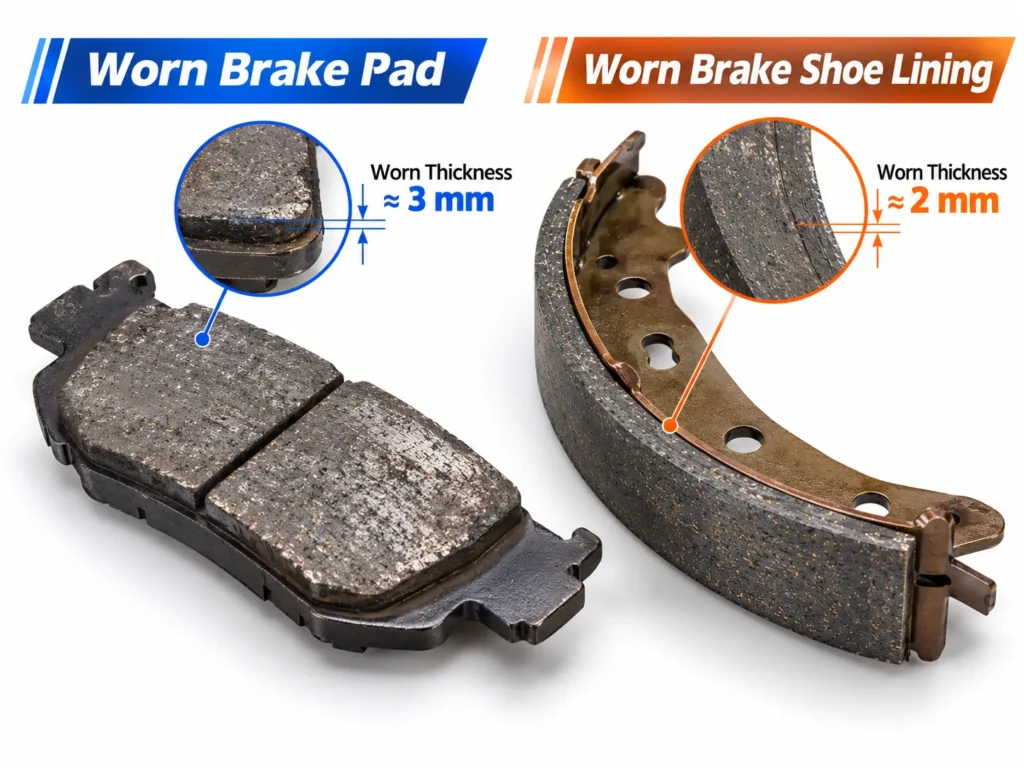
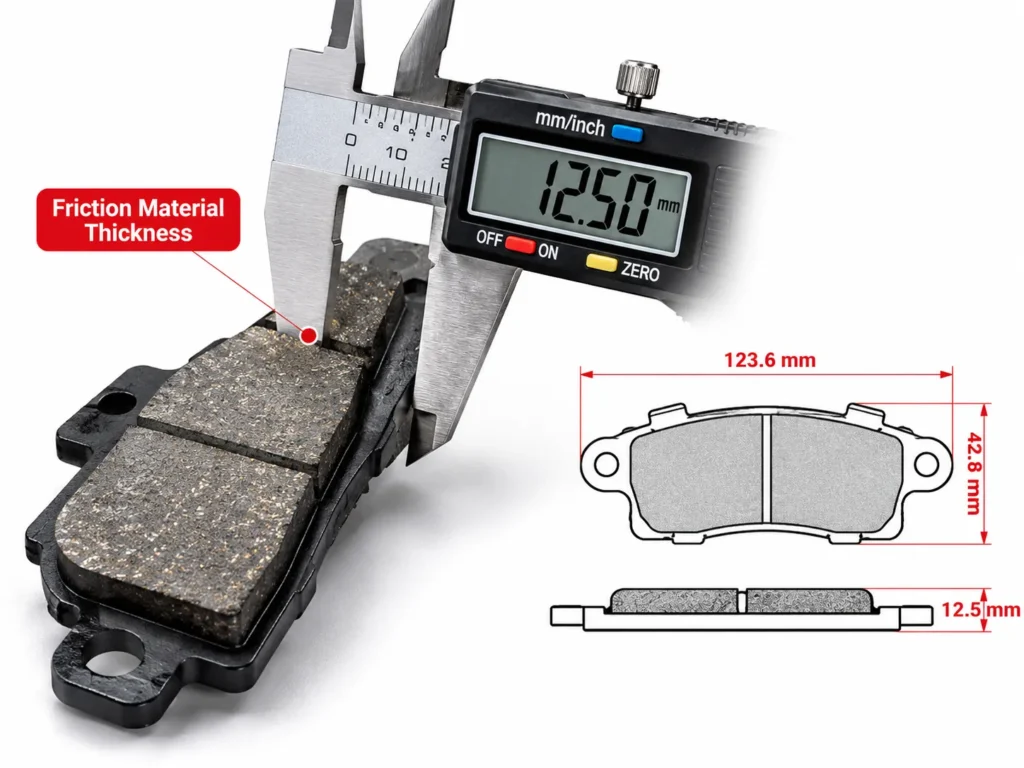
- Minimum usable friction thickness: commonly 2–3 mm above the backing plate, with many vehicle makers specifying replacement at 3 mm.
- Wear pattern to expect: even across the pad face, both pads on an axle within about 1 mm of each other. Anything else is a caliper, slide-pin or rotor problem.
Brake shoes:
- Rear shoes on a passenger car: frequently 80,000–150,000 km, with many vehicles reaching their first shoe replacement only at major service.
- Light commercial and trailer shoes: much shorter, because load and duty rise sharply.
- Minimum usable lining thickness: commonly 1.5–2 mm above the rim on bonded shoes, or flush with the rivet heads on riveted shoes.
- Wear pattern to expect: the leading shoe wears faster than the trailing shoe in a leading-trailing design. That is normal, and both are still replaced together.
Writing Wear Limits Into a Spec Sheet Instead of a Mileage Claim
Do not accept “long life” as a line item. Ask for new friction thickness, the minimum thickness the supplier designs to, and the wear-test method behind any life claim. A number with a test method attached can be checked; a mileage figure cannot, because it silently assumes a duty cycle neither of you has defined.
Factors That Affect Brake Wear
Wear is set by energy, temperature and contact conditions, in that order. Two drivers in the same vehicle on the same pads routinely see a two-to-one difference in pad life. That variability is why laboratory wear testing exists.
Brake pads:
- Position and proportioning: front pads take the larger share of braking energy, and weight transfer increases it further.
- Compound: semi-metallic lasts well and is harder on rotors; ceramic is gentler and cleaner; low-metallic sits between, with higher friction and more dust.
- Rotor condition: thickness variation or a glazed surface accelerates wear and makes it uneven across the pad face.
- Caliper health: a sticking slide pin or seized piston keeps the pad in light contact permanently — the fastest way to destroy a set.
- Duty cycle: urban stop-and-go, towing and mountain descents raise interface temperature, and wear climbs steeply with it.
Brake shoes:
- Adjustment: an adjuster that over-tightens leaves the shoes dragging, producing continuous low-level wear and heat.
- Drum condition: an oversize or out-of-round drum concentrates wear, and a drum past its maximum diameter also loses heat capacity.
- Contamination: a leaking wheel cylinder or axle seal soaks the lining, destroying friction stability and the lining with it.
- Hardware and parking-brake duty: weak return springs let the shoes trail against the drum, and shoes doing double duty as a parking brake see mechanical load the hydraulic circuit never applies.
SAE J2707 and Why Mileage Is Not a Wear Spec
On September 23, 2025, SAE International revised SAE J2707_202509, a recommended practice for measuring the wear rates of automotive service brake linings and disc brake pads using an inertia dynamometer. The procedure provides a common test framework for comparing friction-material wear under defined laboratory conditions, rather than relying solely on mileage-based service-life estimates.
The scope line is the useful part for a buyer: it covers brake linings and disc brake pads in the same document, so pad wear and shoe lining wear can be measured on a comparable basis. A mileage claim never gives you that, because mileage carries the driver, the terrain and the vehicle inside it. When a supplier offers wear data, ask whether both compounds were run under the same procedure and schedule — if not, the numbers are not comparable, however precise they look.
Grade changes wear too, and not always as buyers expect — a cheaper pad is sometimes harder and longer-wearing while being noisier and harsher on rotors. What actually separates the grades is in our comparison of economy, premium and OE-equivalent brake pads.
Signs of Worn Brake Pads and Brake Shoes
Brake pads:
- A high-pitched squeal on light braking that stops when you press harder — the mechanical wear indicator contacting the rotor.
- A brake warning lamp on vehicles with electrical pad sensors, or a pedal that sinks further than usual.
- Friction thickness at or below about 3 mm, visible through the wheel spokes without removing anything.
- Grinding or scraping with braking, which means the backing plate is now cutting the rotor.
Brake shoes:
- A parking brake that pulls far higher than it used to, or no longer holds on a slope.
- A long, soft pedal with normal fluid level, caused by excessive shoe-to-drum clearance.
- Scraping or rumbling from the rear that changes with wheel speed rather than vehicle speed, or fluid traces inside the wheel from a leaking cylinder.
- Lining at or near the rivet heads, or below roughly 1.5–2 mm on a bonded shoe, measured with the drum off.
The asymmetry is the practical point in any brake pad and shoe replacement discussion: pads tell you when they are finished, shoes usually do not. A workshop that inspects drums only when a customer complains keeps buying drums alongside shoes, and that cost lands on whoever sold the parts.
06
Can a Car Have Both Brake Pads and Brake Shoes?
Yes — and most cars on the road do. The common layout is disc brakes with pads on the front axle and drum brakes with shoes on the rear, because the front axle does most of the braking and the rear does not need disc performance to be safe. A second combination is also widespread: four-wheel disc brakes where the rear rotors contain a small drum surface with its own shoes for the parking brake.
So “are brake pads and brake shoes the same thing” has a clean answer. They are not the same part, they are not interchangeable, and the same vehicle very often needs both at once — which means the same customer order often needs both.
Front Disc Brakes and Rear Drum Brakes
Under braking, weight transfers forward, and depending on the vehicle the front axle absorbs roughly 60–80% of the braking energy. Engineering the rear axle to disc standard would add cost and weight for performance the vehicle does not need, so a large part of the market still runs rear drums with shoes.
That is where the brake pads vs brake shoes split actually sits: economy and compact cars in Asia, Latin America, Africa and the Middle East; older vehicles of every class, which are the bulk of the installed base; light commercial vans and pickups, where rear load varies widely; and trailers, where self-energising action means less hardware for the same holding torque.
For a distributor the consequence is unavoidable. You cannot cover rear brakes with one product family — a rear-brake programme needs shoes, drums and hardware on one side, and pads and rotors on the other.
Rear Disc Brakes With Drum-Type Parking Brakes
Many vehicles with four-wheel discs still use shoes. The rear rotor is cast with a small internal drum surface inside its hat, and a compact pair of shoes sits inside, operated by the parking-brake cable or an electric actuator. The hydraulic service brake at that wheel is a normal caliper and pad.
The arrangement exists because the two jobs are different. A service brake needs linear, repeatable, modulated torque — that is a disc. A parking brake needs to hold a stationary vehicle from a mechanical input for weeks without hydraulic pressure — that is a drum.
What this means at the parts counter:
- The vehicle takes rear pads and rear parking-brake shoes: different part numbers, different wear cycles.
- Parking-brake shoes often last the life of the vehicle, so they are a long-tail SKU, not a stocking line.
- When they do fail — usually seized from corrosion or soaked by a leaking seal — the complaint arrives as “parking brake not holding,” never as a shoe complaint. A customer asking for “rear brake shoes” on a four-wheel-disc vehicle may be describing exactly that, so confirm the brake type before picking a part number.
Can Brake Shoes Be Replaced With Brake Pads?
No. Pads need a rotor and a caliper; shoes need a drum and a wheel cylinder. There is no adapter, and converting drum brakes to disc brakes is a full assembly change, not a friction-part substitution. A genuine rear drum-to-disc conversion needs a different hub or axle flange arrangement, a rotor, a caliper and bracket, different lines and hoses, a reworked parking-brake mechanism and proportioning matched to the new rear torque. In regulated markets a modification of that scope can affect road legality, and replacement friction parts themselves fall under approval regimes such as UN Regulation No. 90.
The question usually comes from a reasonable place, so it is worth answering completely:
- If the goal is better braking: correct the existing system first. A true drum, correct shoe arc, new hardware and proper adjustment recover more performance than most people expect.
- If the goal is less maintenance: replace the wheel cylinder and hardware with the shoes. Most recurring drum complaints come from hardware, not lining.
- If the goal is to simplify stock: it does not work. The vehicles that use shoes are not the vehicles that use pads, so dropping shoes drops those customers.
- If the goal is a performance build: that is a chassis project with engineering and liability consequences, not a parts substitution.
07
How Do You Choose the Right Brake Pads or Brake Shoes?
Choosing is a verification process, not a preference. Confirm what the vehicle uses, confirm the part number against OE and FMSI references, confirm the dimensions against a drawing, and confirm that the friction material was tested against something you can name. In practice the brake pads vs brake shoes decision is made for you by the vehicle; what you are really choosing is a part number and a supplier, and grade and price only become real questions once fitment is locked down.
Identify the Vehicle and Brake System
Start from the vehicle, never from the part. “Brake shoes rear” is not an order line. On many models the same year and engine were sold with both rear drums and rear discs depending on trim or market, so trim and market data are not optional.
Work through it in this order
- Capture the full VIN, and from it the model year, engine, trim and production market — not just “2015, 1.6 L.”
- Confirm the front and rear brake type for that exact build, because trim variants within one model often differ.
- For the drum side, record the drum nominal inner diameter and lining width; for the disc side, rotor diameter and thickness and whether it is vented or solid.
- Identify the caliper or wheel-cylinder configuration, including whether the vehicle uses an electric parking brake.
- Note the wear-sensor type the vehicle expects — mechanical indicator, electrical sensor or none — since this changes the part number.
- Check whether hardware comes with the friction part or must be ordered separately for that application.
- Record all of it against the part number in your catalogue, so the next order does not repeat the research.
The One Question That Prevents Most Rear-Brake Returns
Before quoting any rear friction part, ask the customer what the rear assembly looks like with the wheel off: a visible rotor and caliper, or a solid drum. Two sentences on the phone prevent the most common wrong-part return in rear brakes, and they cost you nothing.
Check OE Numbers, FMSI Codes, and Dimensions
An OE number identifies a specific original part. An FMSI code identifies a friction part’s shape and size family. They answer different questions, and you need both. FMSI codes are maintained by the Friction Materials Standards Institute, which assigns standardised numbers to disc pad and drum lining shapes so parts with the same geometry can be identified across brands.
The distinction matters in practice. Two pads can share an FMSI code and still not be equivalent, because the code describes outline geometry — not friction level, chamfer, shim or hardware. An FMSI match tells you the plate will fit the bracket, not that the pad will behave like the one it replaces.
Verify a quoted part this way
- Ask the supplier for the OE reference numbers the part is built against, and the FMSI code where one applies.
- Cross-check those OE numbers against at least two independent catalogue sources, not just the supplier’s own listing.
- Request a dimensioned drawing for each part number, with tolerances stated — not a photograph and not a marketing sheet.
- On pads, measure overall length, height, friction thickness and total thickness, plus backing-plate ear and hole positions.
- On shoes, measure lining arc radius, lining width and thickness, shoe overall diameter, web thickness and the anchor and cylinder tip geometry.
- Confirm the chamfer, slot, shim and wear-indicator configuration matches the OE part the customer expects, item by item.
- Fit one sample to an actual vehicle or reference assembly before releasing the balance of the order, and record the measured values in your incoming-inspection file against that part number.
Compare Friction Materials and Quality Standards
Friction material sets performance; the standards behind it set whether that performance is repeatable. For pads, the practical choice is ceramic, low-metallic, semi-metallic or NAO. For shoes, most automotive linings are non-asbestos organic or semi-metallic, and the bigger variable is how the lining is attached rather than the compound itself.
Bonded and riveted shoes answer different problems, and the riveted brake shoes vs bonded question comes up on almost every shoe enquiry:
- Bonded shoes have the lining adhesive-bonded to the rim with no fasteners. The full lining thickness is usable, contact is uniform, and there are no rivet heads to score a drum. Bond integrity depends entirely on process control — surface preparation, adhesive, press pressure and cure schedule.
- Riveted shoes have the lining mechanically fastened with brass or steel rivets. They tolerate heat, shock load and lining movement well, which is why they persist on heavy-duty applications. The trade-off is that usable lining ends at the rivet heads, and a lining worn to the rivets will cut the drum.
- Choosing between them: follow the OE configuration on passenger cars and let duty decide on commercial applications. For a wholesale programme, specify which one you are buying per part number — the two look similar in a photo and behave differently in service.
Two test methods are worth naming in a specification. Shear strength between friction material and backing plate or shoe rim is measured under ISO 6312, Road vehicles — Brake linings — Shear test procedure for disc brake pad and drum brake shoe assemblies, published by the International Organization for Standardization — one procedure covering both parts in this comparison. Wear rate belongs to SAE J2707, cited earlier.
32 Accord Pad Sets, 4.2 MPa Shear, ±0.15 mm
On September 18, 2025, a quality inspection of a production batch of disc brake pads for the Honda Accord showed a friction material thickness of 10.5 ± 0.2 mm, a measured shear strength between the friction material and the backing plate of 4.2 MPa, and critical dimensional tolerances of ±0.15 mm. The inspection covered 32 sets, and the results were verified against the product drawings and an internal acceptance criterion for shear strength of at least 3.5 MPa.
The number to take from that batch is not 4.2 MPa on its own — it is the gap between 4.2 and the 3.5 MPa limit we accept against. A result sitting just above a limit is a batch that will eventually fall below it, because process variation does not respect a pass mark.
We treat the margin as the real measurement, which is why the record carries the criterion next to the result instead of a bare “pass.” In your own incoming-inspection clause, ask for the acceptance criterion and the measured value together: a certificate that says only “conforms” tells you nothing about how close the batch came to failing.
Compound choice deserves its own comparison rather than a paragraph — we have broken down the three formulas distributors ask about most in our guides to semi-metallic brake pads, ceramic brake pads and low-metallic brake pads.
Evaluate Suppliers for Wholesale Orders
Supplier evaluation is where pad and shoe sourcing differs most. Pads are made on high-volume presses with tightly controlled geometry. Shoes involve stamping, welding, arc grinding and either bonding or riveting, so there are more places to be inconsistent — and more reason to ask how each step is controlled.
Composition is a compliance question too, not only a performance one. Between 2010 and 2015, Washington State and California passed “Better Brakes” laws restricting copper and other constituents in brake friction materials, after research tied copper in road runoff to harm in salmon-bearing waterways. The industry response became the Copper-Free Brake Initiative, a 2015 memorandum of understanding between the U.S. Environmental Protection Agency, state environmental agencies and brake manufacturers, which phased copper down across friction materials and introduced the LeafMark edge-code labelling now found on pad and lining edges.
What makes that case instructive rather than historical is how it landed on distributors. The regulated item was the friction material, so it applied to disc pads and drum linings alike, and compliance was shown by an edge code marked on the part by the factory — evidence no commercial assurance could substitute for.
Importers who had never asked what was in their friction material found that composition had become a market-access condition for whole product lines. The lesson transfers directly: anything in a friction material that a market can regulate should be documented per part number before you order. What the copper-free transition did to compound design is in our guide to low-metallic brake pads.
What to Require From a Pad and Shoe Supplier Before the First Container
✓Dimensioned drawings with tolerances for every part number, pads and shoes alike
✓Stated acceptance criteria — not only results — for shear strength, friction thickness and critical dimensions
✓Named test methods behind any friction or wear claim, with the schedule used
✓Bonded or riveted lining attachment specified per shoe part number, not left to the factory
✓Edge-code and compliance marking confirmed for the markets you sell into
✓Batch coding that traces a complaint back to a production date and a mix
✓First-article samples fitted to a real vehicle, approved in writing, kept as the reference for later batches
✓Hardware scope defined per part number: what is in the box and what is not
Putting Pads and Shoes on the Same Purchase Order
Write pads and shoes as separate line groups with their own inspection clauses, because the critical dimensions differ. A pad line calls out friction thickness, overall thickness, plate outline, shim and chamfer configuration. A shoe line calls out lining arc radius, lining width and thickness, attachment method, and whether springs and hold-down hardware are included. One generic “as per sample” clause covering both is the clause that gets argued about later.
Supplier verification deserves its own procedure, and for shoes it helps to know who the established manufacturers are before comparing quotes. Both are written up separately: a seven-check process for verifying a Chinese brake pad manufacturer, and a researched list of brake shoe manufacturers in China.
08
Looking for a Reliable Brake Pads and Brake Shoes Manufacturer?
We are a brake components manufacturer in Qingcheng District, Qingyuan, Guangdong, China, producing disc brake pads, drum brake shoes and brake rotors on three lines in the same plant, with a combined daily capacity of more than 2,500 components and a workforce of around 60 people. Because pads, shoes and rotors are made under one roof, a rear-brake programme can be quoted and inspected as one package instead of three supply chains.
What that means for a distributor buying both parts:
- Both sides of the rear axle from one supplier. Pads and rotors for disc-braked rear axles, shoes for drum-braked ones, with matched part numbers and one set of documents.
- In-house friction processing. Mixing, hot pressing, curing, grinding and chamfering are controlled on our own lines, which makes batch-to-batch consistency a process question rather than a hope.
- Documented inspection, not just certificates. Measured values recorded per batch against stated acceptance criteria and drawings — the way the 32-set Accord inspection and the 80-sample Taurus shipment above were recorded.
- A quality system you can check. Our IATF 16949 certificate, number ZS86243627650, was issued on 6 June 2025 and is verifiable with the issuing body, not just shown as a logo.
- Mixed orders and private label. Pads and shoes across multiple applications in one container, with packaging, edge-code marking and artwork approved per part number before production.
To see the production and inspection side before talking commercially, our brake parts factory page walks through the lines and the quality inspection process page covers friction-coefficient testing, runout and NVH checks. Ranges and sizes are on the brake pads and brake shoes pages.
Send us the OE numbers, FMSI codes or vehicle list you need covered — pads, shoes or both — and we will come back with drawings, compound options and a quotation per part number.
09
Frequently Asked Questions
Are Brake Pads and Brake Shoes Interchangeable?
No. On brake shoes vs pads, interchangeability is the one thing that is never negotiable: brake pads only work in a disc brake with a caliper and rotor, and brake shoes only work in a drum brake with a wheel cylinder and drum. Different shapes, different mounting, opposite force directions — there is no adapter or substitution. If a vehicle has rear drums it needs shoes, and converting it to discs means replacing the entire rear assembly.
Do Rear Brakes Use Pads or Shoes?
Both are common, and it depends on the exact build. Most mid-range and premium cars now use rear discs with pads, while many economy cars, older models, light vans and trailers still use rear drums with shoes. A third group uses rear discs with small parking-brake shoes inside the rotor hat. Confirm the rear brake type from the VIN and trim before picking a part number — the same model year is often sold both ways.
Are Brake Shoes Cheaper Than Brake Pads?
Per set, yes — the drum design produces more torque from a simpler, lower-cost part. The total job is not always cheaper: drum service takes longer, the drum often needs machining or replacing with the shoes, and springs, hold-down hardware and the wheel cylinder are frequently replaced at the same time. Quote drum jobs as a kit, not as a shoe set.
Do Brake Shoes Last Longer Than Brake Pads?
Usually yes, but mainly because of where they sit. Rear shoes on a passenger car often reach 80,000–150,000 km, while front pads commonly need replacing between 30,000 and 70,000 km, because the front axle absorbs most of the braking energy. Compare front pads with rear pads and the difference largely disappears. Shoes also have more lining area to wear through — and give far less warning when they reach the end of it.
Are Brake Shoes Still Used in Modern Cars?
Yes, in two distinct roles. Current economy and compact models in many markets still use rear drum brakes with shoes, because rear braking demand is low and drums are cheap, well sealed against dirt and easy to use as a parking brake. Separately, many four-wheel-disc vehicles use a small drum-in-hat shoe set purely for parking. Automotive brake shoes are a mature product, not an obsolete one.
Do Drum Brakes Have Pads?
No — drum brakes use shoes, not pads. The question comes up constantly because people search for “brake pads for drum brakes” when they mean shoes. If a customer asks for drum brake pads, they are describing brake shoes, and what you should quote is a shoe set with its hardware. Drum brakes have shoes with linings; disc brakes have pads.
What Is the Difference Between a Brake Lining and a Brake Pad?
This is a different question from the difference between brake pads and shoes. A brake lining is the friction material itself; a brake pad is the complete part, friction material plus steel backing plate. In drum terminology, “lining” means the arced friction block on a shoe, and relined shoes are shoes fitted with new lining on the original steel. In the brake lining vs brake pad comparison, the practical difference is what you receive: a lining is material, a pad or shoe is a finished assembly.
Are Front and Rear Brake Pads the Same?
No. Front and rear brake pads are different part numbers on virtually every vehicle, with different sizes, backing-plate outlines and often different compounds, because the front axle handles far more braking energy. They are never interchangeable front to rear and wear at different rates, so each axle runs its own schedule. Order pads by axle, four pieces at a time, and never mix compounds across an axle.