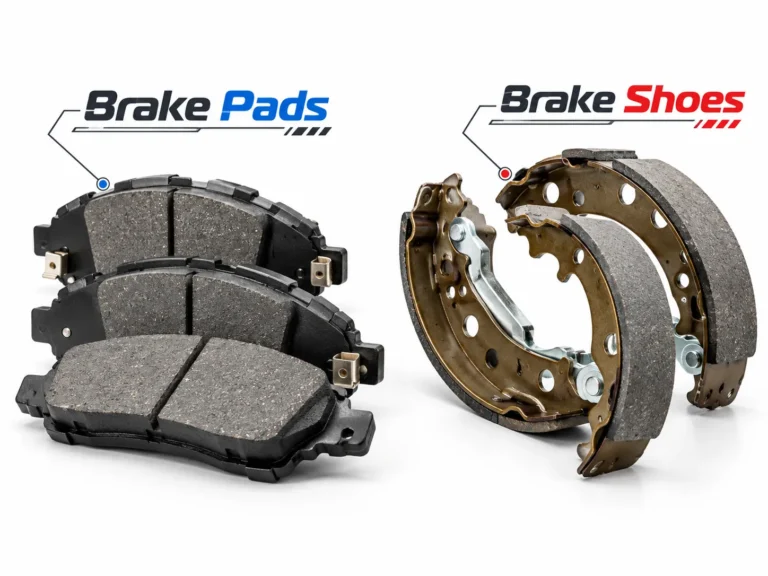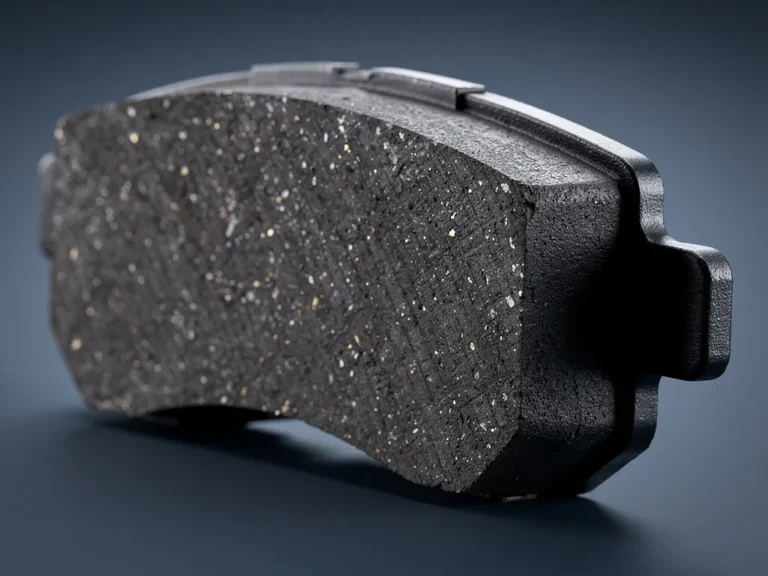
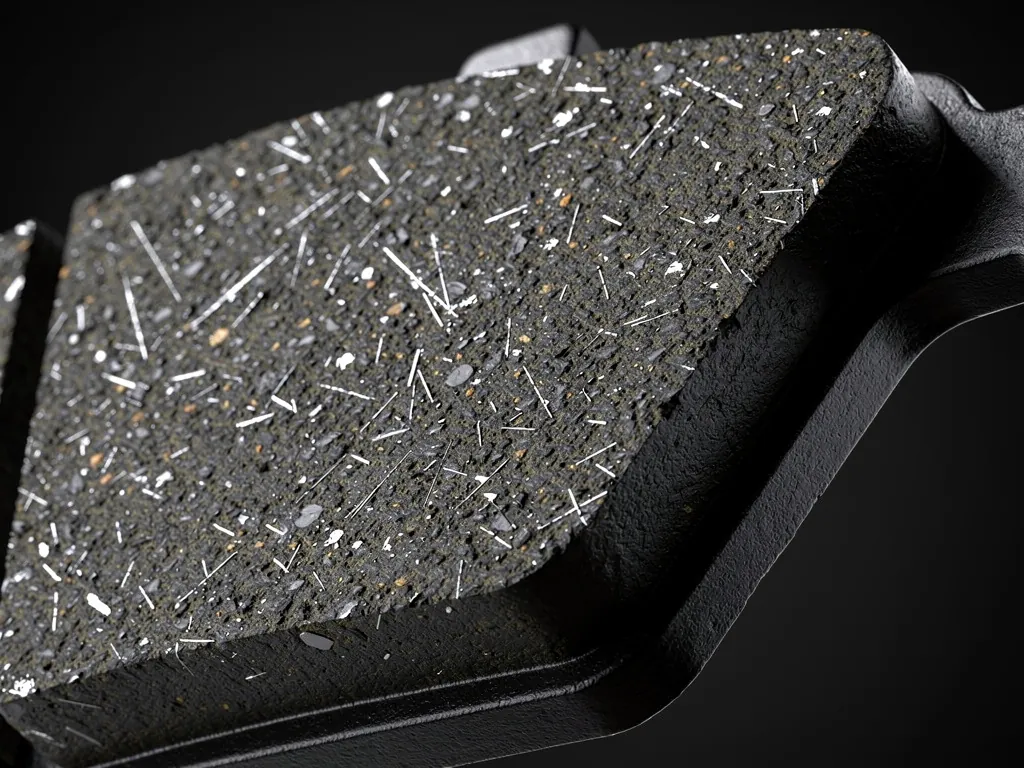

What are semi-metallic brake pads? They are disc brake pads whose friction material contains a large share of metal—usually steel fiber, iron powder and other metallic particles—bonded with resin, fillers and friction modifiers. That metal content gives them strong bite, good heat resistance and a long service record on SUVs, pickups and light trucks. It also brings more dust, more noise potential and more rotor wear than many ceramic formulations.
For a repair shop, that trade-off decides whether a brake job comes back. For an auto parts store or distributor, it decides which friction line to stock for which vehicles. This guide explains what semi-metallic brake pads are, how they perform, where they work best, when another material is the better call, and—because most of our readers buy pads by the carton—how to specify, test and source them so the friction you order is the friction you receive.
Semi-metallic pads run on the same Qingyuan lines as our ceramic and low-metallic ranges, so the production and bench results below are first-hand.
Semi-Metallic Pads in Brief
01
What Are Semi-Metallic Brake Pads?
Semi-metallic brake pads—often shortened to “semi-mets” or simply called metallic brake pads at the parts counter—are one of the three main families of passenger-vehicle brake pad materials, alongside ceramic and organic (NAO) formulations. Low-metallic pads sit between ceramic and semi-metallic as a fourth, related category.
What Makes a Brake Pad “Semi-Metallic”?
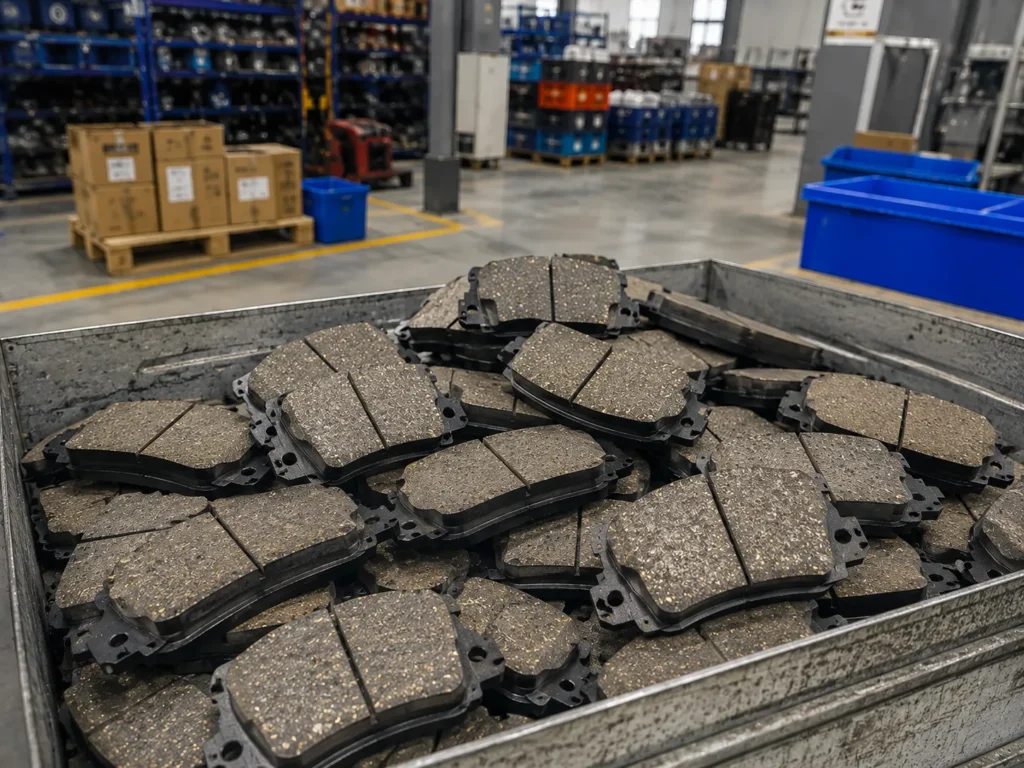
A brake pad is called semi-metallic when metal is a major structural part of the friction material rather than a minor additive. In practice that means:
- High metal content: typically around 30% to 65% of the friction material by weight, depending on the manufacturer and application.
- Steel fiber as the backbone: chopped steel wool or steel fiber reinforces the friction block and helps carry heat away from the rubbing surface.
- A resin-bonded composite, not solid metal: the metal is held together with phenolic resin, fillers and friction modifiers and then hot-pressed onto a steel backing plate.
The word “semi” matters. These are not fully sintered metal pads like those used on many motorcycles and some racing applications. They are composites in which metal does a lot of the work.
What Materials Are Commonly Used in Semi-Metallic Brake Pads?
A typical semi-metallic formulation includes several groups of brake pad materials, each with a job:
The exact recipe is each manufacturer’s core know-how, and small changes in fiber length, particle size or resin content can change friction, noise and wear noticeably.
Copper Limits That Changed Semi-Metallic Formulas
Brake friction formulations are also changing because of material restrictions. Under the U.S. EPA’s Copper-Free Brake Initiative, signed by EPA, states and the automotive industry in January 2015, copper content in motor-vehicle brake pads was targeted below 5% by weight by 2021 and below 0.5% by 2025.
The initiative also addresses lead, mercury, cadmium, asbestiform fibers and hexavalent chromium compounds, making material selection an increasingly important part of aftermarket brake-pad development. For semi-metallic formulas—where copper was traditionally used to help heat transfer and friction stability—this has pushed manufacturers to rebalance steel, iron, graphite and other modifiers to keep performance while meeting the limits.
How Semi-Metallic Brake Pads Differ From Other Friction Materials
For a full introduction to pad construction—backing plates, shims, wear indicators and how friction materials are classified—see our guide What Are Brake Pads? Types, Materials, Parts & How They Work.
02
What Are the Main Characteristics of Semi-Metallic Brake Pads?
Understanding semi metallic brake pad performance starts with the friction material itself. Each characteristic below comes directly from the metal-rich recipe.
Strong Initial Braking Response
Semi-metallic pads usually generate friction quickly when the pedal is applied. Drivers describe this as a firm “bite.” For heavier vehicles, that early response helps the brake system build deceleration without excessive pedal effort. For a light car, the same bite can feel grabby if the formulation is not matched to the vehicle.
Good Heat Resistance Under Repeated Braking
Semi metallic brake pad heat resistance is the main reason the material exists. Steel fiber and iron conduct heat away from the pad surface, and the metal-rich structure stays mechanically stable at temperatures where softer formulations begin to break down. That is why semi-metallic pads are common on vehicles that tow, carry payload or brake repeatedly on long descents.
Stable Friction Performance Across a Wide Temperature Range
A well-made semi-metallic compound keeps a usable friction level from cold morning stops up to high operating temperatures. That stability—rather than one high friction number—is what keeps pedal effort predictable. When friction drops sharply at high temperature, the result is fade; when it spikes at low temperature, the result can be grabbing or noise.
Noise Characteristics
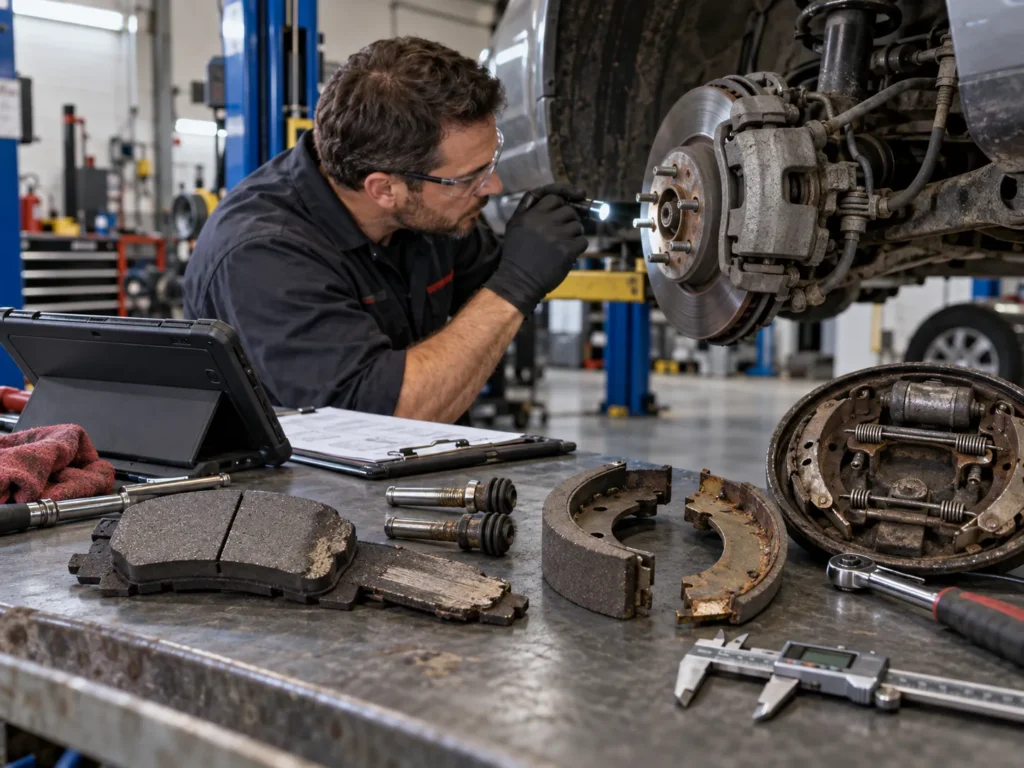
Metal-rich friction materials are stiffer and more abrasive than ceramic compounds. They can excite vibration in the pad, rotor and caliper, which is heard as squeal—especially at low speed and light pedal pressure. That does not mean every semi-metallic pad is noisy. Geometry, shims and installation decide a large share of the outcome. Chamfer and shim fit can move that result further than the compound does, as our low-speed squeal diagnosis documents in detail.
Brake Dust Characteristics
Semi-metallic pads usually produce more visible dust than ceramic pads. The dust contains iron particles from the steel fiber and from the rotor surface. Those particles oxidize and leave the dark, brown-black film that sticks to alloy wheels. Dust volume varies widely between formulations, so “semi-metallic” alone does not tell a buyer how dirty a pad will be.
Characteristics Summary
03
Are Semi-Metallic Brake Pads Good? Advantages and Benefits
So, are semi metallic brake pads good? Yes—for the right vehicle and duty cycle they are one of the most dependable friction choices in the aftermarket. The main semi metallic brake pads advantages are listed below.
Good Braking Performance Under Higher Loads
Brake energy rises with vehicle mass and speed. A loaded pickup or a seven-seat SUV asks far more of its pads on every stop than a compact sedan. Semi-metallic formulations are designed for that energy: they keep friction and structural strength when the pad is working hard.
Better Heat Management for Repeated Stops
Delivery routes, hilly terrain and stop-and-go traffic with heavy vehicles create repeated heat cycles. The metal content helps conduct and spread that heat, which reduces the risk of fade and glazing. For fleet buyers, that often translates into fewer complaints about long pedals after hard use.
Suitable for SUVs, Pickups and Light Trucks
Many original-equipment brake systems on body-on-frame SUVs, pickups and light commercial vehicles were developed around semi-metallic friction. Matching that friction type in the aftermarket keeps pedal feel and brake balance close to the original design.
Wide Aftermarket Application Coverage
Because semi-metallic pads have been used for decades across many vehicle platforms, application coverage is broad. Distributors can usually source semi-metallic options for most passenger-car, SUV and light-truck pad shapes, which simplifies catalog building.
Good Balance Between Performance and Cost
Semi-metallic raw materials are generally less expensive than premium ceramic blends. For many workshops and parts stores, a well-made semi-metallic line delivers the best performance per dollar on heavier vehicles, especially where wheel cleanliness is not the customer’s first concern.
04
What Are the Disadvantages of Semi-Metallic Brake Pads?
The semi metallic brake pads disadvantages are real, and buyers should plan for them rather than discover them through customer complaints.
Higher Brake Dust Levels
More metal in the pad and more abrasion on the rotor mean more visible dust. On passenger cars with open-spoke alloy wheels, this is the most common complaint about semi-metallic pads. If a store sells both ceramic and semi-metallic lines, counter staff should explain the difference before the sale.
Greater Noise Potential in Some Applications
Semi metallic brake pads noise is usually low-speed squeal or a harsher grinding feel during light braking. Typical triggers are missing or poor-quality shims, no chamfer, glazed rotors, dry slide pins and skipped bedding. The NVH case above shows how much geometry and shim design can change the result on the same vehicle.
Potential for Increased Rotor Wear
Steel fiber and abrasives remove more material from the rotor surface than ceramic compounds do. Over time that can mean shorter rotor life, especially with low-cost rotors of soft or inconsistent cast iron. When you quote a brake job or a fleet program, consider pad and rotor together.
Our brake rotors page explains the metallurgy, runout and thickness checks that help a rotor survive an aggressive friction material.
Less Smooth Pedal Feel Than Some Ceramic Formulations
Some drivers notice a firmer, less linear pedal with semi-metallic pads, particularly when cold. On heavy vehicles this is usually acceptable; on light passenger cars, a ceramic or low-noise formulation may feel more refined.
Pros and Cons Summary
Cutting Noise and Dust Comebacks on Semi-Metallic Jobs
Most semi-metallic comebacks are installation and expectation problems rather than pad defects.
A short routine prevents most of them
- Set expectations at the counter. Tell the customer the pad will bite harder and produce more dust than a ceramic pad. A complaint you predicted is not a comeback.
- Inspect or replace the rotors. Measure thickness and runout; resurface or replace glazed, lipped or out-of-spec rotors. A fresh, even surface is the best noise control you can buy.
- Clean the hub face. Rust or scale between hub and rotor causes runout, pulsation and uneven pad deposits.
- Service the caliper hardware. Clean and lubricate slide pins with the correct brake grease; replace worn abutment clips and anti-rattle springs.
- Check the shim. Confirm it is present, correctly seated and undamaged. Never reuse a delaminated shim.
- Bed the pads. Make 8–10 moderate stops from about 35 mph (55 km/h) to 5 mph (10 km/h) without stopping completely, then 3–5 firmer stops from about 45 mph (70 km/h), then drive gently to cool. This builds an even transfer layer and reduces early noise.
- Record the batch code. If the customer returns, you can trace the exact pad batch and give your supplier useful evidence.
05
Where Are Semi-Metallic Brake Pads Commonly Used?
Typical semi metallic brake pads applications follow one rule: the more energy the brakes must absorb, the more sense semi-metallic friction makes.
Passenger Cars
Many compact and mid-size passenger cars were originally fitted with semi-metallic or low-metallic pads, especially on the front axle. In the aftermarket they remain a common budget-to-mid-range option. For drivers who care about wheel cleanliness and quiet braking, ceramic pads are often the upgrade.
SUVs and Crossovers
Larger SUVs and seven-seat crossovers carry more weight and often tow small trailers. Semi-metallic pads suit these vehicles well, particularly on the front axle where most braking energy is absorbed.
Pickup Trucks
Semi metallic brake pads for trucks are the default choice in many fleets and workshops. Half-ton and heavier pickups that tow, haul or work on job sites benefit from the heat capacity and fade resistance of a semi-metallic compound.
Light Commercial Vehicles
Delivery vans, light commercial vehicles and ride-share or taxi fleets make many stops per day at high load. Here pad life and heat stability usually matter more than dust, which makes semi-metallic friction a practical choice.
Vehicles With Higher Braking Loads
Any vehicle that regularly tows, carries heavy payload, drives in mountains or brakes hard in traffic is a candidate. For these vehicles the risk of fade with a mismatched pad is a safety issue, not a comfort issue.
Application Summary
06
When Are Semi-Metallic Brake Pads a Better Choice?
There is no single best brake pad material for every vehicle. The semi metallic brake pads best uses come down to four situations.
When Higher Thermal Capacity Is Required
If the brake system regularly reaches high temperatures—long descents, towing, aggressive driving—choose a friction material built for heat. Semi-metallic formulations handle repeated heat cycles better than most standard ceramic compounds.
When the Vehicle Frequently Carries Heavier Loads
A vehicle that is often loaded close to its rated capacity needs pads that keep friction stable under higher clamping forces and temperatures. Semi-metallic pads are designed for that duty.
When Braking Performance Is Prioritized Over Low Dust
Fleet managers and work-truck owners usually care more about consistent stopping and pad life than about clean wheels. For them, the dust trade-off is acceptable.
When the Application Is Designed for Semi-Metallic Friction
If the original equipment used semi-metallic pads, the caliper, rotor and brake balance were developed around that friction level. Staying with the same friction type is usually the safest aftermarket choice.
How a Counter or Workshop Should Choose the Friction Type
- Identify the vehicle and axle. Confirm year, make, model, brake package and front or rear position.
- Check the original friction type. Use the OE part number or catalog notes; note whether the OE pad was semi-metallic, low-metallic or ceramic.
- Ask about use. Towing, payload, mountain driving or fleet duty point toward semi-metallic.
- Ask about priorities. If the customer’s first concern is clean wheels and quiet braking on a light car, offer ceramic.
- Check rotor condition. A semi-metallic pad on a worn or low-quality rotor increases noise and wear risk.
- Explain the trade-off. Tell the customer to expect more dust with semi-metallic pads before the sale, not after.
- Record the choice. Note the friction type on the repair order so comebacks can be traced.
07
Are Semi-Metallic Brake Pads Better Than Ceramic Brake Pads?
The question of semi metallic vs ceramic brake pads comes up at every parts counter. Which is better, semi metallic or ceramic brake pads? Neither is better everywhere. Here is the short version.
Braking Response
Semi-metallic pads usually bite harder and earlier. Ceramic pads feel smoother and more linear. Heavy vehicles benefit from the semi-metallic response; light cars often feel more refined with ceramic.
Heat Performance
Semi-metallic formulations generally handle sustained heat and repeated hard stops better. Standard ceramic pads perform well at normal temperatures but can fade sooner under heavy loads.
Noise and Dust
Ceramic pads are usually quieter and produce less visible dust. Semi-metallic pads produce more dust and have a higher noise potential, although shims and chamfers narrow the gap.
Vehicle and Driving Application
Choose semi-metallic for SUVs, pickups, light trucks and higher-load duty. Choose ceramic for commuter cars and drivers who prioritize comfort and clean wheels.
We compare the two materials in detail—including rotor wear, cost per service and application rules—in Ceramic vs Semi-Metallic Brake Pads: 8 Key Differences.
08
What Should Distributors Consider When Buying Semi-Metallic Brake Pads?
Choosing a semi metallic brake pad supplier is mostly about consistency. A sample that performs well means little if the next container is different. These are the points to check before placing wholesale semi metallic brake pads orders.
Application Coverage
Check that the supplier’s catalog covers the vehicles your customers actually drive, by OE number, FMSI number and vehicle application. Ask for a cross-reference list for your top-selling SKUs rather than a general catalog.
Friction Formula Consistency
The formula should be identified by a compound code and stay the same from batch to batch.
- What it means: the same raw materials, ratios, particle sizes and process settings for every production batch.
- What it affects: friction level, noise, dust, wear and pedal feel.
- How to judge: ask how raw materials are inspected, how mixing is controlled and whether friction is tested per batch.
- On the PO: “Semi-metallic compound code [XXX]; no change of formula or raw-material source without written approval.”
Backing Plate and Bonding Quality
The backing plate must be flat, the correct thickness and protected against corrosion, and the friction block must stay bonded under heat, load and road salt.
When Friction Material Leaves the Plate: Recall 20V-236
On April 28, 2020, Triumph Motorcycles filed NHTSA recall 20V-236 covering 3,691 motorcycles fitted with Brembo sintered front brake pads. The problem: the friction material could detach from the back plate, “especially but not exclusively when used in a corrosive environment,” and the failure could occur without warning.
The supplier traced the root cause to three factors: a high nickel concentration that reduced the bonded area during sintering, high compound porosity that let salt and water reach the interface, and micro-cracks on the back-plate surface that promoted penetration of salt and water. The remedy was to replace the front pads.
Those were fully sintered motorcycle pads, not resin-bonded semi-metallic car pads, but the lesson carries over directly: with metal-rich friction materials, bond strength, porosity and backing-plate corrosion protection are safety characteristics. Buyers should ask for shear test results—including after corrosion exposure where the market uses road salt—not only for friction data.
Shim, Chamfer and Slot Configuration
Because semi metallic brake pads noise is a common comeback, specify noise-control features rather than leaving them to the supplier’s default. Confirm shim type (multilayer, rubber-coated), attachment method, chamfer angle and length, and slot position against the OE pad or drawing.
Hardware and Wear Sensor Configuration
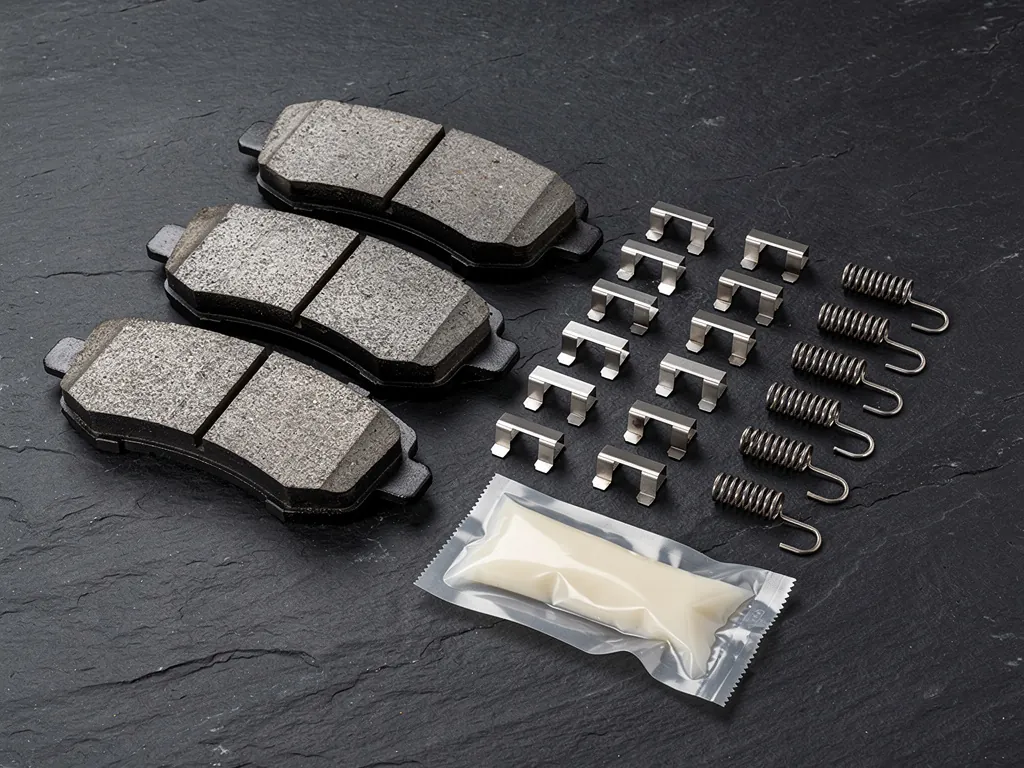
Check whether the pad set includes abutment clips, anti-rattle springs or electronic wear sensors, and whether the sensor type and wire length match the vehicle. Missing hardware is one of the most common reasons a “correct” pad is returned.
Batch Traceability and Quality Records
Each pad and carton should carry a batch or date code that links back to production and inspection records. When a warranty claim arrives, traceability decides whether you can isolate one batch or must recall a whole SKU.
Semi-Metallic Brake Pad Purchasing Checklist
A Semi-Metallic Line Item, Written Out
A complete semi-metallic line item reads like a small specification, not just a part number. For example: “Front disc brake pad set, OE [number] / FMSI [number]; semi-metallic compound [XXX], copper Level N; edge code [FF]; multilayer rubber-coated shim, clip-on; 15° × 4 mm chamfers both ends, center slot; acoustic wear indicator on inner pad; shear strength per ISO 6312 tested per batch; batch code laser-marked on backing plate; packed 1 set per box, 20 boxes per carton.” Every bracketed value should be agreed with the supplier and confirmed on the approved sample.
Evaluating a New Semi-Metallic Brake Pad Supplier
- Shortlist by coverage. Send your top 50–100 SKUs and ask what percentage the supplier can cover with semi-metallic friction.
- Request compound documentation. Ask for the compound code, intended applications, friction data and copper level.
- Order paid samples of your fastest-moving SKUs, including at least one heavy SUV or pickup application.
- Inspect samples for dimensions, shim fit, chamfers, slots, hardware and markings against your current product.
- Run a fit and road check in a partner workshop on two or three vehicles, including a bedding procedure and a noise check at low speed.
- Review quality records: how batch testing is done, what happens to a failed batch, and how long records are kept.
- Start with a trial order, then expand the line once the first months of sales show normal return rates.
For our own semi-metallic, ceramic and low-metallic ranges, application coverage and packaging options, see our brake pads range.
09
How Is Semi-Metallic Brake Pad Quality Tested?
Brake pad quality testing has two goals: prove the design works, and prove every batch matches the approved design. Good brake pad quality control covers both.
What the IATF 16949 Audit Asked For
During our IATF 16949 certification work at our Qingcheng District facility in Guangdong—the certificate was issued on June 6, 2025—I saw that passing an external quality audit involved much more than submitting finished brake-pad samples.
We had to connect material records, production controls, inspection results and batch traceability so that a finished product could be traced back through the manufacturing process.
That experience is why we now treat production records and repeatable QC procedures as part of the product itself, not simply paperwork for certification.
Dimensional Inspection
Dimensional checks confirm that the pad fits and wears correctly.
- Pull samples from several points in the batch, not just the first cartons.
- Measure the backing plate outline against the drawing or a go/no-go gauge.
- Measure total thickness and friction thickness at several points with a caliper or thickness gauge.
- Check flatness and parallelism of the friction surface.
- Check chamfer, slot and wear-indicator position against the drawing.
- Record results with the batch code and accept or quarantine the lot.
Shear Strength Testing
Shear testing measures how strongly the friction block is attached to the backing plate. As defined by ISO 6312, the shear test procedure for disc brake pad assemblies applies a load until the friction material separates and records the force at failure; the standard covers integrally moulded, bonded and mechanically retained pads and recommends elevated-temperature testing around 300°C for disc pads. Buyers should look at both the value and the failure mode—a break inside the friction material is generally preferred to a clean separation at the bond line.
Hardness and Compressibility Testing
Compressibility affects pedal travel and feel. ISO 6310 describes compressive strain test methods for brake linings, measuring how much the pad compresses under defined pressure. Hardness checks (often on a Gogan or Rockwell-type scale, depending on the factory) help confirm that curing and density are consistent from batch to batch. A pad that is too soft can give a long pedal; one that is too hard can be noisy.
Friction and Wear Evaluation
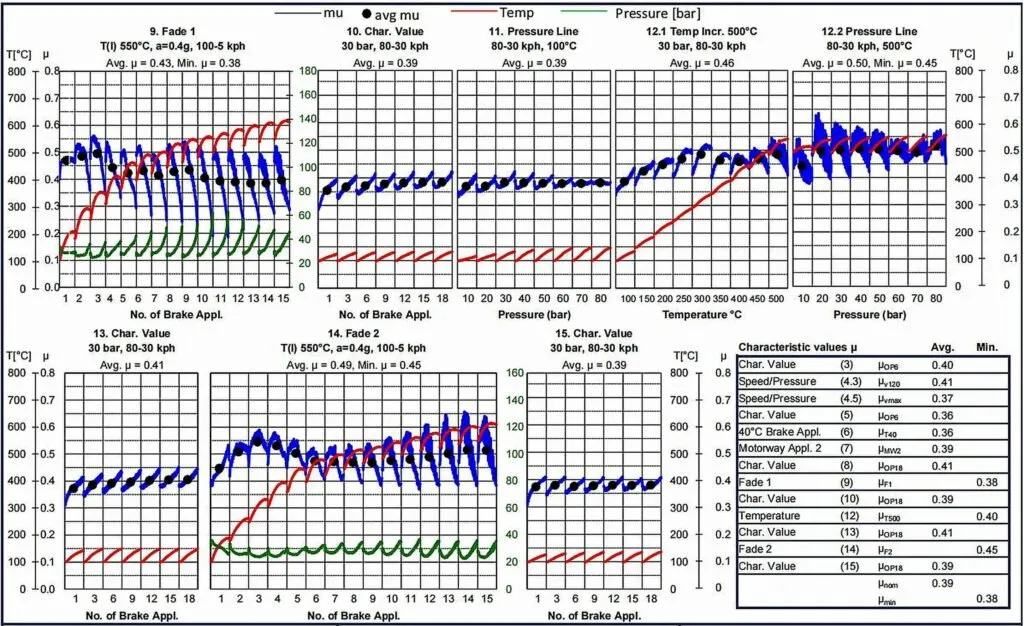
Friction must be stable, not just high.
SAE J661 and Why One Friction Number Is Not Enough
A useful benchmark is SAE J661, the Brake Lining Quality Test Procedure, which establishes a uniform laboratory procedure for obtaining and reporting friction and wear characteristics—data used for in-plant quality control by friction manufacturers and for quality assessment of incoming shipments by buyers.
Industry testing reported by The BRAKE Report also shows why one friction number is not enough. As described in “Benchmarking Matters”, AK Master testing evaluates the friction coefficient across changes in temperature, speed and pressure, and its nominal value is normally in the range of roughly 0.35–0.45. A semi-metallic pad that holds its friction level through fade and recovery stages is worth more than one with a high peak value and a sharp drop when hot.
NVH Evaluation
NVH (noise, vibration and harshness) testing is usually done on a dynamometer with the vehicle’s caliper and rotor, running a matrix of pressures, speeds and temperatures and counting noisy stops. For semi-metallic pads, NVH results should always be tied to the production shim and chamfer—our low-speed squeal diagnosis shows how much those two features move the result.
You can see how we apply these checks from incoming materials to shipment in our quality inspection process.
10
How Are Semi-Metallic Brake Pads Manufactured?
Knowing how semi metallic brake pads are made helps buyers ask better questions. The brake pad manufacturing process has seven main stages.
Inside Our Pad Line: Mixing to Final Inspection
Through 2026 I followed batches end to end at our Qingcheng District brake-parts factory in Guangdong, China—mixing, hot pressing, curing, grinding, chamfering and final inspection.
Across our three brake-parts production lines, daily output is approximately 2,500+ pieces, so maintaining formulation consistency and dimensional control from batch to batch is more important to us than simply increasing production speed.
Friction Material Mixing
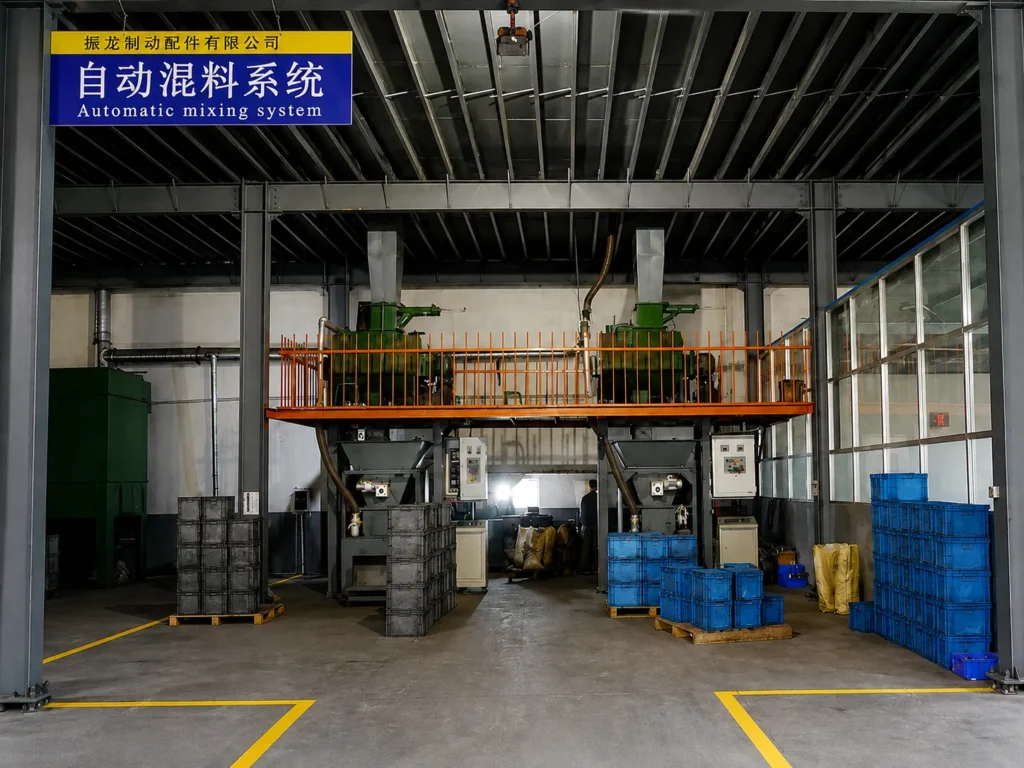
Raw materials are weighed to the formula and blended until fibers and powders are evenly distributed. Steel fiber is prone to clumping, so mixing time and sequence matter. Poor mixing shows up later as uneven friction, hot spots and noise. Buyer question: how are raw materials checked on arrival, and is each mix batch recorded with its formula and weights?
Backing Plate Preparation
Steel backing plates are stamped, cleaned, shot-blasted to roughen the bonding surface and coated with adhesive. Clean, correctly prepared plates are the foundation of shear strength—and, as the recall case above shows, of corrosion resistance at the bond line. Buyer question: what plate thickness and steel grade are used, how is flatness checked, and what coating protects the plate in salt-belt markets?
Hot Pressing
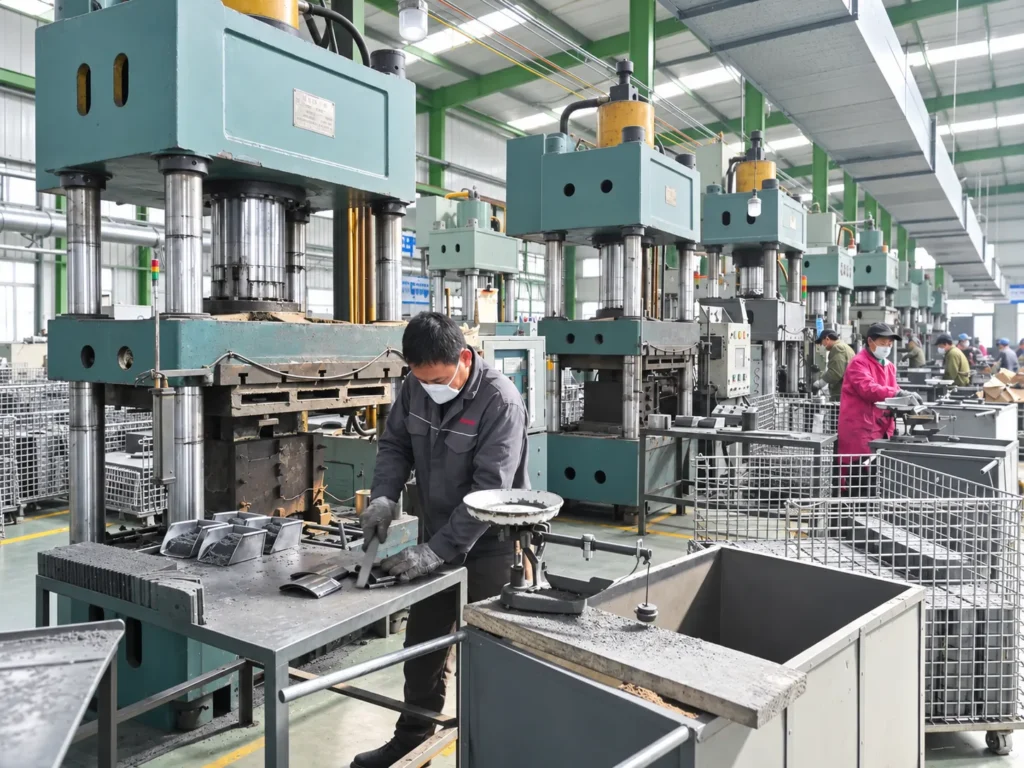
The mixed material, sometimes pre-formed, is placed in a mould with the backing plate and pressed under heat and pressure. Pressure, temperature and time control density, porosity and bond quality. Buyer question: are press parameters fixed per compound and recorded per shift, and how are the first pads of each run checked before full production continues?
Curing
Pressed pads are baked in ovens on a controlled temperature profile to complete the resin cure. Under-curing leaves the pad soft and unstable; over-curing can make it brittle. Many factories also scorch the surface to reduce green fade during the first stops. Buyer question: is the curing profile controlled by recorded oven temperature logs, and are pads scorched for your application?
Grinding, Chamfering and Slotting
The friction surface is ground flat to the correct thickness, then chamfers and slots are cut. These features are critical for noise control on semi-metallic pads.
Shim and Hardware Assembly
Shims are bonded or clipped to the backing plate, and wear sensors or hardware are added where the application requires them.
Final Inspection and Packaging
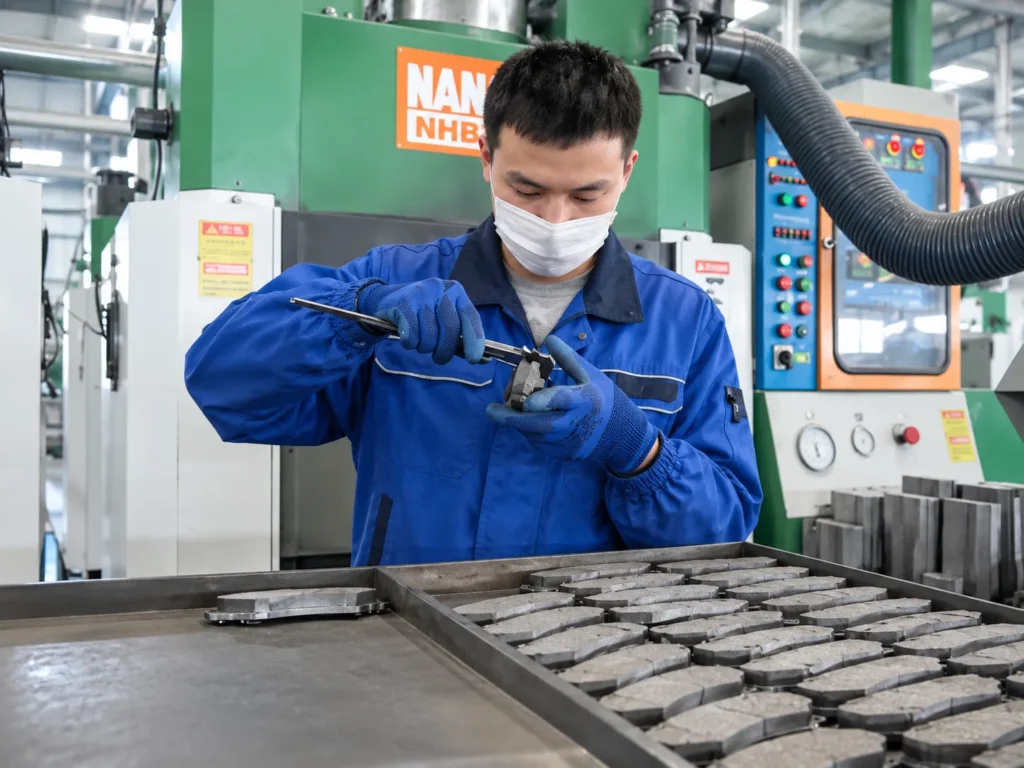
Each batch is inspected for dimensions, appearance and markings, then packed with batch codes on pads and cartons.
Semi-Metallic Brake Pad Production Flow
- Inspect incoming raw materials and backing plates.
- Weigh and mix the friction formula.
- Prepare and coat backing plates.
- Hot-press friction material onto the plates.
- Cure in ovens; scorch the surface if specified.
- Grind to thickness; cut chamfers and slots.
- Fit shims, sensors and hardware.
- Inspect, mark with batch codes and pack.
To see the equipment and lines behind these steps, visit our brake parts factory page.
11
Semi-Metallic Brake Pads for Wholesale and Aftermarket Programs
For distributors, importers and retail chains, working with a semi metallic brake pads manufacturer is less about one pad and more about running a program.
Mixed-SKU Orders
Most aftermarket buyers need many pad shapes in modest quantities rather than one shape in bulk. A practical supplier should accept mixed-SKU orders across pads—and ideally rotors and shoes—so you can fill a container with your real demand instead of overstocking slow movers.
A simple way to build a mixed order
- Export 12 months of sales by part number and rank SKUs by units sold.
- Split the list into fast movers, medium movers and slow movers.
- Mark the friction type you want per SKU—semi-metallic for SUVs, pickups and fleet vehicles; ceramic where low dust is the selling point.
- Ask the supplier to quote the full list, flagging any SKU it cannot cover or that needs a new tool.
- Set quantities to cover your lead time plus safety stock for fast movers, and smaller trial quantities for slow movers.
- Confirm packing so each SKU is boxed, labeled and palletized for easy receiving.
OE, FMSI and Aftermarket Reference Matching
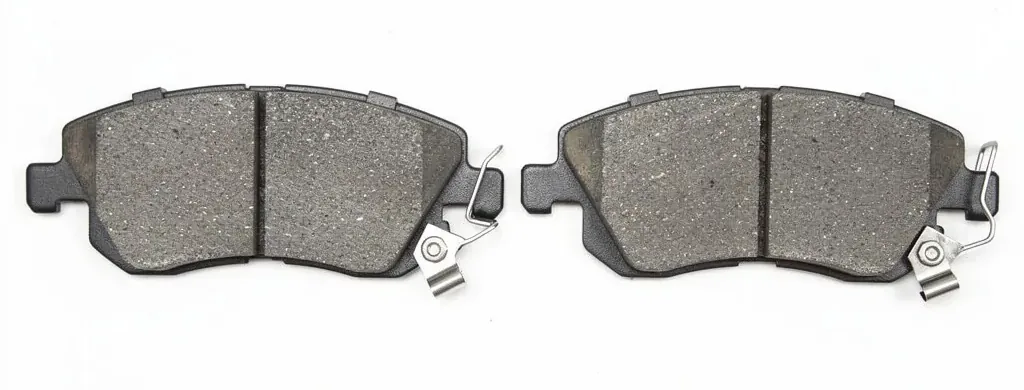
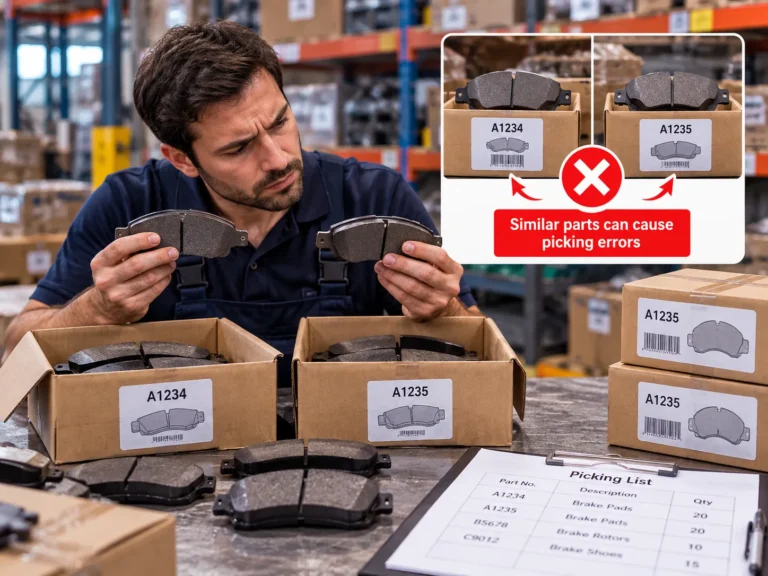
Every SKU should be matched by OE number, FMSI number and, where relevant, other aftermarket references. Ask the supplier to confirm each reference and flag shapes that look identical but differ in thickness, sensor or backing-plate detail.
Private-Label Packaging
Many wholesale semi metallic brake pads programs run under the buyer’s own brand. Confirm box design approval, barcode and label content, multilingual instructions, and how batch codes appear on private-label packaging.
Passenger Car, SUV and Light-Truck Coverage
A strong semi-metallic program covers passenger cars, SUVs and light trucks in one catalog, with clear labeling of which lines are intended for higher-load use.
Sample Confirmation Before Bulk Orders
Before the first bulk order, confirm samples step by step
- Send your SKU list with OE/FMSI numbers and target market.
- Receive and check samples against your current product: dimensions, shim, chamfer, slot, hardware and markings.
- Fit-test a few samples on real vehicles in a partner workshop.
- Review test data for the compound: friction, shear, compressibility and copper level.
- Approve in writing, including compound code and packaging artwork.
- Place the bulk order referencing the approved sample and specification.
If you are building or expanding a semi-metallic line, our brake pads team can prepare a cross-reference and sample plan for your SKU list.
12
Frequently Asked Questions About Semi-Metallic Brake Pads
Are Semi-Metallic Brake Pads Noisy?
They can be noisier than ceramic pads, especially at low speed. Are semi metallic brake pads noisy by default? No—with the right shim, chamfer, slot and a properly surfaced rotor, most applications run quietly. Specify noise-control features on your PO.
Do Semi-Metallic Brake Pads Create More Dust?
Yes. They usually produce more and darker dust than ceramic pads because of their steel and iron content. If clean wheels matter most to the customer, recommend ceramic.
Do Semi-Metallic Brake Pads Wear Rotors Faster?
Generally yes, because steel fiber and abrasives remove more rotor material. Pair them with good-quality rotors and replace or resurface rotors when they are out of specification.
Are Semi-Metallic Brake Pads Good for SUVs and Trucks?
Yes. Semi metallic brake pads for trucks and SUVs are a common choice because they handle heat and heavy loads well, especially for towing, payload and fleet use.
How Long Do Semi-Metallic Brake Pads Last?
There is no fixed number. How long semi metallic brake pads last depends on vehicle weight, driving conditions and rotor and caliper condition. On many vehicles they last well under normal use, and in high-heat duty they often outlast standard ceramic pads.
Are Semi-Metallic Brake Pads Better Than Ceramic Brake Pads?
For heavy loads and heat, often yes; for quiet, clean braking on passenger cars, usually not. Choose by vehicle and duty cycle.
Do Semi-Metallic Brake Pads Rust?
The steel content can show surface rust after rain or washing, which usually wears off in the first stops. Corrosion at the backing plate and bond line is more serious, so buyers in salt-belt markets should ask about plate coating and corrosion-related shear testing.
Can I Switch From Ceramic to Semi-Metallic Brake Pads?
Usually, if the pad shape and application are correct. Expect more bite, more dust and possibly more noise. For vehicles designed around a specific friction level, follow the OE friction type.
What Should I Ask a Semi-Metallic Brake Pad Supplier?
Ask for the compound code, batch friction data, shear and compressibility results, copper level, shim and chamfer specification, cross-reference list and batch traceability. Then approve samples before the first bulk order.