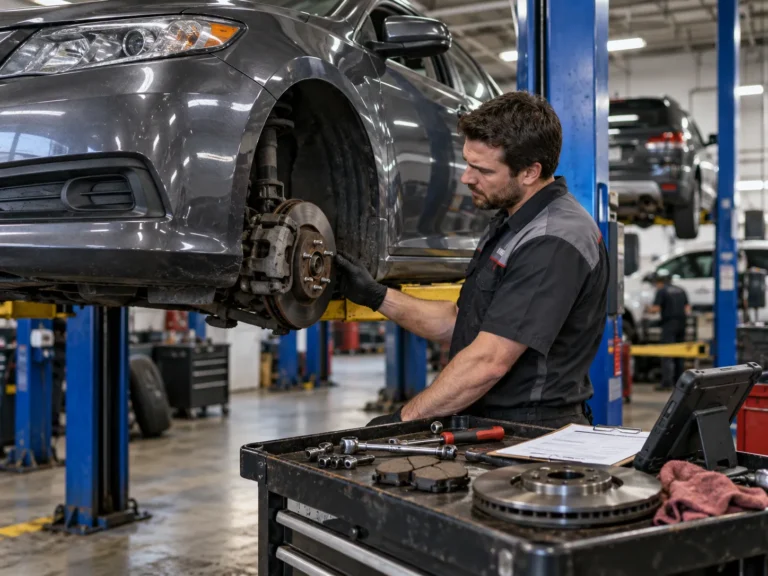

Sourcing brake pads from China comes down to seven steps: define the product and market, prepare OE and FMSI references, verify the manufacturer, approve samples, confirm MOQ and order terms, agree the QC plan, and release production and shipment. The country is not the main risk. The main risk is skipping a step and discovering the problem after the container arrives.
This guide is for distributors, auto parts stores and private-label buyers who know the applications they need but want a repeatable sourcing process. It covers the information to send, the questions to ask, the numbers to compare and the documents to keep. It does not replace a sample approval or a supplier audit; it shows where those checks belong in the order.
Disclosure: Top Brake Parts, the publisher of this guide, is a brake pad manufacturer in Qingyuan, Guangdong. The checks below apply to any Chinese brake pad supplier, including us.
What This Guide Will Not Do
It will not give you one “correct” price for brake pads from China. Friction material, shim and hardware content, packaging, MOQ and trade term change the quote. It gives you a comparison framework that makes those differences visible.
01
How Do You Source Brake Pads from China?
You source brake pads from China in seven steps: define the product and market requirements, prepare OE/FMSI or existing supplier references, shortlist and verify manufacturers, approve samples, confirm MOQ and order terms, define QC before the deposit, and approve production, packaging and shipment.
Each step produces a document the next step depends on. A sample cannot be approved without a part number and specification. A deposit should not be paid without an approved sample and a QC plan. A shipment should not be released without approved packaging and a final SKU list.
Step 1 — Define Your Product and Market Requirements
Start with the vehicle applications and the market, not the supplier. For each reference, record the axle, the friction material the vehicle was designed around, the duty cycle, the destination country and any certification the market requires. A ceramic pad for a quiet commuter and a semi-metallic pad for a loaded SUV may share a shape but not a specification.
The market requirement is part of the product requirement. An EU-bound pad may need ECE R90 approval for that part number. A U.S.-bound pad may need an AMECA registration or a copper declaration, depending on the state and customer. A private-label program may need artwork, barcode and batch-code approval before production. Write these down before asking for a price.
The output is a one-page requirement sheet: applications, axle, material, quantity, packaging, destination and certification. It becomes the cover page of every RFQ.
Step 2 — Prepare OE, FMSI or Existing Supplier References
A brake pad reference tells the supplier what to make. The OE number is the strongest because it identifies the vehicle manufacturer’s part. The FMSI number is the North American aftermarket reference; the WVA number is widely used in Europe. An existing supplier number is useful when changing suppliers, but it must be cross-checked against the OE or application.
Send the reference exactly as it appears, including prefixes, suffixes and supersessions. A missing digit can change the pad, shim or sensor. If you have no number, send the make, model, year, engine and axle. If you have an old pad, send clear photos of the backing plate, friction surface, shim and sensor connector.
Mark each line as exact OE, FMSI, WVA, supplier number, vehicle application or photo-only. A supplier can then tell you which lines need more information before quoting.
Step 3 — Shortlist and Verify Brake Pad Manufacturers
Shortlist suppliers that can show a legal company name, a factory address, the processes they perform in-house and the certificates that apply to your products. A trading company can be a legitimate partner, but you should know which company makes the pads and who owns the batch record.
Verification is not a certificate check alone. Ask for the business license name, the factory address on the certificate, the quality-system scope, the part numbers covered by ECE R90 or AMECA, and a sample batch record. If the certificate cannot be connected to the product and the production site, it does not reduce your risk. Our guide to verifying a Chinese brake pad manufacturer lists the document trail.
The output is a short list with evidence: legal name, factory, in-house processes, certificate numbers and validity dates, application coverage and a named contact. Two or three verified suppliers are enough; twenty unverified names are not a shortlist.
Step 4 — Approve Samples Before Bulk Production
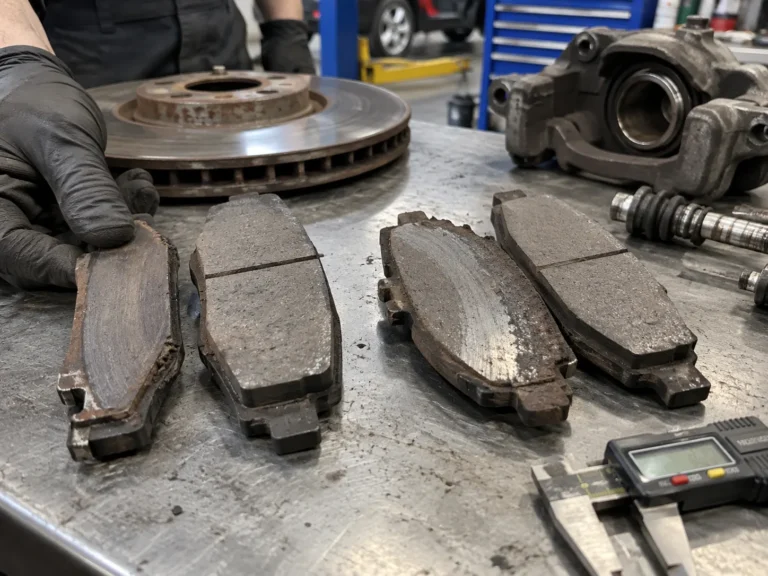
A sample is the cheapest place to catch a fitment, hardware, friction or packaging problem. Approve it against a written checklist, not by looking at it on a desk. Check the backing plate, friction thickness, shim, clips, wear-sensor connector and pad-to-bracket fit. For private label, check the box, label, barcode and batch-code position.
Record what you approved: part number, sample date, supplier, sample or batch ID, measurements, photos and any deviation. The approved sample becomes the reference for the bulk order. If the supplier later changes a shim, a friction source or a packaging printer, revisit the approval.
Our sample terms are in the sample section. The sequence matters: approve the sample before paying a bulk deposit, not after the line has started.
Step 5 — Confirm MOQ, Pricing and Order Terms
MOQ, price and order terms are one package. A price without the MOQ, Incoterm and payment term is not comparable. Ask the quotation to state the MOQ model (per part number, per order or per category), what can be mixed, the lead time, the payment schedule, the trade term and the named port or place.
Check whether the quote includes the shim, clips, wear sensor, hardware kit, box and label. A lower unit price may exclude items the higher quote includes. Ask for a line-by-line quote using your SKU list, not a single “average price.” If the supplier cannot quote line by line, you cannot compare offers or verify the invoice later.
The output is a quotation and proforma invoice that match the requirement sheet. Resolve differences before the deposit, not at shipment.
Step 6 — Define QC Requirements Before Paying the Deposit
The QC plan should exist before production, not after a problem. Agree what will be inspected, how it will be measured, which records will be kept and what happens if a batch fails. For brake pads, the core checks usually include dimensions, backing-plate flatness, shim and hardware, friction appearance, shear strength, compressibility, friction performance and, where specified, NVH.
Name the test method and acceptance criterion in the purchase order. “Good quality” is not a criterion. A drawing with tolerances, an edge code, a shear value and a batch record are. If the supplier cannot state the method, ask how the result was obtained and whether the report belongs to the same compound and batch.
The output is a written QC plan attached to the PO. It should also state the batch-code format, the retention sample and the claim response time. Our quality inspection process shows how these checks are staged.
Step 7 — Approve Production, Packaging and Shipment
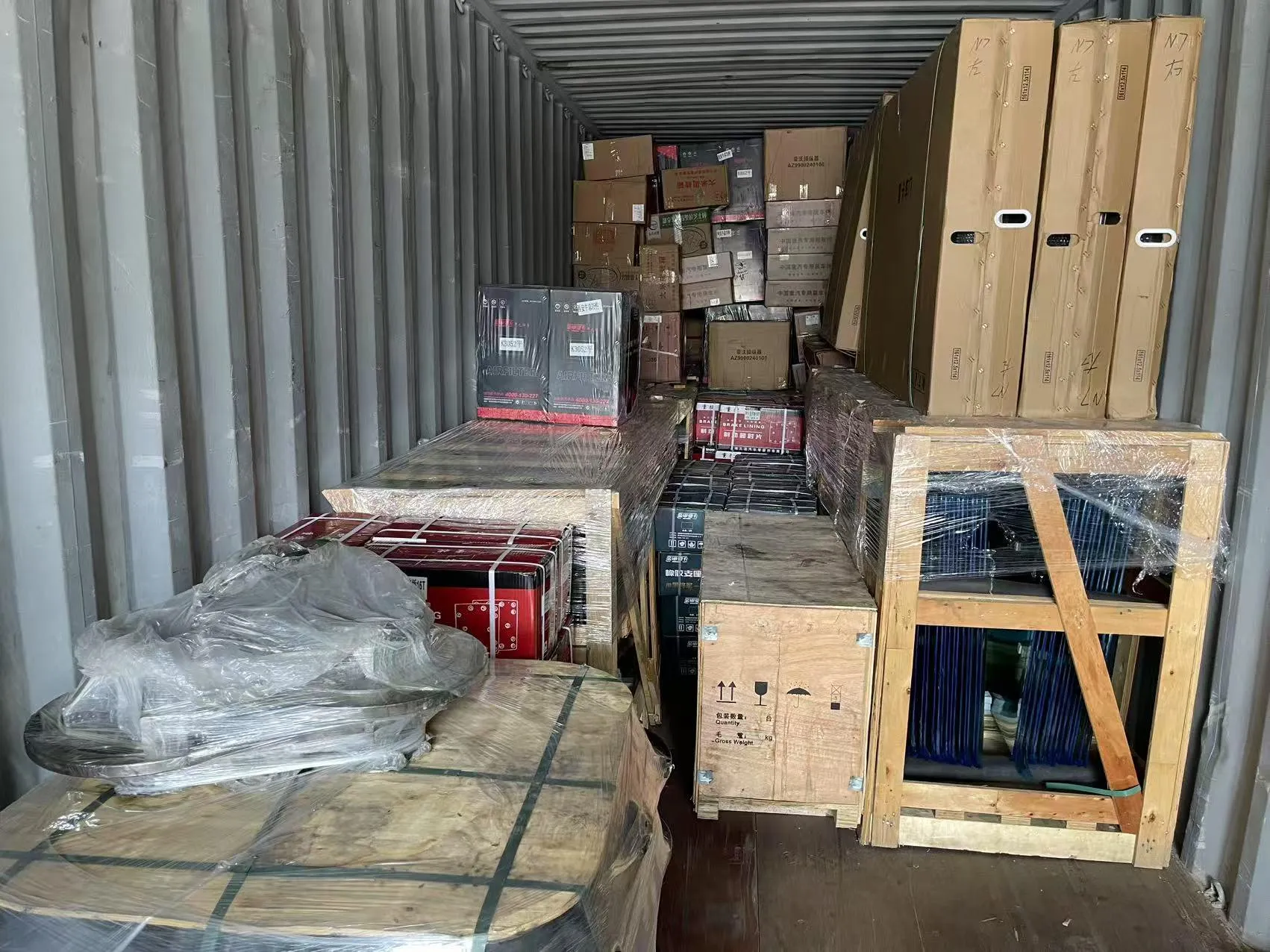
Before the container is sealed, compare the final SKU list and quantity with the PO, approve packaging and labels, collect batch and QC records, confirm carton and pallet details, and check the shipping documents. The balance should release against those documents, not a verbal “ready.”
This is the last point where a mistake is cheap to fix. A wrong label can be reprinted; a wrong pad in the box cannot. For a mixed order, check a sample from every reference against the approved list, not only the first carton. The pre-shipment checklist later in this guide lists the documents and physical checks.
If you already have a part list, send it with your destination and packaging requirement. Our team can review the references and flag what is missing before quoting.
Send your OE, FMSI or existing supplier list to our brake pad supply team with quantities, destination and packaging requirement. We will flag the lines that need a photo or sample before quoting.
02
What Information Should You Prepare Before Contacting a Brake Pad Supplier?
Before contacting a brake pad supplier, prepare six things: the OE, FMSI or existing supplier references; the vehicle applications and axle positions; the friction material or OE material requirement; the quantity per reference; the packaging and private-label requirement; and the destination country and trade term. A complete RFQ gets a comparable quote in one round.
Most slow quotations are caused by an incomplete RFQ, not by the factory. If the supplier has to ask for the axle, quantity, market or packaging after the first email, the quote is delayed or built on assumptions.
OE, FMSI and Aftermarket Reference Numbers
The OE number ties the pad to the vehicle manufacturer’s specification. The FMSI number is the North American aftermarket reference; WVA numbers are widely used in Europe. An existing supplier number is useful for a like-for-like change but should be cross-checked against the OE or application.
Send all the references you have, not just the one you think is official. If they conflict, say so. A supplier that can explain the conflict is more useful than one that silently picks a number. Include the supersession history if the manufacturer replaced an earlier part.
Vehicle Applications and Axle Position
A reference can cover several model years and engine variants, but front and rear pads are never the same reference. Record the axle for every line. For vehicles with more than one brake package in the same model year, add the VIN or brake option code.
The application also tells the supplier which market the pad is for. A North American SUV and a European compact may use different friction levels, wear sensors and shims even when the outline looks similar. A photo alone is not an application.
Ceramic, Semi-Metallic or Other Friction Material Requirements
If you know the friction family, state it. If you want to match the OE material, say “OE material” and send the OE number; the supplier can confirm what the original pad used. Ceramic, semi-metallic and low-metallic pads differ in friction, dust, noise, rotor wear and price.
Do not choose a friction family only by price. A ceramic pad may suit a quiet commuter but not a towing vehicle; a semi-metallic pad may handle heat but produce more dust and rotor wear. Our guides to ceramic, semi-metallic and low-metallic pads explain the trade-offs.
Quantity Per SKU
Quantity is not a single total. Send the quantity per reference and the total. The supplier needs both to check the MOQ model and plan the press, grinding and packaging schedule. If the order is a first trial, say so; a trial still has to meet the MOQ, but the supplier may help you choose references that make the first order useful.
If you have no sales history, use the vehicle population you serve and the repair-shop demand you see. A parts store with a broad, shallow range needs different quantities from a distributor with known fast movers.
Packaging and Private-Label Requirements
Packaging is part of the product. State whether you need a white box, neutral box, private-label box or custom color box. Send the artwork, barcode, label content and market-specific warnings. Confirm where the batch code, part number, application and country of origin must appear.
Private-label packaging adds approval steps and may add a minimum print quantity. Ask for a packaging sample before bulk printing. If the box is in one language and the label in another, check both. A beautiful box with the wrong part number is still a recall.
Destination Country and Trade Terms
The destination changes the documents and sometimes the product. The EU may require ECE R90 approval for the part number. The United States may require an AMECA registration or a copper declaration for certain states. The destination also determines whether the quote should be EXW, FOB, CIF or DDP.
Ask for the named port or place. “FOB China” is not a price; “FOB Shenzhen” or “FOB Ningbo” is. If the quote is DDP, confirm who is the importer of record, who pays duty and taxes, and who handles unloading. The trade term changes the landed cost.
What a Usable RFQ Looks Like
The RFQs that get a fast, accurate quote include the OE or FMSI number, the vehicle application and axle, the quantity per reference, the destination market and the packaging requirement. The ones that ask for “the best price for brake pads” usually need three rounds of questions before anyone can quote.
Keven, Sales Manager, Top Brake Parts
Before You Send the RFQ
✓Reference: OE, FMSI, WVA or current supplier number for every line.
✓Application: make, model, year, engine and front/rear axle.
✓Material: ceramic, semi-metallic, low-metallic or OE material.
✓Quantity: quantity per reference and total order quantity.
✓Packaging: box type, artwork, barcode and batch-code position.
✓Destination: country, port or door, and the requested Incoterm.
✓Certification: ECE R90, AMECA, copper declaration or other.
03
How Should Distributors Choose a Brake Pad Manufacturer in China?
Distributors should choose a manufacturer by verifying the legal company and factory, confirming in-house production, checking application coverage, reviewing test reports and certificate scope, and testing batch traceability and complaint handling. Price is a comparison point, not a qualification.
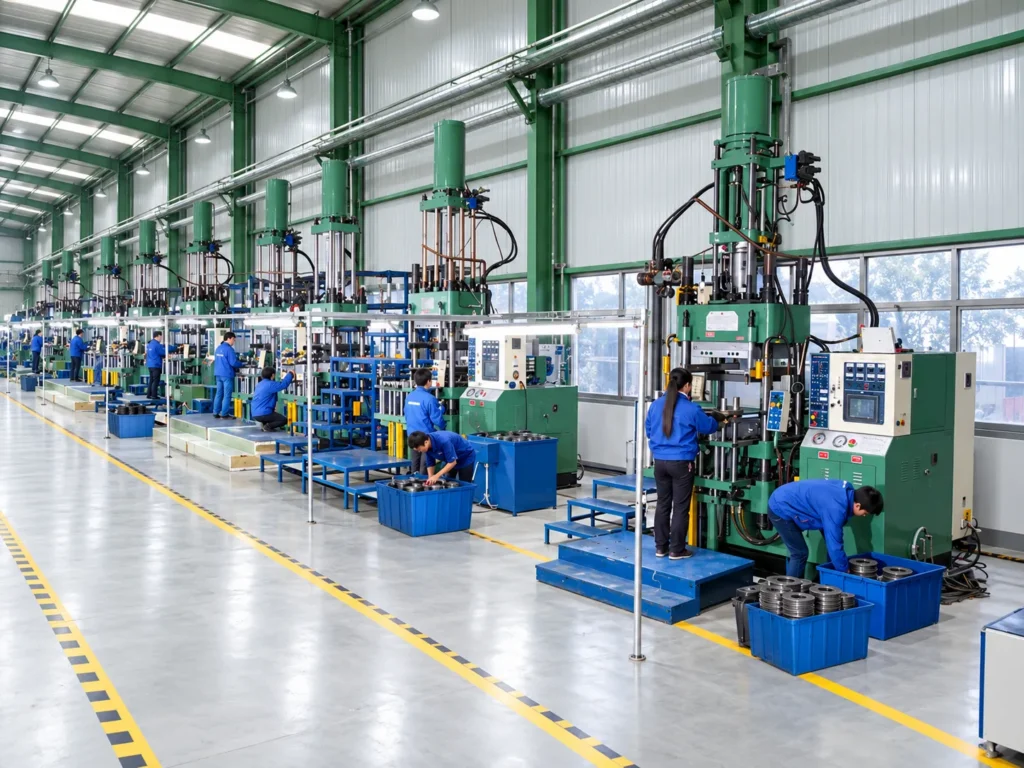
A factory that makes pads, rotors and shoes under one roof is not automatically better than a specialist. What matters is control over the processes that affect your part numbers: friction mixing, hot pressing, heat treatment, grinding, shim bonding, marking and packing.
Verify the Legal Company and Factory
Start with the name on the business license. Compare it with the quotation, proforma invoice, certificate and bank account. If the names differ, ask for the relationship in writing. A brand name is not a legal entity, and a certificate issued to a related company does not automatically cover the site you are buying from.
Check the factory address on the certificate against the quotation. If the certificate covers a different site, ask which site will make your order and whether it is in scope. This decides who is accountable if a batch fails.
Check Whether Brake Pads Are Actually Produced In-House
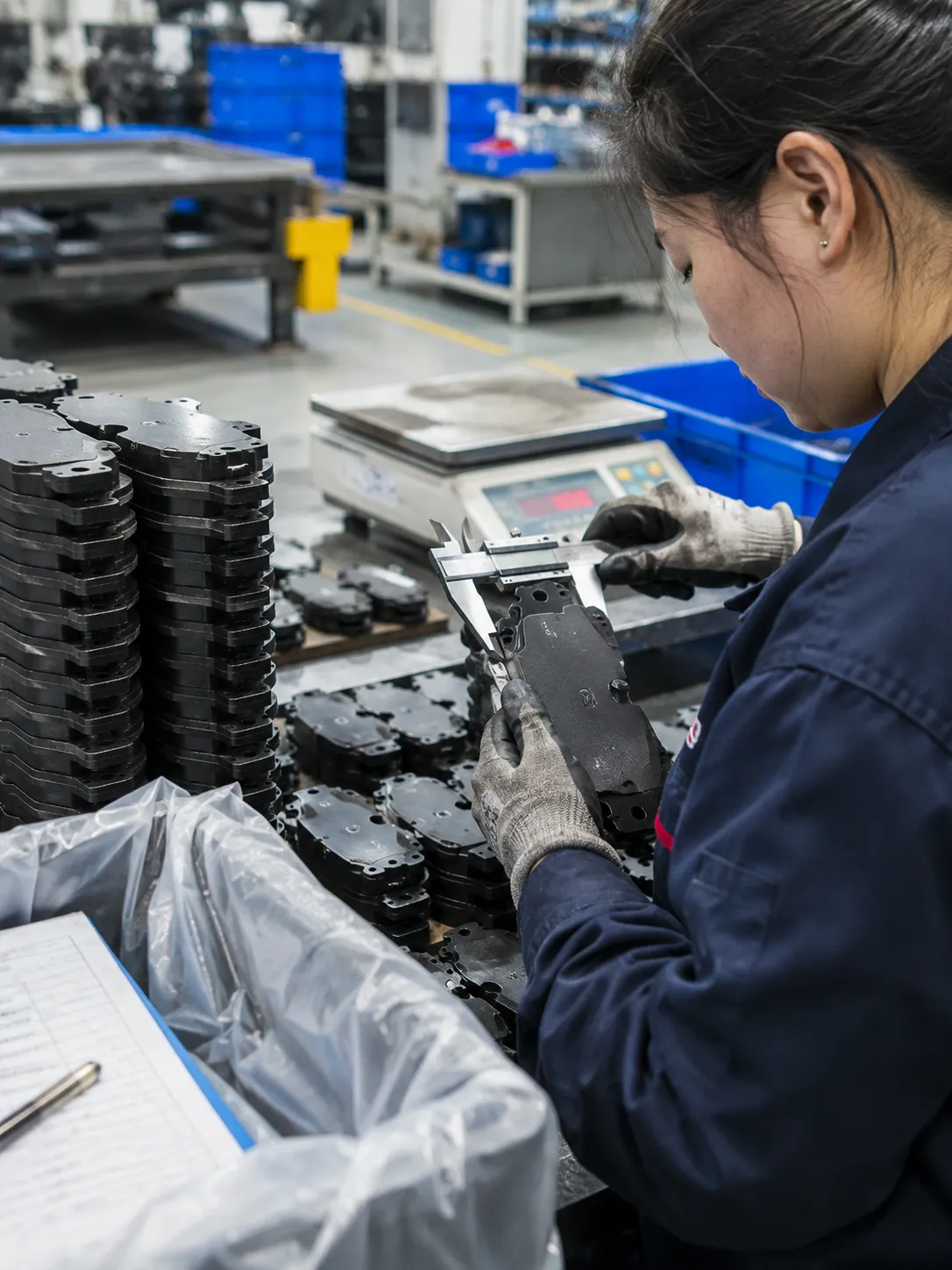
Ask which processes are in-house: friction mixing, hot pressing, heat treatment, grinding, shim bonding, marking and packing. A supplier may assemble or pack pads without making the friction material. That can be valid, but the QC and traceability questions change.
Request a short video or live call that shows the line and the batch records, not only the showroom. If the supplier cannot show the process, ask for the company that performs it. A supply chain you can name is easier to audit.
Confirm Application Coverage
Ask for the application list or a catalog with OE and FMSI references. Check whether your references are covered by current tooling, not only by a generic catalog. A supplier may list thousands of references but produce a subset.
For a first order, choose references the supplier makes regularly. A long-tail reference that needs a new backing plate or compound may have a higher MOQ, longer lead time or different price.
Review Test Reports and Certification Scope
Ask for the certificate number, issuer, validity date and scope. IATF 16949 and ISO 9001 cover the quality system; they do not approve a specific brake pad. ECE R90 is granted per part number to a specific producer. AMECA registration and copper declarations apply to the friction material, not every product a company sells.
A test report should identify the compound, part number or sample, method, laboratory and date. A report without a sample or batch reference is hard to connect to your order.
Check Batch Traceability and Complaint Handling
Ask how a batch code is generated and what it connects to: friction mix, press date, heat-treatment cycle, grinding record, inspection results and packing record. Then ask what happens when a customer reports noise, fitment or wear.
A good supplier asks for the part number, batch code, vehicle, mileage and photos before proposing a replacement. If the answer is “send it back and we will see,” ask for the response time, inspection method and commercial terms. A clear process is more valuable than a vague warranty.
What We Can Prove on Paper
Top Brake Parts is the export brand of Guangdong Zhenlong Brake Parts Co., Ltd. We make brake pads, rotors and shoes in Qingyuan, Guangdong, on three in-house lines. Our quality system is IATF 16949 (valid to 2028-06-05) and ISO 9001 (valid to 2027-03-01). Our compliance file includes AMECA (valid to 2028-01-01), REACH (issued 2020-07-17) and ECE R90 approvals on selected brake pad part numbers.
We can show the certificate scope, production process, batch record and inspection results for the part numbers being quoted. If a reference is not covered by an approval, we say so before the order.
The full document trail for legal identity, factory verification, certificates, samples and batch records is in our guide to verifying a Chinese brake pad manufacturer. Certificate scopes and validity dates are on our certifications page.
04
How Should Brake Pad Part Numbers Be Matched Before Ordering?
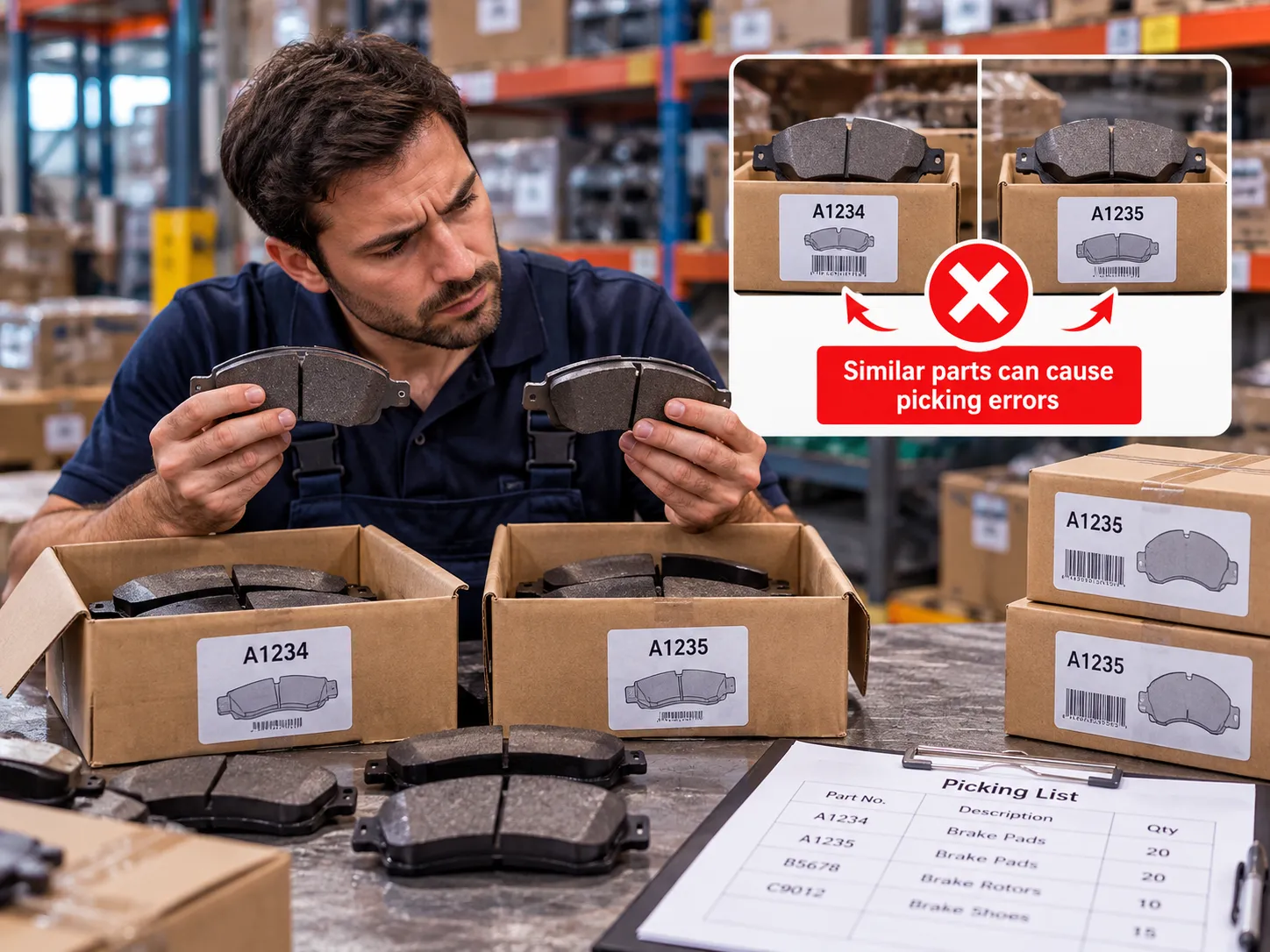
Match by OE number first, then FMSI, WVA or other aftermarket references, then vehicle application and axle. When the number is missing or ambiguous, use photos, dimensions and a physical sample. Do not approve a pad by outline alone.
Two pads can share the same friction outline but differ in backing-plate ears, shim, wear-sensor connector, chamfer or friction thickness. A supplier that substitutes by shape may ship a pad that fits the bracket but not the vehicle’s brake system.
OE Numbers
The OE number is tied to the vehicle manufacturer’s release. Send the complete number, including prefixes and suffixes, and note any supersession. If the number was replaced, ask the supplier to confirm the current reference and the difference.
Do not assume an OE number from one market applies to another. A North American vehicle may use a different pad from the same model sold in Europe. Send the market with each reference.
FMSI Numbers
FMSI numbers are widely used in North America. They are useful for catalog matching and supplier comparison, but may not define the shim, sensor or hardware. Send the FMSI number with the application and a photo.
If FMSI is the only reference you have, ask the supplier to confirm the OE equivalent and backing-plate configuration. A supplier that can cross-reference both is less likely to ship the wrong sensor or shim.
WVA and Other Aftermarket References
WVA numbers are common in Europe and useful when the OE number is unavailable. Other aftermarket systems use their own references. Treat them as cross-references, not a substitute for the OE or application check.
When two reference systems disagree, ask the supplier to explain the conflict. A written explanation shows the supplier checked the part; “it fits” does not.
Vehicle Make, Model, Year and Axle Position
Vehicle application is the fallback when the number is unknown. Send make, model, year, engine, body style and front or rear axle. If the same model year has more than one brake package, send the VIN or brake option code.
The application also helps identify the market-specific pad. A European vehicle may use a wear sensor and shim different from the North American version of the same model.
When Photos, Dimensions or Physical Samples Are Needed
Photos help when the label is missing or unreadable. Photograph the backing plate, friction surface, shim, clips and sensor connector, with a ruler or scale. Dimensions are better when the pad is unusual or the drawing is unavailable.
A physical sample is the strongest fallback. Send a complete set, not one pad, because inner and outer pads may differ in shim, sensor or wear indicator. Mark the sample with the vehicle and the reference you believe it is.
The Outline Is Not the Part Number
A pad can match the outline and still be wrong. Check the backing-plate ears, shim, sensor connector, chamfer, slot and friction thickness before approving a cross-reference.
Our brake pads supply page explains how we match references by OE number, FMSI number, VIN and sample, and how we confirm the shim, hardware and wear sensor for each reference.
05
Should You Request Brake Pad Samples Before Bulk Ordering?
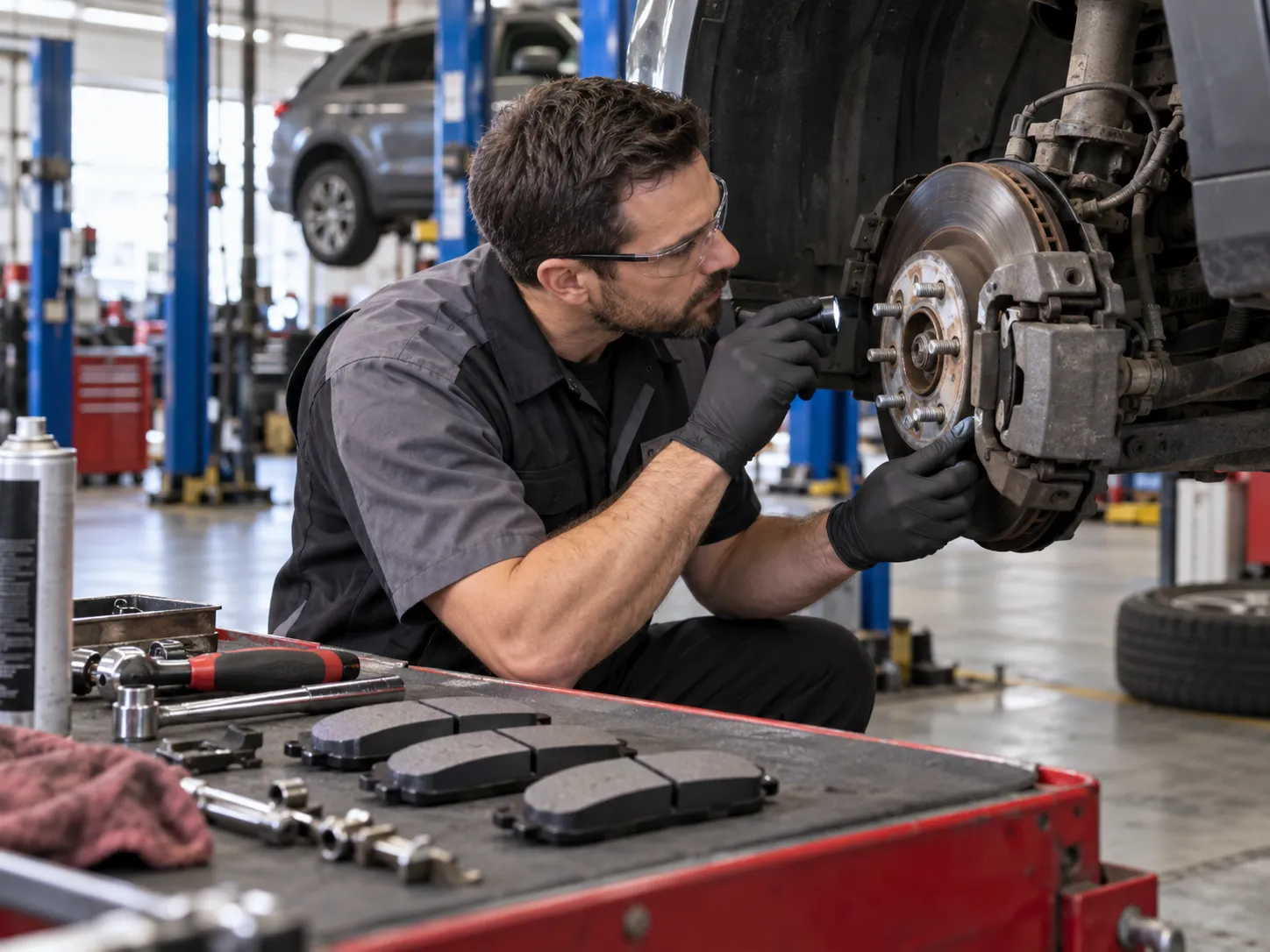
Yes. Request a sample before bulk ordering whenever the reference, supplier, friction material or packaging is new. A sample is the cheapest place to catch a fitment, hardware, friction or packaging problem. Approve it against a written checklist and keep it as the reference for the bulk order.
A sample is not a formality. It is the physical specification. If the sample is approved only by email, the supplier and buyer may remember different things about the shim, sensor or box. The approval record should include photos, measurements and the exact part number.
What Should Be Confirmed on a Sample?
Confirm the part number, application, friction material, shim, hardware, wear sensor, dimensions and packaging. For private label, confirm artwork, barcode and label text. For a market that requires ECE R90 or AMECA, confirm the approval covers the part number or friction material.
The sample should come from the production process, not only the engineering lab. A hand-built sample proves the design; it does not prove the line can repeat it. Ask where the sample was made and whether production tooling will be the same.
Fitment and Dimensions
Measure the backing plate length, width, thickness and ear positions. Measure friction thickness and overall height. Compare with the OE sample or drawing, not a photo. Check that the pad moves freely in the bracket and that clips and shims do not add interference.
If the pad does not fit the bracket, stop. Do not file the backing plate or bend the ears. A pad that needs modification is the wrong pad until the supplier proves otherwise.
Friction Material and Pad Design
Check the friction material for cracks, chips, voids and uneven density. Confirm the edge code and compound name against the quotation. Check the chamfer and slot configuration. If there is an underlayer or scorched surface, confirm it matches the approved specification.
Ask for a friction and shear report for the same compound. The report should identify the method and sample. A generic “ceramic material” report does not prove the performance of your pad.
Shim, Hardware and Wear Sensor Configuration
The shim is part of the noise-control system, not an accessory. Check the type, thickness, attachment and coverage. Check clips, springs and anti-rattle hardware. If the vehicle uses a wear sensor, check the connector, cable length and warning type; a pad with the wrong connector may fit but leave the warning light on.
Our brake pad shim guide explains the common types and why a missing or loose shim creates a noise comeback.
Packaging Sample for Private-Label Orders
Approve a physical packaging sample before bulk printing. Check box material, print quality, barcode, label text, batch-code position, quantity per box and carton configuration. Check the language and market warnings. If the box carries a part number, confirm it matches the pad.
A packaging sample also shows how the box will work at the counter. If the label is hard to read or the barcode is in the wrong place, counter staff will feel it every day.
Our Sample Terms, in Writing
Samples are paid. Existing references are ready in 3–5 days; custom samples take 7–15 days. The buyer pays the freight. We use the approved sample as the reference for the bulk order, so the sample, photos and measurements stay with the order file.
If a production batch differs from the approved sample, the sample is the evidence. That is why we ask for a written approval, not a “looks good” message.
06
What MOQ Should You Expect When Sourcing Brake Pads from China?
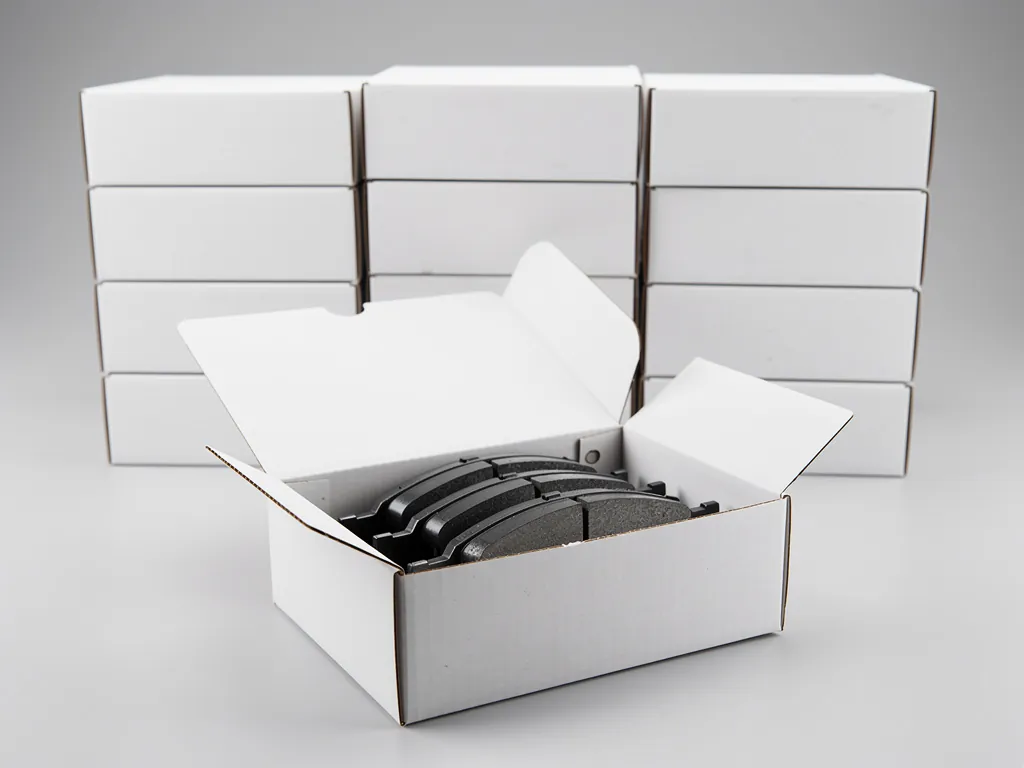
MOQ depends on the factory, friction material, packaging and whether references can be mixed. Published Chinese supplier minimums range from tens of sets per model to 1,000 or more sets per order. At Top Brake Parts, the brake pad MOQ is 100 sets per order, and different brake pad references can be mixed to reach it.
There is no single industry MOQ. A factory with a high-volume line may require 100 sets per part number; another may accept a mixed order of 100 sets in total; a private-label program may require more because of packaging. The number is only meaningful when you know what it applies to.
MOQ Per SKU vs MOQ Per Order
“MOQ per SKU” means each part number must reach the minimum. “MOQ per order” means different part numbers can be combined. The difference is critical for a broad range. A 100-set MOQ per SKU can turn a 30-reference order into 3,000 sets; a 100-set MOQ per order can cover the same range with 100 sets.
Ask the supplier to state the model in the quotation. “100 sets” without “per SKU” or “per order” is an incomplete answer. Ask for an example using your own SKU list.
Why Some Factories Quote Per Part Number
A factory may quote per part number because each reference needs a separate press setup, backing plate, grinding program or packing run. The minimum protects the setup time. For a high-volume standard reference, the setup cost is spread over many sets; for a slow mover, it is not.
This is a legitimate cost model. The buyer’s job is to decide whether the slow mover is worth the minimum or should be added later. A supplier that explains the setup cost is easier to negotiate with.
Mixed-SKU Orders
Mixed-SKU orders let a buyer build a range without overbuying every reference. The supplier can plan the press, grinding and packing schedule across several references, and the buyer can cover more applications with the same total quantity. Confirm which references and categories can be mixed before the order.
At Top Brake Parts, the 100-set brake pad minimum is counted across the brake pad references in the order. Different pad references can be combined to reach it. Brake rotors and brake shoes have their own minimums and are not combined with pad quantities.
Private-Label MOQ Considerations
Private label adds packaging, printing and artwork approval. The pad MOQ may stay the same, but the box or label may have its own print minimum. Ask for the packaging MOQ separately. If the box and label are in different languages, check both before the print run.
Approve a physical packaging sample before bulk printing. If the supplier cannot show one, the first production run becomes the sample, which is an expensive way to learn.
Trial Orders vs Repeat Orders
A trial order is still an order and must meet the MOQ. The difference is the reference mix: a trial should focus on fast-moving applications that will sell through, not a long tail that sits in the warehouse. A repeat order can add references after sell-through is known.
Ask the supplier whether a reference is already in production. A reference that is already running may have a shorter lead time and lower risk than a new reference that needs a setup.
Our MOQ, in Writing
At Top Brake Parts, the brake pad MOQ is 100 sets per order. Different brake pad references can be mixed to reach 100 sets; the minimum is not 100 sets per part number.
Brake rotors have a separate 30-set minimum and brake shoes a separate 100-set minimum. The three categories are not combined to reach one minimum. If you are building a program across all three, we quote each category on its own.
We compared the published MOQ and mixing rules of ten Chinese brake pad manufacturers in our 2026 buyer’s guide. It shows why the mixing rule matters as much as the number.
07
How Should You Compare Brake Pad Quotations?
Compare quotations line by line: the same friction material and specification, shim, hardware and sensor content, packaging, MOQ model, Incoterm, lead time, payment terms and quality evidence. A lower unit price can mean a lower specification, not a better deal.
A quotation is a set of assumptions about compound, backing plate, shim, hardware, box, quantity and trade term. If two quotes use different assumptions, the lower price may be the more expensive product.
Compare the Same Friction Material and Specification
Compare ceramic with ceramic, semi-metallic with semi-metallic, and low-metallic with low-metallic. If one quote is premium ceramic and another economy ceramic, the difference may be real. Ask for the compound name, edge code and friction report.
If the supplier cannot name the compound, the quote is not a specification. A generic “ceramic” label does not prove performance, dust, noise or rotor wear.
Check Whether Shims, Hardware and Sensors Are Included
A pad quote may or may not include the shim, clips, springs, hardware kit and wear sensor. A lower quote may exclude the shim or use a cheaper one. Ask for a line-item breakdown and compare the included content.
The shim is a noise-control component, not a cosmetic accessory. A missing or loose shim can create a comeback that costs more than the price difference. Our brake pad shim guide explains the types.
Compare Packaging Requirements
Compare the same packaging: white box, neutral box, private-label box or custom color box. A private-label quote includes printing, artwork approval and a packaging minimum; a white-box quote does not. If packaging differs, the unit price is not comparable.
Ask for a packaging sample and carton configuration. The cost of a damaged box or wrong label is not in the unit price.
Compare MOQ Per SKU
Compare the MOQ model, not only the number. A 100-set MOQ per SKU and a 100-set MOQ per order are different products. Ask the supplier to quote your actual SKU list and show how the MOQ applies to each line.
If the supplier cannot show the calculation, the quote is incomplete. A simple table with reference, quantity and MOQ status makes the comparison visible.
Compare EXW, FOB, CIF and DDP Correctly
A unit price at EXW is not comparable with DDP. Add freight, insurance, export clearance, import duty, taxes and local delivery to compare landed cost. Ask for the named port or place and the freight validity.
The trade term also affects risk. Under EXW the buyer takes risk at the factory; under FOB at the port; under CIF the seller arranges freight and insurance but the buyer clears import; under DDP the seller delivers to the door and handles import. Match the term to your experience and control.
Check Lead Time and Payment Terms
Compare lead time from the same start point: after deposit and sample approval. A quote that says “20 days” but starts after 10 days of artwork approval is not a 20-day lead time. Ask for standard, mixed-SKU and packaging times separately.
Compare the payment schedule and balance trigger. A 30/70 term with balance before shipment differs from balance after arrival. The payment term should be tied to the documents you need to release.
Compare Quality Evidence, Not Just Unit Price
Ask for the test reports, batch records and certificate scope that apply to the quoted part numbers. A company certificate is not a report for the compound or part number. A supplier that can provide the evidence is easier to hold to the specification.
A lower brake pad quote may reflect a different friction formulation, shim configuration, hardware content, packaging specification, MOQ or trade term—not simply a lower margin.
Where a Cheap Quote Gets Expensive
If a quote is much lower than the others, compare the friction compound, shim and hardware, packaging and MOQ before you celebrate. The difference is usually in the specification, not in the supplier’s generosity.
Our guide to economy, premium and OE-equivalent brake pads explains how the grade changes friction, noise, dust and cost, so you can compare quotes at the same grade.
08
What Quality Checks Should Be Agreed Before Bulk Production?
Before bulk production, agree the dimensional inspection, backing-plate and bonding quality, shim, chamfer and slot configuration, friction and wear testing, compressibility and shear strength, NVH where specified, and batch traceability. Put the acceptance criteria in the purchase order, not a separate email.
The QC plan should be specific enough that two inspectors reach the same decision. “Check the dimensions” is not a plan. “Measure the backing plate against drawing [number] with tolerance [value], record each batch and hold if any sample is outside the limit” is a plan.
Dimensional Inspection
Dimensional inspection starts with the drawing: backing plate, friction thickness, overall height, ear positions, chamfer, slot and critical features. Use the same measurement points and tolerance for every batch.
Ask for the sample size and acceptance rule. One pad measured at the end of the line is not a batch inspection. A first-piece check, in-process check and final sample check give a better picture.
Backing Plate and Bonding Quality
Check the backing plate for flatness, burrs, coating damage and ear deformation. Check the friction-to-plate bond with a shear test per ISO 6312. The report should state the value and the failure mode; a failure inside the friction material differs from a clean separation at the bond line.
Ask whether the shear test is per batch or only on the sample. Bonding is one of the first places a cost reduction shows up.
Shim, Chamfer and Slot Configuration
Check the shim type, thickness, attachment and coverage. Check chamfer angle and length and slot depth and position. These features affect noise, heat and wear; a pad that looks similar but has a different chamfer or slot can behave differently.
If the shim is bonded or mechanically attached, check the method. A loose shim can rattle or fall off. If there is a wear sensor, check the connector and cable route.
Friction and Wear Testing
Ask for a friction test per SAE J661 or the customer specification. The report should show friction level, fade, recovery and the test schedule. If the market or customer requires a friction code, confirm the compound meets it.
Wear testing may be a separate dynamometer or vehicle test. Ask which method was used and whether the result applies to the compound and application. A wear claim without a method is a marketing claim.
Compressibility and Shear Strength
Compressibility affects pedal feel and travel. Test per ISO 6310 and record the value at the specified pressure. Shear strength affects the bond; test per ISO 6312 and record the value and failure mode.
Both should be run per production batch, not only on the approved sample. The sample proves the design; the batch records prove production.
NVH Evaluation
If the program has a noise requirement, agree the method, schedule and acceptance criterion. SAE J2521 is a common dynamometer noise test, but the customer may specify another procedure. A pad that passes a generic noise test may still squeal on a specific vehicle.
Ask for the report and the vehicle or dynamometer configuration. If NVH is not tested, say so in the specification rather than assuming it.
Batch Traceability
A batch code should connect the finished pad to the friction mix, press date, heat-treatment cycle, grinding record, inspection results and packing record. Ask to see a sample batch record before the order. If the code on the box cannot be traced back, the warranty process is weaker.
Traceability also helps the buyer. If a customer reports noise or wear, the code lets the supplier check whether other pads from the same batch have the same issue.
A Batch Is Not Approved Until It Is Measured
On one production run, seven pads measured 4.1–5.0 mm slot depth against a 4.3–4.7 mm target. The grinding fixture stop was reset, and the next 180 sets stabilized at 4.3–4.7 mm. The lesson was not that the pads were “bad”; a feature that looks cosmetic still needs a measured acceptance criterion and a process check.
This is the record we keep for a batch: the measurement, sample size, corrective action and recheck. A buyer who asks for that record is asking the right question.
Our quality inspection process describes the incoming, first-piece, in-process and final checks, the batch traceability system and the documents a buyer can request.
09
What Payment Terms Are Common for Brake Pad Orders?
Most Chinese brake pad orders use a deposit before production and the balance before shipment. At Top Brake Parts, the terms are 30% deposit and 70% before shipment, by T/T, PayPal or XTransfer in USD. Payment terms vary by supplier and order; treat them as part of the specification, not a separate negotiation.
A payment term is a risk allocation. A deposit protects the supplier’s production; a balance before shipment protects the buyer from paying for goods that have not passed inspection. The right balance depends on the relationship, order size and documents.
Deposit Before Production
The deposit covers raw material and the production slot. Before paying, make sure the proforma invoice includes part numbers, quantities, friction specification, packaging, lead time, trade term and payment schedule. The deposit should reference the approved sample and QC plan.
If the supplier asks for a deposit before sample approval, slow down. The sample is the specification; without it, the deposit is for an undefined product.
Balance Before Shipment
The balance is usually due before shipment or before release of the bill of lading. Before paying, check the final inspection report, packing list, photos and shipping documents. If the balance is due before inspection, negotiate a hold point or third-party inspection.
The balance trigger should be in the proforma invoice. “Before shipment” is vague if inspection has not happened; “after final inspection and before container release” is clearer.
T/T and PayPal
T/T is the most common method for B2B brake pad orders. PayPal may be used for samples or smaller orders, but fees and currency conversion should be agreed. XTransfer is another option used by some Chinese exporters. Confirm the beneficiary name, bank account and currency before sending money.
The beneficiary should match the legal company on the proforma invoice. If the account belongs to a different company, ask for a written explanation and authorization. Payment fraud often starts with a changed bank account.
How Buyers Should Link Payment to Approved Specifications
Attach the approved sample, specification and QC plan to the purchase order, and make the proforma invoice reference them. Pay the deposit against the approved package and the balance against the final inspection and shipping documents. This gives both sides a clear release point.
If the supplier changes the shim, compound or packaging after the deposit, the change should be approved in writing and reflected in the balance release. A payment term without a document trail is only a promise.
Payment Should Follow Approval, Not Hope
The sequence is: approve the sample and specification, issue the PO, pay the deposit, produce, inspect, review the documents, pay the balance, release the shipment. If any step is skipped, the payment is carrying more risk than it needs to.
10
How Long Does Brake Pad Production Take?
Standard brake pad production usually takes 20–30 days after deposit and sample approval. Mixed-SKU orders take 25–35 days. Private-label packaging and new compounds can add time. Confirm the start date and approval gate in writing; a lead time without a start point is not a lead time.
Production time includes material preparation, pressing, heat treatment, grinding, shim bonding, marking, inspection, packing and, for private label, printing and artwork approval. A standard reference with an approved sample moves faster than a new reference that needs a new backing plate or compound.
Standard Production Lead Time
Standard production is the time for a reference already in the supplier’s program with an approved sample. At Top Brake Parts, that is usually 20–30 days. The clock starts after deposit and sample approval, not after the first email.
If the reference is new, ask for tooling or drawing time separately. A new backing plate or compound can add time before the standard production window begins.
Mixed-SKU Orders
A mixed-SKU order takes longer because several references share the press, grinding and packing lines. At Top Brake Parts, mixed-SKU production is usually 25–35 days. The exact time depends on the number of references, quantity per reference and packaging.
If the order includes pads and rotors, each category may have its own schedule. Ask for a line-by-line lead time if the shipment must arrive together.
Private-Label Packaging
Private-label packaging adds artwork approval, printing and a packaging sample. Pad production may be on schedule while the printed box is late. Ask for the packaging lead time separately and approve artwork before the print run.
If the packaging is imported or printed by a third party, the supplier may not control the lead time. Put the approval date in the schedule and keep a buffer.
New Product Development or Custom Samples
A new compound, backing plate or sensor can require development and testing. The sample may take 7–15 days, and production may be longer if the sample needs changes. Ask for the development steps and approval gates.
Do not compress the sample stage to save a week. A sample rushed into production can cost a container.
Our Lead Times, in Writing
At Top Brake Parts, standard production is 20–30 days and mixed-SKU production is 25–35 days after deposit and sample approval. Existing-reference samples are ready in 3–5 days; custom samples take 7–15 days. The buyer pays sample freight.
Chinese New Year, national holidays and peak season can extend the schedule. We confirm production dates on the proforma invoice and update them if packaging approval or a material delay changes the plan.
11
Which Shipping Terms Should Brake Pad Buyers Use?
EXW, FOB, CIF and DDP place different costs and risks on the buyer. Choose the term that matches your freight experience and the control you want: EXW if you have a forwarder and want to manage everything, FOB for a common port-to-port arrangement, CIF if you want the supplier to arrange freight and insurance, and DDP if you want a door-to-door price and the supplier can handle import.
The term is not a ranking. It is a division of responsibilities. A first-time importer may prefer DDP because it is simpler, but not every supplier offers it and it can reduce control over freight and customs. An experienced importer may prefer FOB to use its own forwarder.
EXW
Under EXW, the seller makes the goods available at the factory. The buyer handles export clearance, freight, insurance, import and delivery. EXW suits a buyer with a China-based forwarder, but gives the buyer the most responsibility and the least supplier control after the gate.
Confirm the pickup address, loading equipment, export documents and readiness date. A factory unfamiliar with export paperwork can delay pickup.
FOB
Under FOB, the seller delivers to the named port and clears export; the buyer arranges freight and insurance and handles import. FOB is common for experienced importers because it separates the freight cost and lets the buyer use its own forwarder.
Confirm the port, terminal handling charges and cut-off time. “FOB China” is not a price; the port changes cost and schedule.
CIF
Under CIF, the seller arranges and pays freight and insurance to the named port. The buyer handles import clearance, duties and delivery. CIF can be convenient, but check insurance coverage and destination charges.
Ask for the freight validity and what the insurance covers. A CIF price that excludes destination charges is not door-to-door.
DDP
Under DDP, the seller delivers to the buyer’s door and pays import duties and taxes. The buyer has the least logistics work, but less control over freight, customs and the importer of record. Not every supplier offers DDP, and “door” can vary.
Confirm the importer of record, duty and tax responsibility, unloading and what happens if customs requests more documents. A DDP quote should state what is included.
Which Term Is Better for First-Time Importers?
A first-time importer often prefers DDP or CIF because the supplier arranges more transport. That can be a reasonable start, but ask what is included and who is responsible at each stage. If you want to learn the import process and control freight, FOB with a good forwarder may be better after the first order.
There is no universal answer. Ask the supplier to quote two terms so you can compare the landed cost.
A Named Port Is Part of the Price
“FOB China” is not a quote. Ask for the named port, terminal handling charges, cut-off time and freight validity. The port and the Incoterm together determine the landed cost.
12
How Should Distributors Plan a Mixed-SKU Brake Pad Order?
Plan around demand, not catalog size. Start with fast-moving applications, separate high-, medium- and low-demand references, confirm the MOQ and mixing rule, avoid overbuying long-tail applications, and set a reorder trigger for each tier. The goal is a range that sells through, not a warehouse full of references.
A mixed order is a planning exercise. The supplier can combine references, but it cannot tell you which references will sell in your market. Use sales history, customer requests and the vehicle population you serve.
The percentages are illustrative, not a rule. A parts store with a narrow customer base may need a different mix from a national distributor.
Start With Fast-Moving Applications
Start with references that already sell in your market. If you have history, rank by units sold and customer requests. If not, use the vehicle population and the repair shops you serve.
A fast mover is not always the newest vehicle. A common older vehicle with a large car park may sell more pads than a new model with a small population.
Separate High-, Medium- and Low-Demand SKUs
Separate the range into tiers so you can order each differently. Fast movers need depth; medium movers need coverage; slow movers need a test or special order. If every reference is treated the same, slow movers consume the budget and fast movers run out.
Review the tiers after the first order. A slow mover can become a fast mover if a local fleet adopts the vehicle; a fast mover can slow down as a model ages out.
Confirm MOQ for Each SKU
Confirm the MOQ model for each reference before building the order. If the supplier quotes per SKU, a slow mover may not be worth the minimum. If the supplier quotes per order or category, you can combine references and cover more applications.
At Top Brake Parts, the pad minimum is 100 sets per order, and references can be mixed within the category. That makes it possible to include slow movers without a separate 100-set minimum for each reference.
Avoid Overbuying Long-Tail Applications
A long-tail reference has low demand in your market. It may be necessary for a complete catalog, but it should not take a large share of the first order. Test it with a small quantity or add it after the fast movers prove their sell-through.
If the supplier has a per-SKU minimum, the long tail can be expensive. Ask whether the reference is already in production or needs a new setup.
Plan Reorder Frequency
Set a reorder trigger for each tier. A fast mover may need a reorder every few weeks; a medium mover may ride with the next mixed order; a slow mover may be special-ordered. Base the trigger on sell-through and lead time, not a calendar alone.
If mixed-order lead time is 25–35 days, the reorder point should allow for it. A stockout on a fast mover costs more than the freight saved by waiting.
Match the Plan to Your Customer Base
An auto parts store usually needs a broad range for local vehicles, with depth on the top applications. A distributor needs a deeper program for resellers, with a documented SKU list and repeat schedule. A repair-shop supplier needs the references its shops use most, with the shims, hardware and sensors to complete the job.
The same MOQ and lead time can produce different plans for these buyers. Start with the customer you serve most, then expand.
Before You Commit to a Mixed Order
✓Rank references by sales history or local vehicle population.
✓Separate fast, medium and slow movers, and assign a budget share.
✓Confirm the MOQ model and which references can be mixed.
✓Check the shim, hardware and sensor content for every reference.
✓Set a reorder trigger for each tier.
✓Leave room for one or two new references after the first review.
Our auto parts store solutions and repair shop solutions pages show how a mixed brake program is built around counter and workshop demand.
13
What Should Be Confirmed Before the Brake Pads Are Shipped?
Before shipment, confirm the final SKU and quantity list, approved packaging and labels, batch and QC records, carton and pallet details, shipping documents, and the balance and release instruction. The pre-shipment check is the last point where a mistake is still cheap to fix.
A shipment is not approved because production is finished. It is approved when the documents and the physical goods match the PO. A final inspection that checks only the first carton can miss a mixed-SKU error in the last pallet.
Final Quantity and SKU List
Compare the final SKU list with the PO line by line: reference, quantity, packaging and batch code. For a mixed order, check a sample from each reference and each pallet, not only the first carton.
A shortage or extra reference is easier to fix before the container is sealed. Once the container is on the water, a correction costs more.
Packaging and Label Approval
Approve packaging and labels before bulk print. Check box, label, barcode, batch-code position, language and market warnings. If the label is printed separately, check that it matches the box and the pad.
Take photos of the approved packaging and keep them with the order file. The photos are the reference if a later shipment uses a different box or label.
Batch and QC Records
Collect the batch record and inspection report before the balance is paid. The record should connect the batch code to the friction mix, press, heat treatment, grinding, inspection and packing. If the report is only a final visual check, ask for in-process records.
The batch code on the box should match the report. A mismatch is a traceability problem, even if the pads look correct.
Carton and Pallet Details
Confirm carton quantity, dimensions, weight, pallet pattern and total pallet count. Check that cartons are strong enough and labels are visible after stacking. For a less-than-container order, confirm the consolidation plan.
A pallet that is too high or a carton that is too weak can cause damage the product warranty does not cover.
Shipping Documents
Check the commercial invoice, packing list, bill of lading or booking confirmation, certificate of origin and any test reports or certificates the buyer needs for import. The invoice and packing list should match the PO and cartons.
If the destination requires a certificate or declaration, confirm the format and issuer before shipment. A missing document can delay customs.
Final Payment and Release
Pay the balance against approved documents, not a verbal confirmation. Send the release instruction to the forwarder only after payment is confirmed and documents are checked. If the supplier asks for balance before final inspection, negotiate a hold point.
A clear release process protects both sides. The supplier knows when payment arrives; the buyer knows what documents will be released.
Pre-Shipment Release Checklist
✓Final SKU list and quantities match the PO.
✓Packaging and labels match the approved sample.
✓Batch code on the carton matches the QC record.
✓Carton, pallet and weight details are confirmed.
✓Invoice, packing list, bill of lading and certificates are complete.
✓Balance payment and release instruction are confirmed in writing.
14
What Happens After the First Order?
After the first order, the goal is a repeatable program: record fast- and slow-moving SKUs, track returns and noise complaints by part number and batch, keep approved samples and specifications, build a repeat-order list, and add applications gradually. The second order should be easier than the first.
Many sourcing guides stop at shipment. The distributor’s real work starts after the first sell-through review. The data tells you what to repeat, drop or add. The supplier’s after-sales process tells you whether the relationship can scale.
Record Fast- and Slow-Moving SKUs
Record sell-through for every reference, not only the total. A reference that sold out in two weeks is a candidate for a deeper order; one that did not move is a candidate for a smaller quantity or special order. Include customer type, application and price.
If you do not have a system, use a spreadsheet: reference, quantity ordered, quantity sold, weeks to sell through and returns. First-order data is more useful than a generic catalog ranking.
Track Customer Returns and Noise Complaints
Track returns and complaints by part number, batch code, vehicle and mileage. A noise complaint may be a pad, installation or rotor issue; the batch and vehicle details help separate them. A fitment return may be a catalog, packaging or wrong-part-in-box error.
Share the pattern with the supplier. A supplier that can trace the batch and compare it with the retained sample responds faster than one that only sees a returned pad.
Keep Approved Samples and Specifications
Keep the approved sample, drawings, test reports and packaging sample for every reference. The sample is the physical specification; the documents are the evidence. If a later batch differs, they are the reference for the claim.
Store the sample in a labeled bag with part number, supplier, approval date and sample or batch ID. A sample without a label is only a pad.
Build a Repeat-Order SKU List
Build a repeat-order list from sell-through data: fast movers, medium movers that sell regularly, and slow movers necessary for the range. Review the list before each order and adjust quantities.
A repeat order is not a copy of the first. If a reference did not sell, do not repeat it at the same quantity; reduce it, replace it or special-order it.
Add New Applications Gradually
Add new applications after the first order’s data is clear. A new application may need a new reference, shim or sensor, and possibly a new sample. Add a few references at a time so you can measure sell-through and returns.
A gradual expansion is easier to finance and manage than a large catalog launch. It also gives the supplier time to plan production and packaging.
What a Supplier Should Provide After the First Order
A good supplier should trace a batch, compare a returned pad with the retained sample, explain the inspection result and propose a replacement or corrective action. The response should include a timeline and a named contact, not only an apology.
At Top Brake Parts, the batch code and inspection record stay with the order file. If a repair shop reports noise or early wear, we ask for the part number, batch code, vehicle, mileage and photos before deciding whether the cause is the pad, the installation or another brake component.
The Second Order Should Be Easier Than the First
If the second order is as difficult as the first, the first order did not produce a usable specification. Keep the approved sample, SKU list, packaging file and QC records so the repeat order starts from a known point.
Our repair shop solutions page covers the comeback and claim process, and our quality inspection process explains the records a supplier should keep for a batch.
15
Brake Pad Sourcing Checklist for Distributors
Use four checkpoints: before the RFQ, before sample approval, before the bulk order and before shipment. Each checkpoint has a short list of items that should be in writing. If an item is missing, the next step is not ready.
The checklist is deliberately short. It is not a substitute for the detailed sections above; it is the minimum set that prevents the most expensive mistakes. Print it, attach it to the PO or use it as the agenda for a supplier call.
Before RFQ
Before you send the RFQ, confirm the reference, application, material, quantity, market and packaging. A complete RFQ reduces quotation rounds and makes the quotes comparable.
Before the RFQ
✓OE, FMSI, WVA or current supplier reference for every line.
✓Vehicle make, model, year, engine and front/rear axle.
✓Friction material: ceramic, semi-metallic, low-metallic or OE material.
✓Quantity per reference and total order quantity.
✓Destination country, port or door, and requested Incoterm.
✓Packaging: box type, artwork, barcode and batch code.
✓Market certification: ECE R90, AMECA, copper declaration or other.
Before Sample Approval
Before approving the sample, check fitment, dimensions, shim, hardware, sensor, friction material and packaging. The sample should come from the production process, not only the lab.
Before Sample Approval
✓Backing plate, ears, friction thickness and height match the drawing.
✓Pad fits the bracket without filing or force.
✓Shim type, thickness and attachment match the specification.
✓Clips, springs and hardware are included and fit.
✓Wear sensor connector and cable length match the vehicle.
✓Friction material, edge code and chamfer/slot match the quotation.
✓Packaging sample matches the artwork and label requirement.
Before Bulk Order
Before paying the deposit, confirm the MOQ, price, QC plan, payment terms and lead time. The quotation and proforma invoice should match the approved sample and the PO.
Before the Bulk Order
✓MOQ model is stated: per SKU, per order or per category.
✓Mixing rule is stated: which references and categories can be combined.
✓Price includes shim, hardware, sensor, box and label as specified.
✓QC plan, test methods and acceptance criteria are attached to the PO.
✓Payment schedule and balance trigger are in the proforma invoice.
✓Lead time starts after deposit and sample approval, and is in writing.
Before Shipment
Before the container is released, confirm the final quantity, packaging, batch records, carton and pallet details, documents and balance. The pre-shipment check is the last cheap correction point.
Before Shipment
✓Final SKU list and quantities match the PO.
✓Packaging and labels match the approved sample.
✓Batch code on the carton matches the QC record.
✓Carton, pallet, weight and dimensions are confirmed.
✓Invoice, packing list, bill of lading and certificates are complete.
✓Balance payment and release instruction are confirmed in writing.
16
Frequently Asked Questions About Sourcing Brake Pads from China
What Is the MOQ for Brake Pads From China?
There is no single MOQ. Published Chinese supplier minimums range from tens of sets per model to 1,000 or more sets per order. At Top Brake Parts, the brake pad MOQ is 100 sets per order, and different brake pad references can be mixed to reach it. Ask whether the number is per SKU, per order or per category.
Can I Order Different Brake Pad SKUs in One Shipment?
Yes. A mixed-SKU order can combine different brake pad references in one production and shipment, as long as each reference is approved and the order meets the supplier’s mixing rule. At Top Brake Parts, pad references can be mixed to reach the 100-set pad minimum. Rotors and shoes have separate minimums and are not combined with pad quantities.
Can Chinese Brake Pad Manufacturers Make Private-Label Packaging?
Yes. Many Chinese brake pad manufacturers offer private-label boxes, labels and barcodes. Packaging needs artwork approval and a physical sample before bulk print. Ask for the packaging MOQ separately from the pad MOQ, because printing and setup can add a minimum quantity or lead time.
What Information Do I Need to Get a Brake Pad Quote?
Send the OE, FMSI, WVA or current supplier reference; the vehicle application and axle; the friction material or OE material requirement; quantity per reference and total; packaging and private-label requirement; destination country and Incoterm; and any market certification. A complete RFQ gets a comparable quote faster.
Should I Send OE or FMSI Numbers?
Send both if you have them, and say which is authoritative. The OE number is the strongest reference because it ties the pad to the vehicle manufacturer’s specification. The FMSI number is useful for North America but may not define the shim, sensor or hardware. If they conflict, ask the supplier to explain the difference.
How Long Does Brake Pad Production Take?
At Top Brake Parts, standard production takes 20–30 days after deposit and sample approval. Mixed-SKU production takes 25–35 days. Private-label packaging and new compounds can add time. Ask for the start date and approval gate; a lead time without a start point is not a lead time.
Should I Request Samples Before a Bulk Order?
Yes. A sample is the cheapest place to catch a fitment, shim, hardware, sensor, friction or packaging problem. Approve it against a written checklist and keep it as the reference for the bulk order. At Top Brake Parts, existing-reference samples are ready in 3–5 days and custom samples take 7–15 days; samples are paid and the buyer pays freight.
How Do I Verify a Chinese Brake Pad Manufacturer?
Verify the legal company and factory, confirm which processes are in-house, check application coverage, review certificate scope and test reports, and ask for batch traceability and a complaint procedure. A company certificate is not an approval for the part number. Our guide to verifying a Chinese brake pad manufacturer lists the documents to request.