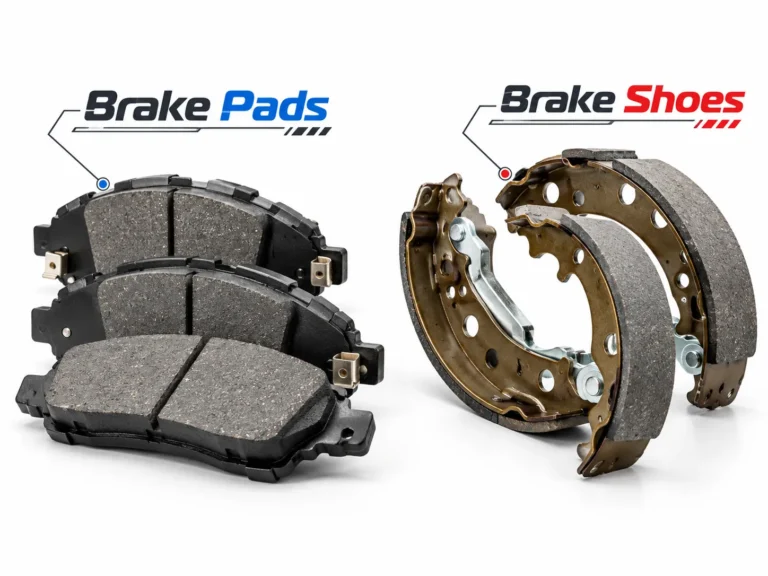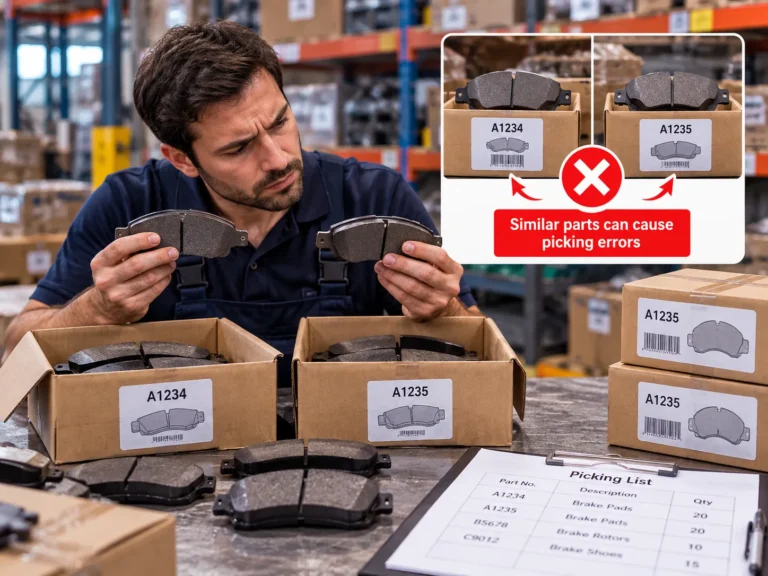

Low-metallic brake pads are disc brake pads whose friction material contains a small share of steel fiber or iron powder—less than about 30% steel fiber by mass—combined with non-ferrous metals, abrasives, carbon and sulfide lubricants. They were developed in the 1970s mainly for European cars. They give strong bite, good fade resistance and stable high-speed braking, at the cost of more wheel dust, faster pad and rotor wear and higher noise potential.
For a repair shop, that trade-off decides whether a European brake job comes back with a dust or noise complaint. For an auto parts store or distributor, it decides which friction line to stock for which part numbers. This guide explains what low-metallic pads are, how they perform, how they compare with ceramic and semi-metallic pads, how copper rules apply to them, and what to check before you order them by the carton.
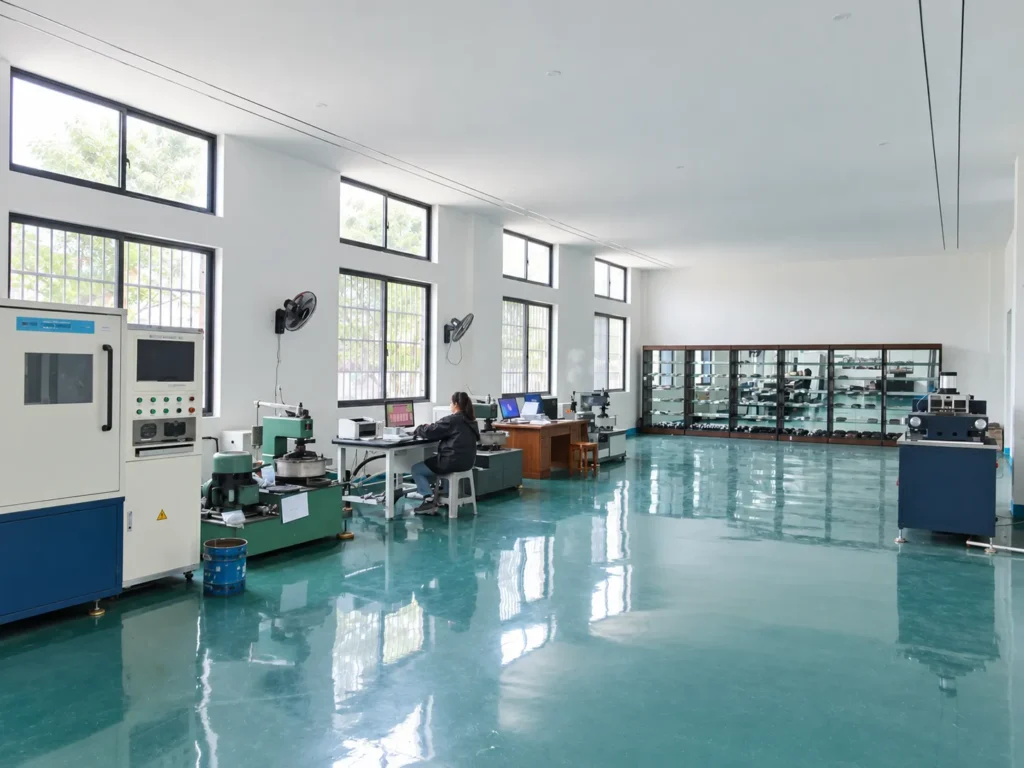
Our Qingyuan factory runs low-metallic pads alongside its ceramic and semi-metallic lines, and every low-metallic formula we produce is copper-free; the formulation trials and project targets quoted below are our own.
Low-Metallic Brake Pads: The Short Version
01
What Are Low-Metallic Brake Pads?
Low-metallic brake pads are a friction material family that sits between ceramic (NAO) and semi-metallic pads. They contain some steel fiber and/or iron powder—less than about 30% steel fiber by mass—plus non-ferrous metals, organic and inorganic fibers, aggressive abrasives and a high share of carbon and sulfide lubricants. The metal content raises friction and heat stability; the lower steel share keeps weight and rust lower than in semi-metallic pads.
What “Low-Metallic” Means: Metal Content Compared
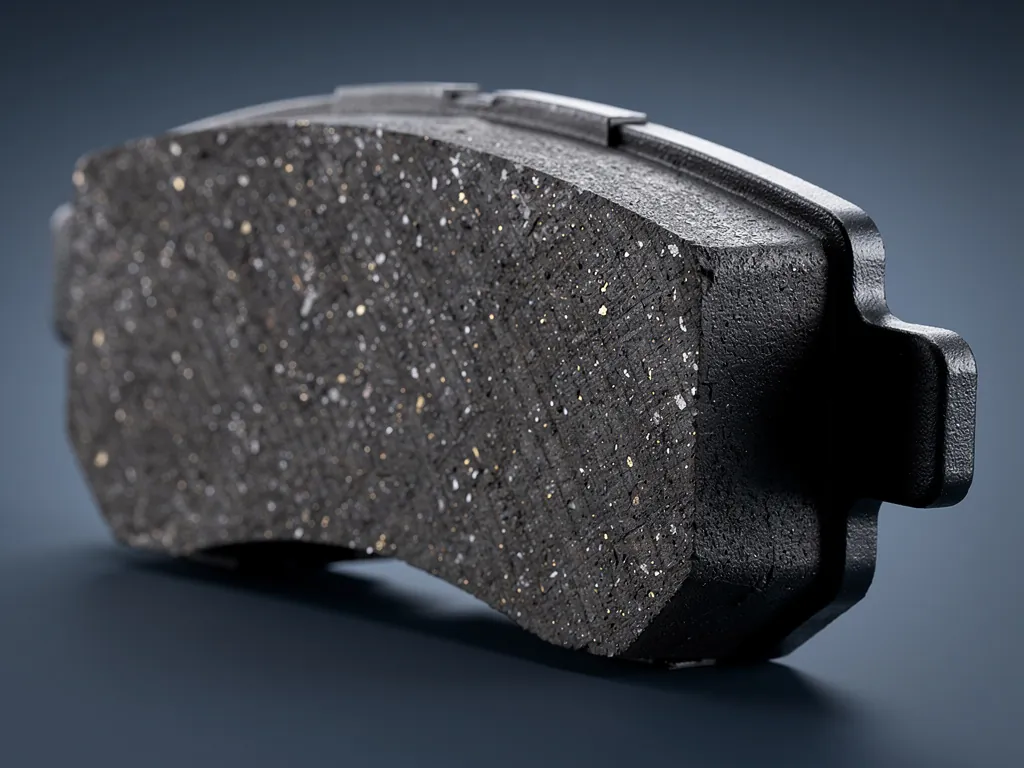
“Low-metallic” describes how much steel is in the friction material, not how much metal in total. Friction engineers classify disc pad materials mainly by their steel fiber content. A brake pad patent granted to Resonac (formerly Showa Denko Materials) in 2021, US10927913B2, puts the classification this way: semi-metallic materials contain 30 to 60 mass % steel fiber, low-steel materials contain less than 30 mass %, and NAO materials contain no steel fiber.
Steel content: US10927913B2. Friction ranges: Akebono, “OE Friction Material Requirements for North America,” 2007.
Two points surprise many buyers. First, a low-metallic pad usually runs a higher friction level than a semi-metallic pad, even though it contains less steel. Second, “metallic” in the name says nothing about copper—copper is a non-ferrous metal and is controlled separately, as explained later in this guide.
What Goes Into a Low-Metallic Formula
According to Akebono’s OE friction material training document, low-metallic formulas typically contain ferrous and non-ferrous metals, inorganic and organic fibers, aggressive abrasives, and large amounts of carbonaceous and sulfide lubricants. In practice, a low-metallic recipe is built from these groups:
The ratio between abrasives and lubricants is where low-metallic formulas differ most from each other. More abrasive content gives sharper bite and a cleaner rotor surface; more lubricant content smooths friction and reduces noise. That balance is the main thing a supplier adjusts when a low-metallic pad is too noisy or too dusty for a market.
Why Low-Metallic Pads Are Linked to European Cars
Low-metallic friction was developed in the 1970s, mainly for European applications. European driving puts a premium on sustained high-speed braking, and a high, stable friction level at speed was the design goal. The Resonac patent notes that Europe frequently used low-steel materials to keep the friction coefficient during high-speed braking, while European use of NAO materials, which produce less wheel dirt and squeal, has been increasing in recent years.
That history explains a common parts-counter request: owners of European cars fitted with low-metallic pads see heavy wheel dust and ask for “a cleaner pad” at replacement time.
How Akebono Classifies OE Friction Materials
Akebono’s training document “OE Friction Material Requirements for North America” (2007) describes low-metallics as developed in the 1970s, mainly for European applications, with higher friction levels of μ 0.38–0.50. It lists their characteristics as good pedal feel and braking confidence, good fade and high-speed performance, high pad and rotor wear, lots of wheel dust, a “corrective” wearing action that can true up the rotor over time, and inferior noise and life.
For comparison, the same document gives semi-metallics a friction range of μ 0.28–0.38 and NAOs μ 0.33–0.40, and notes that NAOs are often called “ceramic” formulations in the aftermarket.
“Low-Met”, “Low-Steel” and “Low-Metallic NAO”: Labels at the Parts Counter
Catalogs use several names for the same family and a few names that sound similar but are not:
- Low-met / low-metallic / low-steel: the same friction family. Some brands also call it a “European formula.”
- Low-metallic NAO: a label some catalogs use for formulas positioned between NAO and low-metallic. There is no standard definition, so ask for the compound description and friction data rather than relying on the label.
- Hybrid: usually a ceramic formula with some metal content. Definitions vary by brand.
- Metallic: at most parts counters this means semi-metallic, not low-metallic.
When labels conflict, the edge code printed on the pad and the supplier’s compound data are more reliable than the name on the box.
For a full introduction to pad construction, friction families and how pads are classified, see our guide What Are Brake Pads? Types, Materials, Parts & How They Work.
02
How Do Low-Metallic Brake Pads Perform?
Low-metallic brake pads perform best where high friction and heat stability matter most. They deliver a strong initial bite, a firm pedal and good resistance to brake fade at high speed and temperature. The trade-offs are predictable: more visible dust, faster pad and rotor wear, and a higher risk of squeal than ceramic pads. Shims, chamfers and the right rotor reduce the noise and wear penalties.
Friction Level and Initial Bite
With μ typically between 0.38 and 0.50, low-metallic pads sit at the top of the passenger-car friction range. Drivers feel this as immediate response when the pedal is first pressed. On the SAE J866 friction coding used for pad edge codes, F covers μ 0.35–0.45 and G covers 0.45–0.55, so many low-metallic compounds are coded FF or around the F/G boundary. Matching the friction level of the original pad matters: a replacement that is much lower or higher than OE changes pedal effort and front-to-rear brake balance.
March 2024: Tuning an FF-Level Low-Metallic Formula
In March 2024, at our brake pad production facility in Guangdong, China, we evaluated a low-metallic formulation targeting FF-level friction performance. Our trial targets were a cold friction coefficient of μ 0.42 and a hot coefficient of μ 0.39, with pad wear below 0.35 mm under defined dynamometer conditions.
We used the results to guide resin content and metallic fiber adjustments before production approval.
Fade and High-Speed Braking
Brake fade is the loss of friction when pads and rotors get very hot. Low-metallic formulas resist fade well because their metal content carries heat away from the friction surface and their abrasive-and-lubricant system is designed to hold friction at high temperature. This is the main reason they suit vehicles that brake hard from high speed, such as motorway driving in Europe. For buyers, fade and recovery data from a dynamometer test is more useful than a single friction number.
Wear Rate: Pads and Rotors
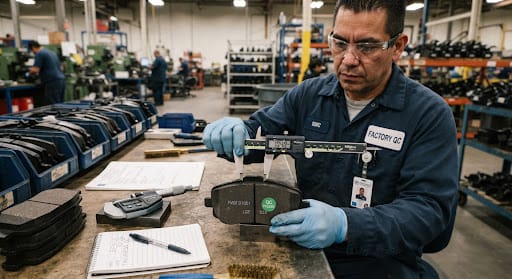
Low-metallic pads wear themselves and the rotor faster than ceramic pads. Akebono describes this as high pad and rotor wear with a “corrective” wearing action—the pad can clean and even out the rotor surface over time. That is helpful for rotor condition but shortens rotor life, so rotor thickness should be measured at every pad change. Shops quoting a European brake job should price pads and rotors together.
Brake Dust
Wheel dust is the most common complaint about low-metallic pads. The combination of iron content, aggressive abrasives and rotor wear produces dark, adherent dust on alloy wheels. This is a characteristic of the friction family, not a defect. Counter staff should set expectations before the sale and offer a ceramic alternative where the vehicle allows it.
Noise and NVH
Low-metallic pads have higher noise potential than ceramic pads because their friction material is stiffer and more abrasive, which can excite pad, rotor and caliper vibration. In practice, most squeal comes from the system around the friction material: missing or worn shims, no chamfers, glazed rotors and dry slide pins. Our brake pad shims guide explains how shim type changes noise.
June 2024: Test Targets for a European Passenger-Car Pad
In June 2024, we conducted a trial low-metallic brake pad development project in Guangdong for a European passenger-car application. The proposed SAE J2522 test targets included an average friction coefficient of μ 0.41, a μ 0.35 minimum during high-temperature fade, and 95% friction recovery.
We also specified an SAE J2521 noise assessment and a maximum pad thickness loss of 0.30 mm under the agreed test cycle.
What SAE J2521 Counts as Squeal
In October 2022, SAE International published SAE J2521_202210, an inertia dynamometer squeal noise test procedure for passenger cars and light trucks below 4,540 kg GVWR. The procedure identifies squeal events at peak sound levels of at least 70 dB(A), within 1.25–16 kHz for tests using full suspension corners or axle assemblies, or 2–16 kHz for brakes not using a full corner.
This threshold defines reportable squeal events rather than a universal product pass/fail limit. Buyers should ask what percentage of stops exceeded it and under which conditions.
How Friction, Fade and Noise Are Measured
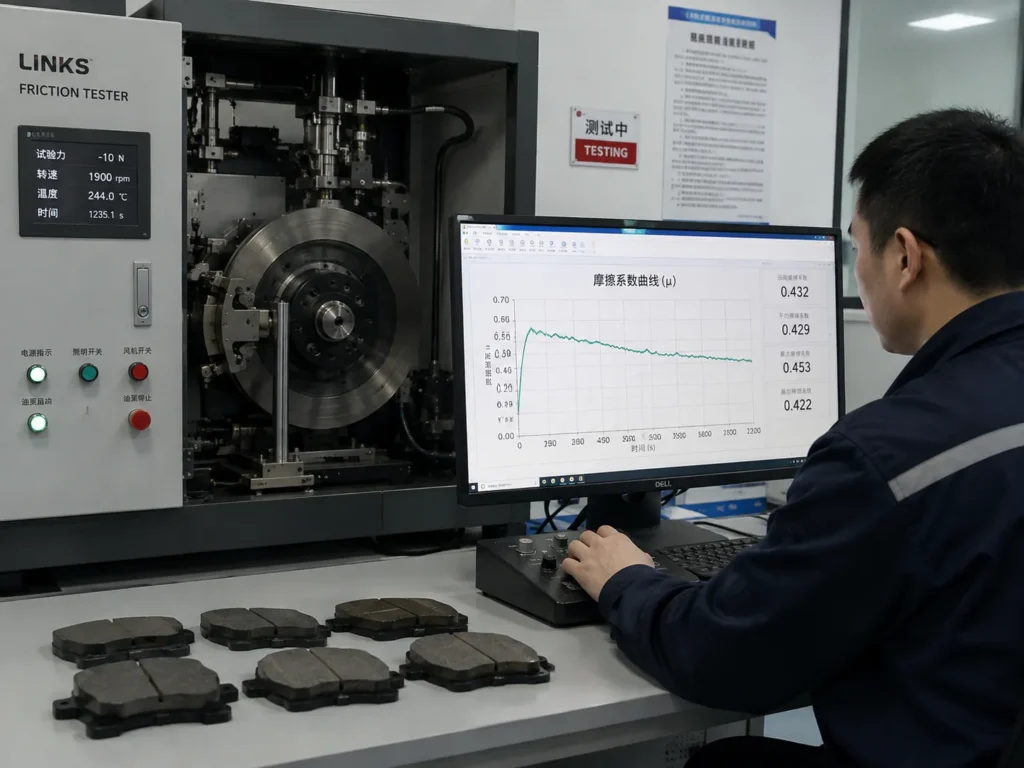
Three kinds of test answer different questions about a low-metallic pad:
- SAE J661 is a lining quality test that gives cold and hot friction and wear on a small sample. It is the basis of the SAE J866 edge code.
- SAE J2522 (AK Master) is a full dynamometer test with the vehicle’s brake, covering friction across speed, pressure and temperature, fade and recovery.
- SAE J2521 measures squeal noise on a dynamometer, as described above.
What China’s GB 5763-2018 Checks
China’s mandatory standard GB 5763-2018, Brake Linings for Automobiles, was published on November 19, 2018 and took effect on October 1, 2019. As the China Friction and Sealing Materials Association explains, it replaced the old constant-speed friction test with drag and small-sample bench methods based on Annex 9 of ECE R90, and added requirements on harmful substances. For disc linings tested by the drag method, the friction coefficient deviation must stay within ±15%.
These are regulatory test criteria, not performance results for a particular low-metallic compound.
Performance Summary
03
What Are the Pros and Cons of Low-Metallic Brake Pads?
The main advantages of low-metallic brake pads are strong bite, confident pedal feel, good fade resistance and stable high-speed braking. The main disadvantages are heavy wheel dust, faster pad and rotor wear, and higher noise potential than ceramic pads. Whether the trade-off is right depends on the vehicle’s original friction type and on what the driver values more: braking feel at speed or clean, quiet wheels.
Advantages of Low-Metallic Brake Pads
- High friction level: μ about 0.38–0.50 gives short pedal travel and strong initial response.
- Good fade resistance: friction holds up under repeated hard stops and high temperatures.
- High-speed performance: the family was designed for sustained high-speed European driving.
- Rotor-cleaning action: the “corrective” wear can keep the rotor surface even.
- OE match for many European applications: keeping the original friction type keeps the original pedal feel and brake balance.
Disadvantages of Low-Metallic Brake Pads
- Heavy wheel dust: the most common customer complaint.
- Higher pad and rotor wear: shorter service intervals than ceramic pads.
- Noise potential: more squeal risk than ceramic, especially with poor shims or glazed rotors.
- Shorter pad life than ceramic in normal commuting.
Pros and Cons Summary
How Shops Can Reduce Dust and Noise Comebacks
Most low-metallic comebacks are expectation and installation problems, not pad defects.
This routine prevents most of them
- Set expectations at the counter. Tell the customer a low-metallic pad bites hard and makes more dust than ceramic.
- Check or replace the rotors. Measure thickness and runout; replace rotors that are below minimum thickness, lipped or glazed.
- Clean the hub face. Rust between hub and rotor causes runout, pulsation and uneven pad deposits.
- Service the caliper. Clean and lubricate slide pins; replace worn abutment clips and anti-rattle springs.
- Fit the correct shim. Confirm the shim is present, seated and undamaged; never reuse a delaminated shim.
- Bed the pads. Make 8–10 moderate stops from about 35 mph (55 km/h) to 5 mph (10 km/h), then a few firmer stops, then drive gently to cool.
- Record the batch code. If the customer returns, you can trace the exact batch.
If a vehicle still squeals after a correct installation, our guide to 5 Causes of Brake Squeal and Their Solutions walks through the system-level checks.
04
Low-Metallic vs Ceramic Brake Pads: Which Is Better?
In the low-metallic vs ceramic brake pads decision, neither is better everywhere. Low-metallic pads bite harder and hold friction better under high-speed and high-temperature braking. Ceramic pads are quieter, produce much less visible dust and are gentler on rotors. Choose low-metallic when the vehicle was designed around it or is driven hard at speed; choose ceramic when clean wheels and quiet braking matter most.
When Low-Metallic Is the Better Choice
- The original pad was low-metallic and the customer wants the same pedal feel.
- The vehicle is driven at sustained high speed or with spirited braking.
- The customer has complained that a previous ceramic pad felt soft or faded.
When Ceramic Is the Better Choice
- The customer’s main complaint is wheel dust or noise.
- The vehicle is mainly driven in town at moderate speeds.
- The application lists a ceramic option with a friction level close to OE.
Switching a European car from low-metallic to ceramic is common and usually acceptable when the replacement pad is developed for that application. Expect a softer initial bite and less dust. What a shop should avoid is fitting a generic ceramic pad with a much lower friction level, which lengthens pedal travel and changes brake balance.
For how ceramic pads perform on their own, read Are Ceramic Brake Pads Good? Pros, Cons & Best Uses.
05
Low-Metallic vs Semi-Metallic Brake Pads: What’s the Difference?
The difference between low-metallic and semi-metallic brake pads is steel content and friction level. Semi-metallic pads contain 30–60% steel fiber by mass and run a lower friction level of about μ 0.28–0.38, with strong heat capacity for heavy vehicles. Low-metallic pads contain less than 30% steel fiber but run a higher friction level of about μ 0.38–0.50, tuned for high-speed passenger-car braking.
Which Vehicles Suit Each
Semi-metallic pads suit vehicles that absorb a lot of braking energy because of mass: pickups, body-on-frame SUVs, light commercial vehicles and towing. Low-metallic pads suit lighter, faster passenger cars where high friction at speed matters more than heat capacity under load. Both families are often confused at the counter because both are called “metallic.”
Low-Metallic vs Semi-Metallic vs Ceramic at a Glance
For the full picture of the other two families, see What Are Semi-Metallic Brake Pads? Pros, Cons & Best Uses and Ceramic vs Semi-Metallic Brake Pads: 8 Key Differences.
06
Which Vehicles Use Low-Metallic Brake Pads?
Low-metallic brake pads are most common on European passenger cars and on vehicles that brake hard from sustained high speed. Search and catalog demand for low-metallic pads clusters around European makes such as BMW, Mercedes-Benz, Audi and Volkswagen. They also appear in other markets wherever an application was developed around a high-friction pad. The safest rule for replacement is to follow the original friction type for the exact part number.
European Passenger Cars
Europe’s long use of low-steel friction means many European platforms were developed around a high friction level. Replacing those pads with a low-metallic formula keeps the pedal feel and front-to-rear balance the vehicle was designed for. This is why parts stores serving European car owners usually stock low-metallic and ceramic options side by side.
Vehicles Driven at Sustained High Speeds
Any vehicle that regularly brakes from high speed—motorway driving, mountain descents at speed, spirited driving—benefits from the fade resistance of low-metallic friction. For these drivers, braking confidence usually outweighs dust.
Replacing OE Low-Metallic Pads: Keep the Same Friction Type?
Yes, as a default. Check the OE part number or the catalog note for the friction type, then match it. If the customer asks for a change, explain the trade-off before the sale and choose a replacement developed for that application, not a generic pad that merely fits.
When Customers Ask to Switch to Ceramic for Less Dust
This is the most common request on European cars. A ceramic pad developed for the application will cut visible dust sharply. Tell the customer to expect a softer first bite, and confirm the ceramic pad’s friction level is close to OE.
Our low-metallic range is not limited to European vehicles. We supply low-metallic pads for European, North American, Japanese, Korean and Chinese vehicle applications, matched by OE, FMSI and aftermarket reference for each part number.
07
Are Low-Metallic Brake Pads Copper-Free?
Not automatically. “Low-metallic” refers to steel content, while copper is a separate ingredient that some formulas use for heat transfer and friction stability. Whether a low-metallic pad is copper-free depends on its formula, so buyers should ask for the documented copper level. Under the U.S. EPA Copper-Free Brake Initiative, copper in brake pads is limited to below 0.5% by weight from 2025. Our low-metallic formulas contain no copper.
What the Copper-Free Brake Initiative Requires
Copper Limits Under the EPA Initiative
Under the Copper-Free Brake Initiative, signed in 2015 by the U.S. EPA, states and the automotive industry and modeled on California and Washington State laws, copper in motor-vehicle brake pads was targeted below 5% by weight by 2021 and below 0.5% by 2025.
The initiative also restricts mercury, lead, cadmium, asbestiform fibers and hexavalent chromium. For low-metallic formulas that traditionally used copper for heat transfer, this has pushed manufacturers to rebalance steel, iron, graphite and other modifiers to keep high-speed friction while meeting the limits.
How to Check a Pad’s Copper Level on the Box and Edge Code
In the United States, compliant pads carry the LeafMark symbol on the packaging. The letter in the mark shows the copper level: Level N means less than 0.5% copper. The edge code printed on the pad ties it to a registered formulation, so the copper level, the edge code and the formulation on the supplier’s documents should all match.
Our guide How to Verify a Chinese Brake Pad Manufacturer explains how to check edge code registration and LeafMark documentation before you order.
What This Means for Imported Low-Metallic Pads
For U.S. and other regulated markets, put the copper level in writing on every purchase order and ask for documentation per formulation, not per company. A low-metallic pad from an older formula may still contain copper even if the supplier’s newer ceramic line is copper-free. Our low-metallic formulas are copper-free, which keeps them below the 0.5% Level N threshold.
08
What Should Parts Stores and Repair Shops Check When Buying Low-Metallic Pads?
When buying low-metallic brake pads, check five things for every part number: the friction type and level match the OE pad; approvals such as ECE R90 cover that exact part number; the edge code and friction data agree; shims, chamfers and slots match the original; and the copper level is documented for your market. Then confirm order terms such as mixed-SKU quantities and lead times.
OE vs Aftermarket Low-Metallic Pads: Match the OE Friction Type
An aftermarket low-metallic pad should match the OE pad’s friction type and level, not just its shape. Ask the supplier which OE friction type each part number replaces and what friction class the replacement compound carries. When the OE pad was low-metallic and the replacement is ceramic, the catalog should say so.
ECE R90 Approval Is Granted per Part Number
For Europe, the UK and other markets that apply UN Regulation No. 90, replacement pads need ECE R90 approval. According to the UNECE text of Regulation No. 90, approval is granted after type testing for specific replacement brake lining assemblies, with performance compared against the original equipment parts. It covers specific part numbers, not a whole factory or friction family.
A small number of our low-metallic part numbers have obtained ECE R90 approval. For R90 markets, send us your part list and we will confirm which references are covered before you order.
Edge Code and Friction Data
Read the edge code on sample pads and compare it with the supplier’s friction report. If the code reads FF but the data would place the material in another class, ask which is correct before approving the sample. For low-metallic pads, also ask for fade and recovery data, since that is the reason to choose the family.
Shims, Chamfers and Slots
Because noise is a common low-metallic complaint, specify noise-control features rather than leaving them to the supplier’s default: shim type (for example multilayer, rubber-coated), attachment method, chamfer size and slot position, all checked against the OE pad or drawing.
Copper Level and Documentation
For the United States, ask for the LeafMark level and the documentation behind it for each formulation. For other markets, ask which restricted-substance rules the formula meets. Write the requirement on the purchase order.
Mixed Orders With Ceramic and Semi-Metallic Pads
Most buyers need low-metallic pads for some part numbers and ceramic or semi-metallic pads for others. We accept mixed orders across all three friction families from 100 sets per order, with a lead time of 25–35 days for mixed orders.
A practical way to build one
- Export 12 months of sales by part number and rank SKUs by units sold.
- Mark the friction type you want per SKU—low-metallic where the OE pad was low-metallic, ceramic where low dust is the selling point, semi-metallic for trucks and SUVs.
- Send the full list with OE, FMSI or aftermarket references and target markets.
- Review the supplier’s quote for coverage, friction type, edge code and any part needing new tooling.
- Approve samples in writing, including compound and packaging.
- Place the order referencing the approved samples and specification.
Low-Metallic Brake Pad Purchasing Checklist
Writing a Low-Metallic Line Item
A complete low-metallic line item reads like a small specification. For example: “Front disc brake pad set, OE [number] / FMSI [number]; low-metallic compound [XXX], copper-free; edge code [FF]; multilayer rubber-coated shim; chamfers and slot per OE drawing; wear sensor per OE; batch code on backing plate and carton.” Every bracketed value should be agreed with the supplier and confirmed on the approved sample.
For our low-metallic, ceramic and semi-metallic ranges, application coverage and packaging options, see our brake pads range and our certifications.
09
Frequently Asked Questions About Low-Metallic Brake Pads
What Do Low-Metallic Brake Pads Mean?
Low-metallic means the friction material contains a small amount of steel fiber or iron powder—less than about 30% steel fiber by mass—plus non-ferrous metals, abrasives and lubricants. The name describes steel content, not copper content.
Are Low-Metallic Brake Pads Good?
Yes, for the right vehicle. Low-metallic brake pads give strong bite, good fade resistance and stable high-speed braking, and they keep the OE feel on applications designed for them. The trade-offs are more dust, faster pad and rotor wear and higher noise potential than ceramic pads.
Are Low-Metallic Brake Pads Better Than Ceramic?
For high-speed and high-temperature braking and for vehicles designed around a high-friction pad, often yes. For quiet braking, clean wheels and longer pad life in daily driving, ceramic is usually better. Choose by the OE friction type and the driver’s priorities.
Do Low-Metallic Brake Pads Wear Rotors Faster?
Yes. Their abrasives and metal content remove more rotor material than ceramic pads. Pair them with good-quality rotors and check rotor thickness at every pad change.
Are Copper-Free Brake Pads Better?
Copper-free pads are not automatically better or worse in braking; they are required in markets that limit copper, such as the United States under the EPA initiative. A well-developed copper-free formula can match the friction and fade performance of an older copper-containing one. Ask for test data rather than judging by copper content alone.
Can I Replace Low-Metallic Pads With Ceramic Pads?
Usually yes, if the ceramic pad is developed for that application. Expect less dust and noise and a softer initial bite. Avoid generic ceramic pads with a much lower friction level than OE.